What to Know About Yo-Yo Financing in California

If a California dealer calls you back demanding new terms after you have driven off the lot, you do not automatically have to comply. Under the Automobile Sales Finance Act and its Rees-Levering provisions, a dealer who fails to notify you within the statutory window may remain bound to your original contract. Stop negotiating by phone immediately, and put every future exchange in writing.
TL;DR:
- Dealers must notify buyers within a reasonable window if financing falls through; missing this window can make the original contract binding.
- Proper documentation, including a signed, fully executed contract and lender denial proof, is essential within 48 to 72 hours after a callback.
- Avoid yo-yo financing by securing preapproved financing or paying cash and inspecting all paperwork thoroughly before signing any new agreements.
- California law allows buyers to recover refunds, trade-in value, and penalties if dealers use deceptive spot delivery or yo-yo tactics.
- Consulting an attorney is advised once the dealer misses notification deadlines, refuses trade-in return, or pressures for new terms despite written objections.
Table of Contents
- What Is Yo-Yo Financing California Buyers Should Watch For?
- What California Law Governs Spot Delivery and Yo-Yo Financing?
- What Should You Do in the First 48 to 72 Hours After a Callback?
- How Can You Avoid Yo-Yo Financing Before You Ever Sign?
- When Does a Yo-Yo Financing Case Need a Lawyer?
- An Attorney’s Note on Dealer Defenses and What Actually Works
- How The Law Offices of Jeffrey Le Pere Can Help You Fight Back
- Sources
What Is Yo-Yo Financing California Buyers Should Watch For?
Yo-yo financing starts as something called spot delivery. The dealer lets you drive home in the car the same day you sign, before your loan is actually approved by a bank or credit union. Days or weeks later, the finance office calls and says the deal fell apart, and you need to come back in and sign new paperwork, usually at worse terms.
That callback is the moment spot delivery becomes yo-yo financing. The dealer is betting that you have already grown attached to the vehicle, told your insurance company, maybe even given away your old car, and will agree to almost anything rather than give it back.
Watch for these recurring scripts and pressure tactics:
- “Your financing fell through” with no lender denial letter offered as proof
- A sudden demand for a larger down payment or a cosigner
- Threats to repossess the vehicle if you do not return immediately
- Claims that your trade-in “already sold” or its payoff changed
- Pressure to sign a new contract on the spot, often at a higher interest rate
Trade-in manipulation is especially common. Some dealers sell or auction the trade-in vehicle before your financing is finalized, then tell you it is no longer available for return. That maneuver, and the way it strips away your leverage, is one of the deceitful practices in car and RV dealer fraud that shows up again and again in California dealer fraud claims.
What California Law Governs Spot Delivery and Yo-Yo Financing?
California’s Automobile Sales Finance Act, also known as Rees-Levering, controls how dealers structure and finalize vehicle sales contracts under Civil Code §§2981 through 2984.6. The law requires every conditional sale contract to appear as a single, fully executed document, signed by both buyer and dealer, and delivered to the buyer before the car leaves the lot, according to research summarizing California’s contract requirements.
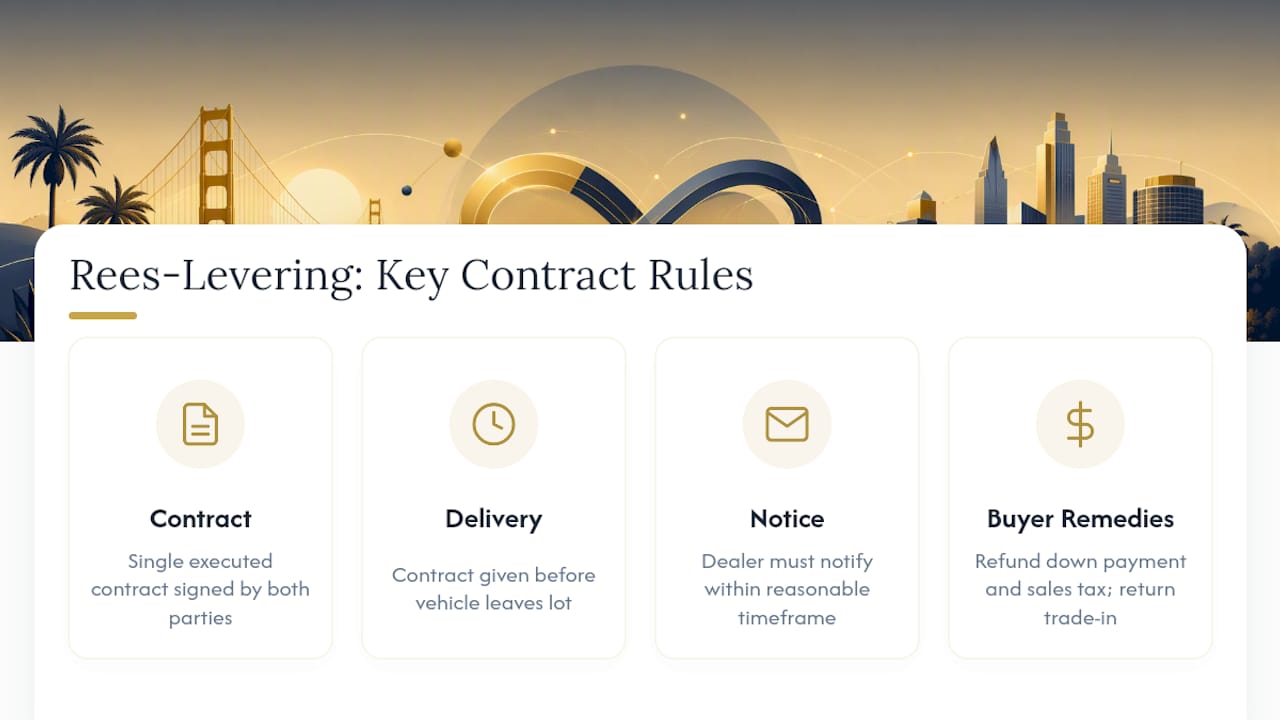
A critical factor in a yo-yo dispute is the dealer’s requirement to notify you within a specific timeframe. California practice generally requires notification within a reasonable window if a dealer cannot assign your contract to a lender on the terms you signed. Miss it, and the original contract can remain binding, according to guidance on the spot delivery notice rule. If you made every payment on time and the dealer never sent that notice, you have a strong argument that you should keep the deal you originally signed.
When a dealer does rescind properly within that window, Rees-Levering spells out what happens next. You are generally entitled to a refund of your down payment and any sales tax already paid, plus the return of your trade-in vehicle or its wholesale value if the dealer already disposed of it. The Automobile Sales Finance Act deems the sale rescinded outright when you took possession before the loan was secured and it turns out you cannot qualify on the original terms, under the Rees-Levering statute itself.

Beyond Rees-Levering, California’s Consumers Legal Remedies Act and Unfair Competition Law give buyers separate causes of action against deceptive spot-delivery tactics, often with the possibility of recovering attorney fees if you win. The Federal Trade Commission has also gone on record challenging yo-yo financing as a deceptive practice worth federal enforcement attention, though that guidance sits on top of California’s own statutes rather than replacing them.
What Should You Do in the First 48 to 72 Hours After a Callback?
Your first move is to stop talking and start documenting. Verbal promises from a finance manager disappear the moment you hang up the phone, but a paper trail does not.
- End the phone conversation and ask the dealer to put any request in writing, sent by email or certified mail.
- Gather your original contract, down payment receipts, insurance card, and any text messages or emails from the dealership.
- Photograph every document, including the VIN sticker and odometer disclosure, before you hand anything back to the dealer.
- Count the days between your original contract date and the dealer’s callback. Write that number down, because it decides whether the 10 day notice window was met.
- Call your trade-in lender directly to confirm the actual payoff amount rather than trusting a number the dealer gives you over the phone.
- Do not sign a second contract or any addendum at the dealership, no matter how much pressure you feel in that moment.
- File a complaint with the FTC’s fraud reporting portal and with the California Attorney General’s consumer protection office if the dealer will not back down.
Pro Tip: Ask the dealer to send the lender’s denial letter before you agree to anything. A real financing failure comes with paperwork. If the dealer cannot produce it within a day or two, that silence tells you the “financing fell through” story is probably a pressure tactic, not a fact.
How Can You Avoid Yo-Yo Financing Before You Ever Sign?
The safest position is walking into the dealership with your financing already locked in. A preapproval letter from your own bank or credit union, or paying cash outright, removes the dealer’s ability to use financing as leverage after the fact.
If you do use dealer-arranged financing, insist on seeing the fully executed, single-document contract before you take delivery, exactly as Civil Code §2981 requires. Do not accept a promise that “the paperwork will follow.” Read the itemization of the amount financed line by line, and confirm that insurance charges, service contracts, and add-ons appear as separate disclosures rather than buried inside the total, as required under Civil Code §2982 and §2982.2.
A few habits go a long way toward keeping you out of a yo-yo situation entirely:
- Never sign anything at the finance desk that you have not read in full, even under time pressure.
- Ask directly whether your financing is final or still conditional before you take the keys.
- Refuse to sign a separate addendum “just in case” the deal needs adjusting later.
- If a salesperson pushes you to leave with the car same day despite an unresolved loan question, walk away.
For a deeper look at the tactics dealers use to rush buyers past these safeguards, our guide on how to avoid crooked car and RV dealer tactics breaks down the warning signs by name.
When Does a Yo-Yo Financing Case Need a Lawyer?
You should contact an attorney once the dealer has missed the notice window, refuses to return your trade-in or its value, or keeps pressuring you to sign new terms despite your written objection. Those are the moments where a demand letter from counsel changes the conversation fast.
An attorney pursuing a California yo-yo financing claim can seek rescission of the second contract, a refund of your down payment and sales tax, recovery of your trade-in or its wholesale value, and, where the dealer’s conduct was especially deceptive, civil penalties on top of actual damages. Attorney fees may also be recoverable under the Consumers Legal Remedies Act and Unfair Competition Law, which shifts pressure back onto the dealer rather than the buyer.
Dealers commonly claim the financing simply fell through and push buyers to sign immediately. Before any negotiation starts, we demand proof: a genuine lender denial letter and confirmation of the trade-in payoff. Without that paperwork, the dealer’s story rarely holds up.
That approach comes directly from the firm’s practice background. Jeff Le Pere has spent 25 years practicing lemon law and dealer fraud, including 11 years defending manufacturers and dealerships before switching sides. He built his practice around California RV and auto lemon law because he already knows how the other side builds its defense. If you decide to move forward, expect an attorney to request your original contract, every communication with the dealer, proof of payments, and your trade-in payoff statement before mapping out next steps.
An Attorney’s Note on Dealer Defenses and What Actually Works
In my years defending dealerships, I saw the same three defenses used over and over: the buyer “understood” the deal was conditional, the trade-in “had already sold,” and the callback happened “within a reasonable time.” Every one of those defenses collapses against a clear paper trail. If you have your dated contract, your payment records, and a written record of exactly when the dealer called, you are usually in a stronger position than the dealer wants you to believe. Documentation is not a formality here. It is the entire case.
— Jeff Le Pere
How The Law Offices of Jeffrey Le Pere Can Help You Fight Back
The Law Offices of Jeffrey Le Pere takes yo-yo financing and spot delivery cases on contingency, which means you pay nothing upfront and nothing at all unless the case recovers money. That structure matters because dealers count on buyers assuming a lawsuit costs more than the car is worth.

Recovery options in a successful yo-yo financing claim can include rescission of the deal, a refund of your down payment and sales tax, return of your trade-in or its wholesale value, and civil penalties when a dealer’s conduct was especially deceptive. When you request a free case review, bring your original contract, any second contract the dealer tried to push on you, payment receipts, insurance documents, and copies of every email or text from the dealership. Unlike high-volume lemon law operations where you speak mainly with a case manager, this firm’s contingency model keeps you talking directly with the attorney handling your dealer fraud claim. If a dealer has called you back demanding new terms, start your free case review today and find out exactly where you stand.
This article is general information, not a substitute for advice from a qualified lawyer. Consult a qualified legal professional about your own circumstances before acting on anything here.
Sources
- California Codes — Automobile Sales Finance Act (ASFA) / Rees-Levering
- FTC — Deal or no deal? FTC challenges yo-yo financing tactics