Why Lemon Law Advertising Budgets Matter for Consumers

Lemon law advertising budgets are the financial engine behind California’s high-volume litigation model, and they directly shape whether you get a real attorney or a case manager when your vehicle fails. Under California’s Song-Beverly Consumer Warranty Act, manufacturers must pay attorney fees when consumers win. That fee-shifting structure creates a powerful incentive for firms to process as many cases as possible, as fast as possible. The Law Offices of Jeffrey Le Pere was built on the opposite premise: that your case deserves direct attorney attention, not a standardized template and a rushed settlement.
Why lemon law advertising budgets matter to your case outcome
The size of a firm’s advertising budget is not a measure of its legal skill. It is a measure of its intake capacity. Top lemon law firms spend between $200 million and $350 million annually on TV, digital, and billboard advertising. That level of spend requires an equally massive volume of cases just to break even, let alone profit.
California’s Song-Beverly Act allows prevailing consumers to recover attorney fees from the manufacturer. This provision was designed to protect consumers. High-volume firms have turned it into a revenue model. Some firms have filed over 20,000 cases in five years, billing manufacturers for attorney fees on each one. The math only works if cases move quickly and cheaply.

To keep costs low and volume high, these firms rely on non-attorney staff, overseas document processors, and standardized filing templates. Standardized templates and case managers reduce per-case attorney scrutiny, which means critical evidence can be overlooked. A missed repair order or an unverified Technical Service Bulletin can cost you thousands of dollars in your final recovery.
Pro Tip: Ask any firm you contact: “Will I speak directly with the attorney handling my case, or will I be assigned to a case manager?” The answer tells you everything about how that firm operates.
The fee-shifting incentive also creates a troubling billing dynamic. Certain high-volume firms have been accused of inflating billable hours by up to 7,000%, exploiting the fee-shifting system to maximize revenue from manufacturers. That behavior draws regulatory scrutiny and, increasingly, lawsuits from automakers. It also signals that the firm’s financial interest may not align with yours.
How volume litigation affects the quality of your lemon law claim
Volume-driven firms settle quickly. That is not always bad, but it becomes a problem when speed is the goal rather than the best possible outcome for you. Highly advertised firms avoid trial to maintain fast settlement cycles, which reduces their clients’ negotiating leverage. Manufacturers know which firms never go to trial, and they negotiate accordingly.
A firm with genuine trial experience carries a credible threat. Manufacturers settle higher when they believe the attorney across the table will actually litigate. Boutique firms with less advertising spend often invest more attorney time per case, develop stronger evidentiary records, and are more willing to push for the civil penalty California law allows: up to two times actual damages when a manufacturer willfully ignored its warranty obligations.
Template demand letters are calibrated for average cases. Your case may not be average. An RV with multiple warranty systems, a truck with a recurring transmission defect, or a vehicle with a disputed repair history all require individualized analysis. Cases handled by personally involved attorneys tend to achieve better settlements and are more likely to reach trial when necessary.
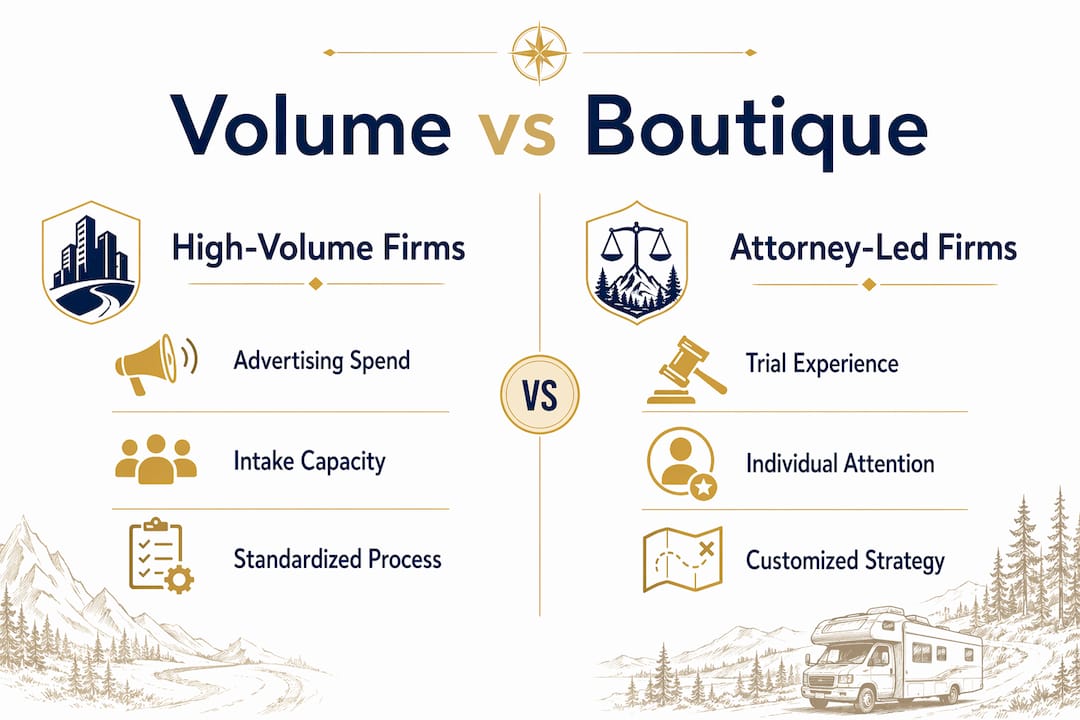
The table below contrasts how advertising-driven volume firms and attorney-led boutique firms typically approach California lemon law claims.
| Factor | High-volume advertising firm | Attorney-led boutique firm |
|---|---|---|
| Primary contact | Case manager | Licensed attorney |
| Filing method | Standardized templates | Case-specific analysis |
| Trial readiness | Rarely goes to trial | Prepared to litigate |
| Settlement speed | Fast, often lower recovery | Measured, higher leverage |
| Fee transparency | Variable | Clearly explained upfront |
Pro Tip: Before signing a retainer, ask the firm how many lemon law cases it has taken to trial in the past two years. A firm that cannot answer that question has not been to trial recently.
What advertising budgets signal about a firm’s priorities
Heavy advertising often masks limited personal attorney involvement. Firms operating on high-volume intake logic prioritize lead conversion over case-specific handling. That is not a criticism of marketing itself. It is a description of what happens when a firm’s financial model depends on processing thousands of cases per year.
California consumers should watch for these warning signs when evaluating a lemon law firm:
- You speak with a “case coordinator” or “intake specialist” rather than an attorney during your first call.
- The firm pushes you toward a quick settlement before fully reviewing your repair history.
- The attorney’s name appears in advertising but is not the person reviewing your file.
- The firm cannot explain its trial record or deflects questions about litigation experience.
- You receive a settlement offer with no explanation of how the amount was calculated.
Legal advertising targets high-intent consumers who are already frustrated and ready to hire. That urgency can lead to rushed decisions. A firm’s billboard reach does not predict its ability to win your specific case under the Song-Beverly Act.
The importance of lemon law budgets becomes clearest when you understand what they fund. Large budgets fund intake infrastructure, not legal talent. Verifying direct attorney access before you sign is one of the most protective steps you can take.
How California’s lemon law advertising market has changed
California’s lemon law advertising surge accelerated after 2020, driven by supply chain disruptions, a spike in defective vehicles, and the financial opportunity created by fee-shifting. The result was a rapid increase in filings that drew both legislative attention and manufacturer lawsuits.
California AB 1755 was enacted as part of the legislative response to abuse in the lemon law market. The law shortens the deadline for filing a lemon law claim: consumers must now file within one year of the warranty’s expiration date. That change was designed to reduce the filing of stale cases by volume firms, but post-2024 legislation made only a minimal dent in the record number of lemon lawsuits filed in California.
Manufacturers responded with their own legal actions. Ford Motor Company filed suit against high-volume lemon law firms alleging billing fraud, including claims that overseas, low-paid non-lawyers were used to churn out standardized filings. These lawsuits are not just corporate disputes. They reveal the operational reality behind firms that spend heavily on advertising and rely on assembly-line processing to sustain their model.
The advertising arms race has also raised the cost of entry for smaller, attorney-led firms. Digital advertising costs for legal keywords in California rank among the highest in the country. That pricing pressure pushes more firms toward volume models just to compete for visibility. Understanding the impact of advertising spend on firm structure helps you ask better questions before you hire anyone.
Key Takeaways
Lemon law advertising budgets drive high-volume intake models that prioritize speed over individualized representation, directly affecting the quality and outcome of your California lemon law claim.
| Point | Details |
|---|---|
| Advertising spend drives volume | Firms spending $200M–$350M annually need thousands of cases to cover overhead. |
| Fee-shifting fuels the model | California’s Song-Beverly Act lets firms bill manufacturers, rewarding speed over quality. |
| Templates miss case details | Standardized filings reduce attorney scrutiny and can overlook critical evidence. |
| Trial readiness matters | Firms that never litigate have less leverage; manufacturers know who will and will not go to trial. |
| AB 1755 changes your deadline | You must file within one year of your warranty’s expiration date under current California law. |
What I’ve learned after 25 years on both sides of these cases
I spent 11 years defending manufacturers and dealerships before I switched sides. I know exactly how manufacturers evaluate the firms that sue them. They track which attorneys actually go to trial and which ones fold at the first settlement offer. That knowledge shapes everything about how I handle cases at The Law Offices of Jeffrey Le Pere.
The advertising budget question is one I get asked about directly, and my answer is always the same: a firm’s marketing spend tells you about its business model, not its legal ability. I was the senior managing attorney at one of the large lemon law mill firms. I watched cases get assigned to case managers who had never read the repair orders. I watched settlement offers go out calibrated to what the firm needed to close the file, not what the client deserved to recover.
Consumers often assume that a firm they see on television has more resources to fight for them. The opposite is frequently true. The advertising budget is the overhead. The case volume is how they pay for it. Your case becomes one unit in a financial model, not a client relationship.
What actually produces results is an attorney who reads your repair history, understands the specific defect in your vehicle, knows the manufacturer’s internal defense playbook, and is willing to file in court if the offer is inadequate. That is not a function of advertising spend. It is a function of how a firm chooses to practice law. The benefits of specialized representation are real, and they show up most clearly when a case gets complicated.
— Jeff Le Pere
Experienced California lemon law representation without the assembly line
The Law Offices of Jeffrey Le Pere takes a different approach to California lemon law. Every client speaks directly with Jeff Le Pere, not a case manager. Every case is reviewed by an attorney who spent 11 years on the manufacturer’s side and knows how they build their defense.

Whether you own a defective car, truck, SUV, or RV, The Law Offices of Jeffrey Le Pere handles your case on full contingency. You pay nothing. The manufacturer covers all fees and costs when you win. Recovery options include a full repurchase, a replacement vehicle, or a cash settlement, plus a civil penalty of up to two times actual damages for willful warranty violations. If you are ready to find out whether your vehicle qualifies, request a free case review with a California lemon law attorney who will actually read your file.
FAQ
What does a lemon law firm’s advertising budget actually fund?
A lemon law firm’s advertising budget funds intake infrastructure, including digital ads, TV spots, call centers, and case management staff, not legal talent or trial preparation. High spend requires high case volume to generate profit under California’s fee-shifting model.
Does a bigger advertising budget mean better lemon law results?
No. Advertising reach does not predict trial capability or settlement quality. Firms with smaller advertising budgets and direct attorney involvement often secure higher recoveries because they carry credible litigation threats.
How does California AB 1755 affect my lemon law claim?
California AB 1755 requires consumers to file a lemon law claim within one year of their warranty’s expiration date. Missing this deadline eliminates your right to recover under the Song-Beverly Consumer Warranty Act.
What should I ask a lemon law firm before hiring them?
Ask whether you will speak directly with the attorney handling your case, how many cases the firm has taken to trial in the past two years, and how your settlement amount will be calculated. These questions reveal whether the firm operates on a volume model or provides individualized representation.
Why do manufacturers sue high-volume lemon law firms?
Manufacturers have filed suit alleging that certain high-volume firms inflate billable hours and use non-attorney staff to generate standardized filings at scale. These lawsuits reflect the broader tension between California’s fee-shifting law and firms that treat lemon law claims as a financial processing operation rather than consumer advocacy.