Why a Defense Background Matters for California Lemon Law Clients
A lawyer who spent 11 years defending manufacturers and dealers brings a measurable advantage to California lemon law and dealer fraud clients: better discovery, earlier substantive settlement offers, and stronger fee-shifting outcomes under the Song-Beverly Consumer Warranty Act (Cal. Civ. Code §§ 1790–1795.8).
What you can recover under Song-Beverly:
- A full repurchase or replacement vehicle, or a cash settlement
- A civil penalty of up to two times actual damages when a manufacturer willfully ignored its warranty
- Statutory attorney fees paid by the manufacturer when you prevail, under Cal. Civ. Code § 1794(d)
AB 1755 shortened the filing window: you must file within one year of your warranty’s expiration date. Contact The Law Offices of Jeffrey Le Pere before that deadline closes.
Key Takeaways
A lawyer’s prior defense-side experience representing manufacturers and dealers is the single most reliable predictor of stronger discovery, faster substantive offers, and better fee-shifting outcomes for California lemon law and dealer fraud clients.
| Point | Details |
|---|---|
| Defense background equals better discovery | Defense-experienced counsel demands TSBs, fleet repair indexes, and warranty validation logs that reveal pattern defects. |
| AB 1755 shortens your deadline | You must file within one year of your warranty’s expiration date; contact counsel before that window closes. |
| Fee-shifting covers your attorney | Under Cal. Civ. Code § 1794(d), the manufacturer pays attorney fees when you prevail, so contingency representation costs you nothing upfront. |
| Collect repair orders and days-in-shop logs | Bring all repair orders, parts records, and days-in-shop documentation to your first consult. |
| The Law Offices of Jeffrey Le Pere | Jeff Le Pere’s 11 years defending manufacturers give California RV and vehicle owners a direct line to defense-informed plaintiff strategy. |
Table of Contents
- What “defense background” actually means for a lemon law attorney
- Six concrete ways defense experience benefits you in a California claim
- How these advantages play out in RV, motorhome, and travel trailer claims
- California statutes and deadlines you need to know
- How warranty language and commencement methods create exposure
- What to ask when hiring an attorney with defense experience
- What to expect for process, timeline, and costs
- Three case types where defense experience matters most
- What 11 years defending manufacturers taught me about winning for plaintiffs
- The Law Offices of Jeffrey Le Pere: contingency representation for California vehicle owners
- Sources
What “defense background” actually means for a lemon law attorney
Defense background, in this context, means prior work representing manufacturers, distributors, or dealers in warranty disputes, joint defense agreements, and product-liability litigation. It has nothing to do with criminal defense or background investigations.
A defense-experienced attorney has drafted manufacturer discovery sets, negotiated joint defense agreements between co-defendants, and reviewed the internal repair-routing and billing systems dealers use to manage warranty claims. That firsthand exposure reveals how manufacturers build their case, which document categories they index, and where their documentation practices create exploitable gaps for plaintiff counsel.
Six concrete ways defense experience benefits you in a California claim
-
Targeted discovery from day one. Defense-experienced counsel knows exactly which document categories manufacturers maintain: Technical Service Bulletins (TSBs), warranty validation logs, repair-order metadata, and fleet repair histories. Requesting those categories early forces disclosure of pattern evidence before manufacturers can narrow their responses.
-
Anticipating and neutralizing common defenses. Manufacturers routinely argue that a defect was caused by owner misuse, that repair attempts were reasonable, or that the vehicle conformed to warranty after the final repair. An attorney who built those arguments for manufacturers can preempt them with targeted evidence before the complaint is even filed.
-
Knowing settlement ranges and decision-maker dynamics. Defense counsel understand which manufacturers settle early to limit statutory fee exposure and which ones litigate aggressively. That knowledge shapes demand strategy and timing.
-
Leveraging fee-shifting under Cal. Civ. Code § 1794(d). Under California law, a prevailing buyer recovers attorney fees from the manufacturer. Defense counsel are acutely aware of accumulating fee exposure, and a plaintiff attorney who understands that pressure can use it to accelerate substantive offers.
-
Using fleet-wide defect patterns uncovered in defense files. Manufacturers index repair orders by model, model year, and defect code. A defense-experienced attorney knows to demand those indexes, not just the individual repair orders for your vehicle. Fleet-wide patterns strengthen your claim and raise the stakes for the manufacturer.
-
Managing joint defense and indemnity issues when dealers and manufacturers are co-defendants. Joint defense agreements create conflicts: manufacturers can withdraw defense from a dealer when their interests diverge. An attorney who has navigated those agreements from the defense side can identify and preserve those conflicts as negotiation leverage.
Pro Tip: When requesting discovery, ask specifically for TSBs, warranty validation method records, and fleet repair-history indexes by VIN range and model year. Those categories reveal pattern defects that individual repair orders alone will never show.
How these advantages play out in RV, motorhome, and travel trailer claims
RV claims are more complex than car claims because a single motorhome, fifth wheel, or travel trailer typically carries multiple warranties: a chassis warranty from the vehicle manufacturer and a separate coach or component warranty from the RV builder. Slide-out systems, HVAC units, and electrical systems often fall under component warranties from third-party suppliers, not the chassis manufacturer.
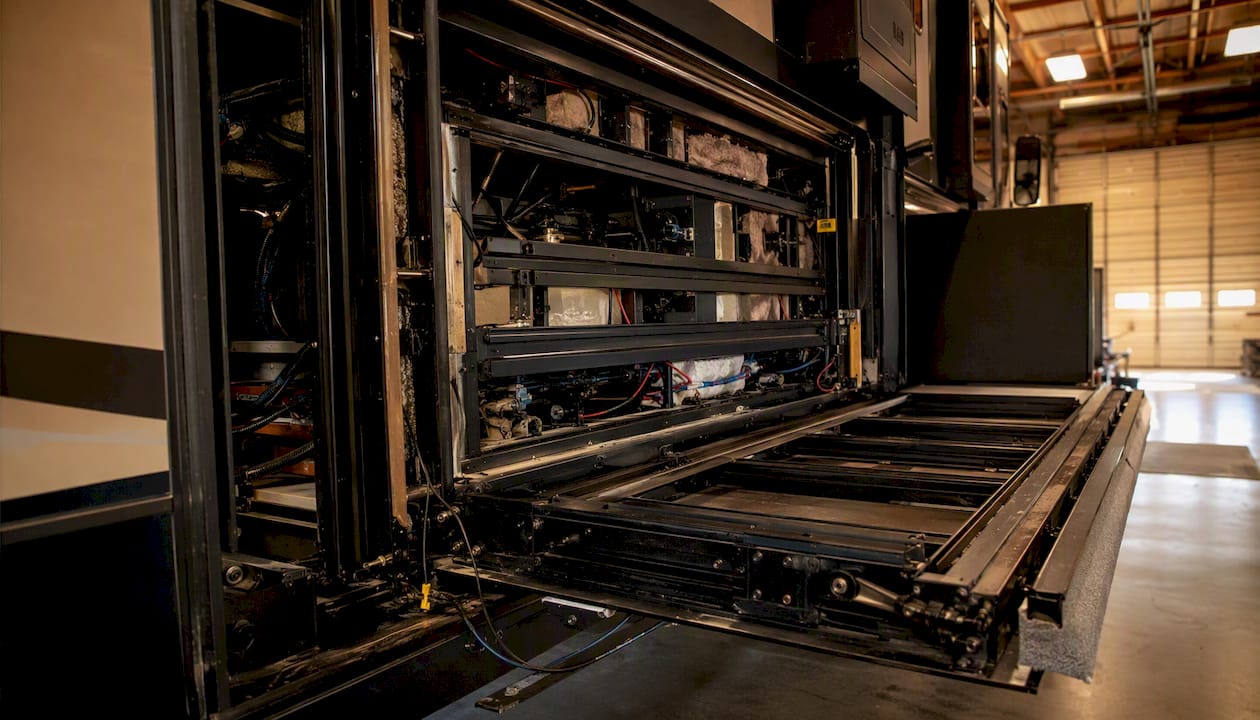
Consider a recurring slide-out failure on a Class A motorhome. The chassis manufacturer may deny responsibility, pointing to the coach builder. The coach builder may point to the slide-out component supplier. A defense-experienced attorney recognizes that triangulation immediately, because manufacturers use it routinely to delay resolution. Knowing which entity owns the warranty obligation for each component, and which repair-routing records prove it, is the difference between a fast resolution and years of finger-pointing.
For travel trailer and fifth wheel electrical defects, fleet-wide TSBs are often the most persuasive evidence. Manufacturers issue TSBs internally when a defect appears across multiple units of the same model year. Demanding those TSBs by model and year, along with dealer repair-history logs showing how many units received the same repair, builds a pattern case that is very difficult for a manufacturer to dismiss as an isolated incident. For more on RV-specific lemon law claims by brand and model, the firm maintains a current guide.
Key documents to collect for any RV claim:
- All repair orders, including parts replaced and labor codes
- Days-in-shop logs for each repair visit
- TSBs and recall notices tied to your RV brand and model year
- Warranty registration records and delivery documentation
California statutes and deadlines you need to know
The Song-Beverly Consumer Warranty Act (Cal. Civ. Code §§ 1790–1795.8) is the primary framework for lemon law remedies in California. Cal. Civ. Code § 1793.1 requires clear, simple warranty disclosures and mandates that repair invoices contain a conspicuous warranty-service statement in ten-point boldface type. Fee-shifting under Cal. Civ. Code § 1794(d) means the manufacturer pays your attorney fees when you prevail.
| Authority | What it covers | Why it matters to you |
|---|---|---|
| Song-Beverly Act, Civ. Code §§ 1790–1795.8 | Core lemon law remedies: repurchase, replacement, civil penalty | Primary basis for your claim |
| Cal. Civ. Code § 1793.1 | Warranty disclosure and repair-invoice requirements | Noncompliant invoices can support your claim |
| Cal. Civ. Code § 1794(d) | Attorney fee recovery for prevailing buyers | Manufacturer pays fees; you pay nothing upfront |
| AB 1755 | Filing deadline: one year from warranty expiration | Missing this deadline can bar your claim |
AB 1755 is the deadline change most owners miss. Confirm your specific filing window with counsel promptly. For more on California lemon law repair-attempt standards, including the 30-day and repair-attempt thresholds, see the firm’s current guide.
This article is educational information only, not legal advice. Consult a qualified California lemon law attorney to confirm current statutes and deadlines for your specific claim.
How warranty language and commencement methods create exposure
Warranty commencement is where many claims turn on a single document. Under DLA Piper’s guidance on Song-Beverly compliance, sellers should consider switching from proof of purchase to proof of delivery from a shipper as the warranty trigger, because proof of purchase creates compliance risks when the purchase date and delivery date differ. Sellers who fail to update their warranty language across all literature and websites, or who rely on staff who validate warranty periods incorrectly, create exposure that plaintiff counsel can exploit.
Red flags a defense-experienced attorney looks for:
- Warranty commencement language buried in packaging rather than disclosed clearly at point of sale
- Inconsistent repair invoices that omit the required boldface warranty-service statement under § 1793.1
- Warranty language that differs between the dealer’s paperwork and the manufacturer’s website
- Staff-validated warranty periods that contradict the delivery date shown in shipper records
When those red flags appear in your repair history, they can support both a Song-Beverly claim and a dealer fraud claim. An attorney who has seen these practices from the seller’s side knows exactly where to look.
What to ask when hiring an attorney with defense experience
Not every attorney who claims defense experience has the kind that actually helps. Use these questions on your consult call:
- How many years did you spend defending manufacturers or dealers specifically in warranty and lemon law cases?
- Can you describe a case where your defense-side knowledge changed the outcome for a plaintiff client?
- Will I speak directly with you, or will a case manager handle my file? (Direct attorney access matters more than most clients realize.)
- Is the representation purely on contingency, with no upfront fees to me?
- Have you taken lemon law cases to trial, or does your firm settle everything before filing?
- Have you handled RV-specific claims involving multiple warranties and component suppliers?
Red flags to watch for: refusal to describe prior defense-side work in any detail, a case-manager-only communication model, or vague answers about how prior defense clients are screened for conflicts of interest. On that last point, ask directly whether the attorney has represented your vehicle’s manufacturer or dealer in the past three years. A straightforward answer is a good sign.
What to expect for process, timeline, and costs
California lemon law cases on contingency cost you nothing upfront. When you prevail, the manufacturer pays your attorney fees under § 1794(d).
One cost item owners sometimes overlook: a repurchase settlement typically includes a mileage offset, calculated from miles driven before the first repair attempt. Your net recovery is the repurchase price minus that offset. A defense-experienced attorney anticipates that calculation and factors it into demand strategy from the start.
Three case types where defense experience matters most
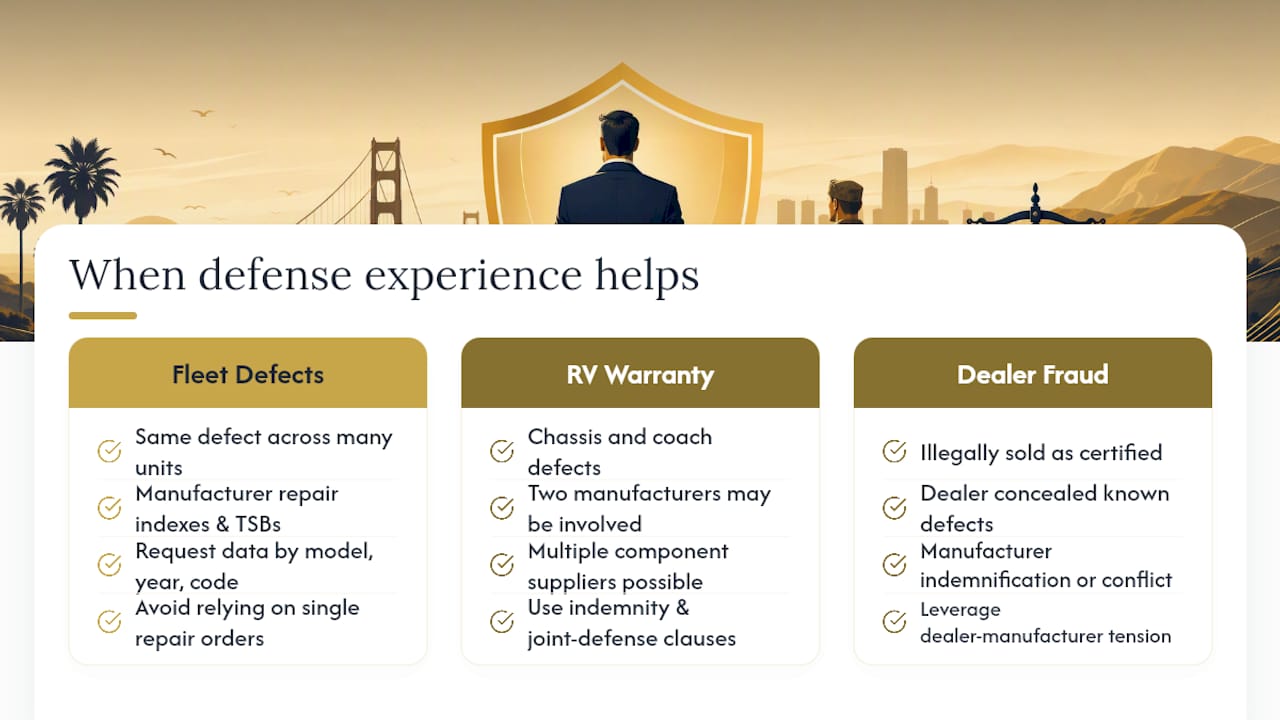
Fleet-wide defects across a model line. When the same defect appears in dozens of units of the same model year, the manufacturer’s internal repair indexes and TSBs are the most persuasive evidence available. Defense-experienced counsel knows those indexes exist and demands them by model, year, and defect code. Without that knowledge, a plaintiff attorney may request only the individual vehicle’s repair orders and miss the pattern entirely. See the firm’s guide on qualifying defects for California auto lemon law for a practical reference.
Complex RV warranty disputes involving chassis and coach components. When a motorhome defect spans the chassis and the coach, two manufacturers and potentially multiple component suppliers are involved. Defense experience with joint defense agreements and indemnity clauses helps plaintiff counsel identify which entity bears liability for each defect, rather than accepting a manufacturer’s deflection.
Dealer fraud and misrepresentation cases. In dealer fraud claims, the interaction between the dealer and the manufacturer is often central to the case. A dealer who sold a vehicle as certified when it did not qualify, or who concealed a known defect, may be entitled to indemnification from the manufacturer or may face a conflict with the manufacturer’s defense position. An attorney who has worked inside those relationships understands how to use that tension. For more on dealer fraud claims, including vehicles illegally sold as certified, the firm handles those cases statewide.
What 11 years defending manufacturers taught me about winning for plaintiffs
Spending 11 years on the defense side of lemon law and warranty litigation changes how you see every plaintiff case. I know which document requests manufacturers treat as routine and which ones cause real concern internally. Repair-order metadata, specifically the date stamps, labor codes, and parts-replaced fields, tells a story about pattern and chronology that manufacturers would rather not have in front of a mediator. I learned to read that story by building it for manufacturers first.
The other thing defense work teaches you is how manufacturers think about fee exposure. Defense counsel track accumulating attorney fees carefully, and they bring that number to every settlement conversation. A plaintiff attorney who understands that dynamic can time demands and discovery requests to maximize pressure at exactly the right moment.
What that means for clients at The Law Offices of Jeffrey Le Pere is direct access to an attorney who has been on both sides of this table, not a case manager reading from a file. Every case runs on contingency. RV claims, car and truck claims, and dealer fraud cases all qualify. The goal is a full repurchase, replacement, or the best available cash settlement, plus statutory fees paid by the other side.
The Law Offices of Jeffrey Le Pere: contingency representation for California vehicle owners
If your RV, car, truck, or SUV has a recurring defect and the manufacturer has failed to fix it, you have options under California law. The Law Offices of Jeffrey Le Pere represents California owners of motorhomes, fifth wheels, travel trailers, cars, trucks, and SUVs in lemon law claims and dealer fraud cases on a pure contingency basis. No upfront fees. No hourly billing. When you prevail, the manufacturer or dealer pays the attorney fees under Song-Beverly.
Jeff Le Pere’s 11 years defending manufacturers is the firm’s core advantage: he knows the playbook because he wrote parts of it. Every client speaks directly with Jeff, not a case manager. AB 1755 means your filing window is shorter than you may think. Request a free case review today and bring your repair orders, days-in-shop logs, and warranty documentation to the call.
Sources
- Findlemonlaw
- Sellers take note: Changes to Song-Beverly Consumer Act may require updated warranty language
- Lemon lawsuits and joint defense agreements: An ounce of prevention is worth a pound of cure | Scali Rasmussen
- Codes Display Text
This article is general information, not a substitute for advice from a qualified lawyer. Consult a qualified legal professional about your own circumstances before acting on anything here.