Why California Lemon Law Favors Consumers: Your Rights

California’s Song-Beverly Consumer Warranty Act is defined as the strongest vehicle warranty protection law in the United States, giving consumers the right to a full refund or replacement vehicle when a manufacturer cannot fix a defect within a reasonable number of attempts. The law goes further than any comparable state statute by requiring manufacturers to pay your attorney fees when you win, allowing civil penalties up to double your actual damages for willful violations, and covering the full purchase price including taxes, registration, and incidental costs. Understanding why California lemon law favors consumers so decisively starts with knowing exactly what the law entitles you to recover.
Why California lemon law favors consumers more than any other state
California’s Song-Beverly Act gives consumers three distinct recovery paths: a full repurchase, a replacement vehicle, or a cash settlement. Most states offer only one or two of these options. The repurchase covers your down payment, monthly payments, sales tax, registration fees, and incidental expenses like rental car costs and towing charges.
The buyback calculation uses a specific formula. The manufacturer subtracts a mileage offset calculated as: (Price Paid x Miles Before First Repair) / 120,000. The 120,000-mile denominator is fixed by statute regardless of the vehicle’s actual expected lifespan. That means the sooner you bring the car in for its first repair attempt, the smaller the offset and the larger your refund.

California Civil Code § 1794© authorizes a civil penalty up to two times actual damages when a manufacturer willfully fails to repurchase or replace a defective vehicle. Willfulness means the manufacturer knew about the defect and still refused its warranty obligations. That penalty effectively triples your total recovery in the worst cases of manufacturer bad faith.
The rebuttable presumption under Civil Code § 1793.22 triggers after four or more repair attempts for the same defect, or 30 or more cumulative days out of service within the warranty period. Once that threshold is met, the burden of proof shifts to the manufacturer to show the vehicle is not a lemon. That shift is significant. Without it, consumers would have to prove a negative in court.
Pro Tip: Document every repair visit with a written repair order, even for the same recurring problem. Each visit is a separate repair attempt that counts toward the statutory threshold.
Key provisions that set Song-Beverly apart:
- Full purchase price reimbursement including down payment, monthly payments, taxes, and fees
- Mileage offset formula using 120,000 miles as the fixed denominator, calculated from miles at first repair
- Civil penalty of up to two times actual damages under Cal. Civ. Code § 1794© for willful violations
- Rebuttable presumption after 4 repair attempts or 30 days out of service under Cal. Civ. Code § 1793.22
- Attorney fee shifting under Cal. Civ. Code § 1794(d), requiring manufacturers to pay your legal costs when you prevail
How does California lemon law compare to other states and federal law?
California’s protections exceed both typical state lemon laws and the federal Magnuson-Moss Warranty Act in nearly every category. The federal law requires manufacturers to honor written warranties but provides far narrower remedies. Magnuson-Moss does not mandate full purchase price reimbursement, does not include a rebuttable presumption, and does not require manufacturers to pay attorney fees in the same direct way Song-Beverly does.
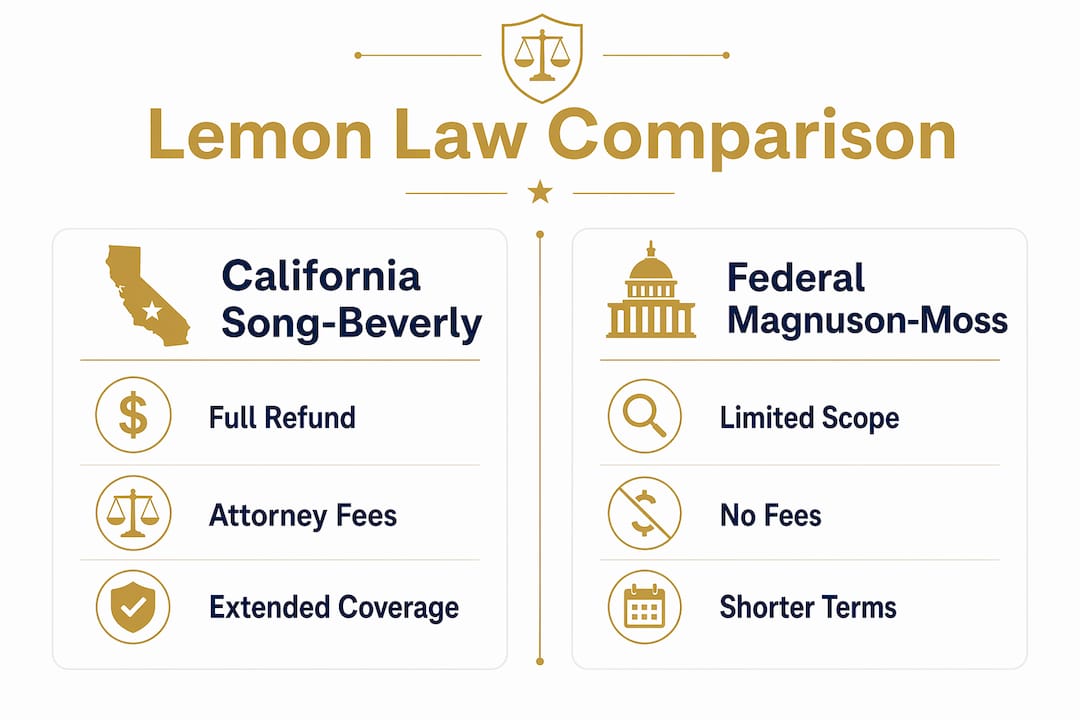
Most state lemon laws cover only the original purchaser and apply for a limited time after purchase. California’s Song-Beverly Act covers both original and subsequent purchasers during the express warranty period. That distinction matters for used vehicle buyers who are still within the manufacturer’s warranty window.
The attorney fee provision under Cal. Civ. Code § 1794(d) is the single feature that separates California most sharply from other states. Fee shifting enables consumers to hire experienced attorneys with no upfront cost. Manufacturers know this. It changes the negotiation dynamic entirely because the manufacturer faces not just the buyback cost but also the consumer’s legal fees if they lose.
Pro Tip: If a manufacturer’s offer seems low, do not accept it before consulting an attorney. The law entitles you to the full statutory remedy, not whatever the manufacturer’s claims adjuster volunteers first.
| Feature | California Song-Beverly Act | Federal Magnuson-Moss Act | Typical state lemon law |
|---|---|---|---|
| Full purchase price refund | Yes, including taxes and fees | No | Partial in most states |
| Rebuttable presumption | Yes, after 4 repairs or 30 days | No | Rare |
| Civil penalty for willfulness | Up to 2x actual damages | No | Rare |
| Attorney fee shifting | Yes, mandatory | Limited | Uncommon |
| Covers subsequent purchasers | Yes, within warranty period | No | Rarely |
What procedural requirements affect California lemon law claims in 2026?
California AB 1755 and SB 26 introduced procedural changes that took effect in 2025 for manufacturers who opt into the new framework. These changes affect timing and process but do not reduce your substantive rights under Song-Beverly.
The most critical change is the one-year filing deadline after the express warranty expires for opted-in manufacturers. Previously, consumers had more time. Now, if your manufacturer participates in the AB 1755 framework, you must file your claim within one year of the warranty’s expiration date or lose your right to pursue it.
The new process for opted-in manufacturers works as follows:
- Send written notice. You must give the manufacturer a written 30-day notice before filing a lawsuit. This notice must describe the defect and the remedy you are seeking.
- Wait for the manufacturer’s response. The manufacturer has 30 days to respond to your notice with a repurchase offer or a denial.
- Enter mandatory mediation. If the manufacturer responds but does not resolve the claim, mediation must occur within 150 days of the manufacturer’s response.
- File suit if mediation fails. If mediation does not produce a settlement, you may then file a lawsuit under the full Song-Beverly framework.
- Confirm your manufacturer’s status. Not all manufacturers have opted into AB 1755. For non-opted manufacturers, the prior process applies and the one-year deadline does not govern.
The procedural reforms aim to speed resolution but require consumers to act quickly and follow strict notice and mediation requirements. Missing the 30-day notice or the one-year deadline can derail an otherwise valid claim. The substantive rights, including the civil penalty, the full buyback, and the attorney fee provision, remain fully intact under both frameworks.
How can you maximize your recovery under the California lemon law?
Consumers who understand the law’s mechanics recover more than those who accept the first offer. The most common mistake is accepting a manufacturer’s initial settlement without knowing what the statute actually entitles you to receive.
Many consumers accept lowball offers without realizing the law entitles them to a full buyback plus attorney fees. That gap in knowledge is exactly what manufacturers count on. A manufacturer’s first offer rarely includes all incidental damages, and it almost never accounts for the civil penalty you may be entitled to claim.
Protecting your mileage offset is the first financial priority. The first repair attempt documentation determines the miles used in the offset calculation. If you drove 5,000 miles before the first repair and paid $50,000 for the vehicle, your offset is only $2,083. If you drove 20,000 miles before the first repair, your offset jumps to $8,333. Bring the vehicle in at the first sign of a recurring defect.
Proving willfulness to claim the civil penalty requires showing the manufacturer knew about the defect and still refused to honor its warranty. Technical Service Bulletins, recall notices, and internal manufacturer communications often establish this knowledge. An attorney who has worked on the defense side knows exactly where to look for that evidence.
Key steps to protect your recovery:
- Bring the vehicle in immediately at the first sign of a defect to minimize the mileage offset
- Keep every repair order with dates, mileage, and the technician’s description of the problem
- Do not accept verbal assurances that the problem is fixed without a written repair order confirming the outcome
- Request all Technical Service Bulletins related to your vehicle’s defect, as they can establish manufacturer knowledge
- Consult an attorney before settling, since attorney fee shifting means representation costs you nothing if you prevail
Pro Tip: Ask the service advisor to write the exact defect symptom on the repair order in your own words, not just a vague code. Precise language on repair orders strengthens your claim significantly.
Key Takeaways
California’s Song-Beverly Consumer Warranty Act is the strongest vehicle lemon law in the United States because it combines full purchase price refunds, civil penalties for willful violations, a consumer-favorable rebuttable presumption, and mandatory attorney fee shifting into a single statute.
| Point | Details |
|---|---|
| Full refund entitlement | Buyback covers purchase price, taxes, fees, and incidental costs minus a statutory mileage offset. |
| Civil penalty available | Manufacturers who willfully ignore warranty obligations face penalties up to two times actual damages. |
| Rebuttable presumption | Four repair attempts or 30 days out of service shifts the burden of proof to the manufacturer. |
| Attorney fees paid by manufacturer | Prevailing consumers recover legal costs, making contingency representation widely available. |
| AB 1755 deadline is critical | Consumers must file within one year of warranty expiration for opted-in manufacturers or lose their claim. |
What 25 years of lemon law practice taught me about California’s consumer protections
I spent 11 years defending manufacturers before I switched sides. That experience gave me a clear view of how manufacturers think about lemon law claims, and the answer is almost always financial. They calculate the cost of a buyback against the cost of litigation and make an offer designed to settle for less than the full statutory amount.
What I see consistently is that consumers who know their rights recover significantly more than those who do not. The civil penalty provision is the clearest example. Most consumers never ask for it. Manufacturers never volunteer it. But when a manufacturer has a Technical Service Bulletin on file for the exact defect your vehicle has been in the shop for repeatedly, willfulness is not hard to establish.
The attorney fee provision is the law’s most powerful feature, and it is the one manufacturers dislike most. It means a consumer can retain an experienced attorney with no money out of pocket. The manufacturer pays those fees if the consumer wins. That provision is why California’s lemon law produces better outcomes than any other state’s statute.
The recent AB 1755 procedural changes concern me for one reason: the one-year filing deadline. Consumers who wait too long after their warranty expires lose their right to file entirely, regardless of how strong their underlying claim is. If your vehicle is still in the shop for the same problem and your warranty is approaching expiration, contact an attorney immediately.
The law is on your side in California. The only way to lose is to wait too long or accept less than you are owed.
— Jeff Le Pere
Your lemon law rights, backed by 25 years of experience
If your vehicle has been back to the dealer for the same defect multiple times, or has spent 30 or more days out of service, California law may already entitle you to a full refund or replacement vehicle.
The Law Offices of Jeffrey Le Pere offers a free case review for California vehicle owners, including cars, trucks, SUVs, motorhomes, fifth wheels, and travel trailers. Every case runs on contingency, so you pay nothing. The manufacturer covers attorney fees when you prevail. Jeff Le Pere spent 11 years on the manufacturer’s side before representing consumers, which means he knows exactly how manufacturers evaluate and fight these claims. Contact The Law Offices of Jeffrey Le Pere to have your repair history reviewed at no cost, whether you are in Sacramento or anywhere else in California.
FAQ
What is the Song-Beverly Consumer Warranty Act?
The Song-Beverly Consumer Warranty Act is California’s lemon law, requiring manufacturers to repurchase or replace a defective vehicle that cannot be repaired within a reasonable number of attempts during the warranty period.
How many repair attempts trigger the lemon law presumption in California?
Four or more repair attempts for the same defect, or 30 or more cumulative days out of service, trigger the rebuttable presumption under California Civil Code § 1793.22, shifting the burden of proof to the manufacturer.
Does California lemon law cover RVs and used vehicles?
California’s Song-Beverly Act covers motorhomes, fifth wheels, and travel trailers, as well as used vehicles that are still within the original manufacturer’s express warranty period.
What does the AB 1755 one-year deadline mean for my claim?
Under AB 1755, consumers must file a lemon law claim within one year of the express warranty’s expiration date if the manufacturer has opted into the new framework. Missing this deadline eliminates the right to pursue a claim regardless of its merit.
Can I really hire a lemon law attorney for free in California?
Yes. California Civil Code § 1794(d) requires the manufacturer to pay your attorney fees and costs if you prevail, which is why most California lemon law attorneys, including The Law Offices of Jeffrey Le Pere, take cases on a full contingency basis with no upfront cost to you.