What Triggers California Lemon Presumption: Your Rights

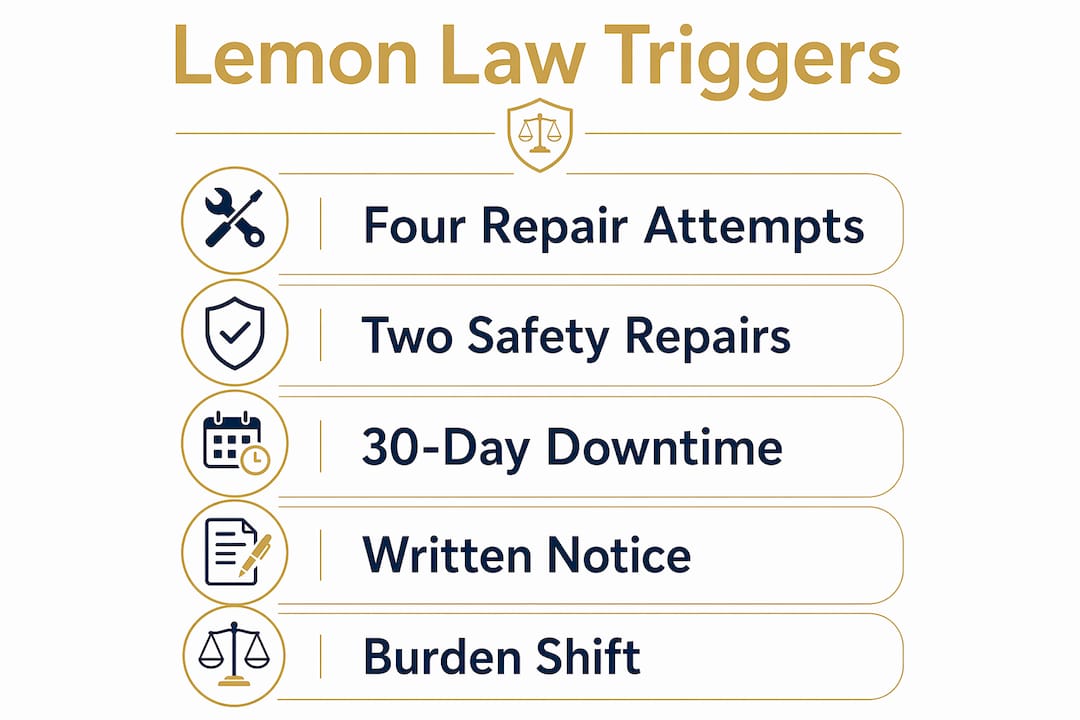
The California lemon law presumption is defined as a legal shortcut under California Civil Code §1793.22 that activates when your vehicle meets one of three specific thresholds within the first 18 months or 18,000 miles of ownership. Understanding what triggers California lemon presumption is the first step toward recovering a refund, replacement vehicle, or cash settlement under the Song-Beverly Consumer Warranty Act. The three triggers are four or more repair attempts for the same defect, two or more repair attempts for a serious safety defect, or 30 or more cumulative days out of service for warranty repairs. When any one of these conditions is met, the burden of proof shifts to the manufacturer to prove your vehicle is not a lemon.
What are the repair attempt thresholds that trigger the presumption?
The repair attempt trigger requires four or more attempts to fix the same underlying defect within the 18-month or 18,000-mile window. Each visit must address the same nonconformity, not four different problems. That distinction matters enormously in practice.
Manufacturers frequently try to break the repair count by redefining each visit as a separate, distinct issue. A transmission that slips on acceleration might be logged as a “torque converter concern” on one visit and a “transmission fluid issue” on the next. Your repair orders may describe the same mechanical failure in different language, but the underlying defect is the same. Courts look at the substance of the problem, not the label on the repair order.
Safety defects carry a lower threshold. Two or more repair attempts for a defect likely to cause death or serious bodily injury are enough to trigger the presumption. Brake failures, steering malfunctions, and fuel system fires fall into this category. The legislature set a lower bar because the stakes are higher.
Key facts about the repair attempt trigger:
- All four attempts must occur within 18 months or 18,000 miles, whichever comes first
- The defect must substantially impair use, value, or safety (minor annoyances do not count)
- Safety defects require only two attempts, not four
- Written notice to the manufacturer is required if the warranty or owner’s manual discloses this requirement
- After proper notice, the manufacturer gets one final repair opportunity before the presumption fully applies
Pro Tip: Save every repair order, even if the dealer says the problem was not reproduced. A “could not duplicate” notation still counts as a repair attempt for purposes of the presumption.
How does the 30-day cumulative downtime trigger work?
The 30-day cumulative downtime trigger is the most consumer-friendly path to the lemon law presumption. Your vehicle qualifies if it spends 30 or more calendar days out of service for warranty repairs, and those days do not need to involve the same defect.

That is the critical difference from the repair attempt trigger. A week in the shop for an electrical issue, two weeks for a transmission rebuild, and another week waiting for a backordered part all count toward the same 30-day total. The defects can be completely unrelated. The law treats your time without a working vehicle as the injury, regardless of what caused it.
This trigger also requires no prior written notice to the manufacturer. You do not need to send a demand letter or give the manufacturer a final repair opportunity before invoking it. The days accumulate objectively, and the presumption follows automatically once the threshold is crossed.
What counts toward your 30 days:
- Days the vehicle is physically at the dealership for any warranty repair
- Days you are waiting for parts, even if the vehicle is not yet at the shop
- Days across multiple separate service visits, added together cumulatively
- Days spent at any authorized dealership, not just the selling dealer
Pro Tip: Request a loaner vehicle in writing every time your car or RV goes in for service. The dealer’s refusal creates a paper trail that supports your downtime count and strengthens your overall claim.
The 30-day downtime trigger is often the most practical path for RV owners. Motorhomes, fifth wheels, and travel trailers routinely sit at service centers for weeks waiting on specialty parts. Those days add up faster than most owners realize, and the multi-defect flexibility makes this trigger especially powerful for complex vehicles with multiple warranty systems.
What qualifies as a substantial impairment under California lemon law?
A defect qualifies under the California lemon law presumption only if it substantially impairs use, value, or safety. That phrase is the legal standard, and it excludes a wide range of minor complaints.
Slight wind noise, a small rattle in the dashboard, or a paint blemish on a non-structural panel does not meet the standard. The defect must meaningfully affect how you use the vehicle, reduce its market value in a measurable way, or create a genuine safety risk. Courts apply a reasonable consumer standard: would a reasonable person in your position find this defect unacceptable?
Defects that regularly qualify include:
- Engine failures, including connecting rod bearing failures and oil consumption beyond manufacturer specifications
- Transmission malfunctions such as slipping, hard shifting, or complete failure
- Brake system defects, including ABS failures and brake fade under normal conditions
- Electrical system failures affecting safety systems, such as airbag warning lights or power steering loss
- Fuel system defects with fire or leak risk
- Slide-out failures and roof leaks in RVs that make the vehicle unusable for its intended purpose
Cosmetic issues can qualify if they affect resale value significantly. A persistent paint defect that a dealer acknowledges cannot be corrected may substantially impair the vehicle’s value even if it does not affect drivability. The key is documentation. Get the dealer to acknowledge the defect in writing on every repair order, and get written estimates of the value impact when possible. Owners researching qualifying defects for California auto lemon law will find that the list is broader than most people expect.
What procedural requirements must consumers follow to activate the presumption?
The written notice requirement is the single most common reason lemon law claims fail at the presumption stage. If your manufacturer’s warranty or owner’s manual discloses a notice requirement, you must send direct written notice to the manufacturer before the repair attempt presumption applies.
Notice to the dealership is not enough. The notice must go to the manufacturer’s corporate address, clearly identify the defect, list the repair attempts, and demand either a buyback or a final repair opportunity. Manufacturers are then entitled to one last attempt to fix the problem before the presumption locks in.
Procedural steps for the repair attempt trigger:
- Check your warranty booklet and owner’s manual for a notice requirement disclosure
- Send notice by certified mail or another traceable method to the manufacturer’s corporate address
- Include your vehicle identification number, a description of the defect, and the dates of all prior repair attempts
- State your demand clearly: repurchase, replacement, or final repair
- Keep a copy of everything you send and the delivery confirmation
The 30-day downtime trigger has no notice requirement. You do not need to send any letter to the manufacturer. The days accumulate on their own, and the presumption applies once the threshold is crossed.
Pro Tip: Never send notice by email alone. Use certified mail with return receipt requested. Manufacturers have been known to claim they never received email notices, and a traceable delivery record eliminates that defense entirely.
Failing to send required notice does not destroy your underlying lemon law claim under the broader Song-Beverly Act. It only prevents you from using the presumption as a procedural shortcut. Your case can still succeed, but it becomes harder and more expensive to litigate without the presumption working in your favor.
How does the lemon law presumption shift the burden of proof?
The presumption is a procedural tool, not a guaranteed outcome. Once triggered, the burden shifts to the manufacturer to prove that your vehicle does not qualify as a lemon. That is a significant legal advantage for consumers.
Without the presumption, you must prove the vehicle is defective, that the manufacturer had a reasonable number of repair opportunities, and that it failed to fix the problem. With the presumption, the manufacturer must disprove those facts. That shift changes the entire negotiating dynamic, often pushing manufacturers toward settlement before trial.
Manufacturers use several tactics to rebut the presumption:
- Arguing that each repair visit addressed a different defect, breaking the repair count
- Claiming the defect does not substantially impair use, value, or safety
- Disputing the downtime count by challenging which days legitimately qualify
- Asserting that the consumer caused or contributed to the defect through misuse
Maintaining complete, organized repair records is the single most effective defense against manufacturer rebuttal tactics. Every repair order, every loaner vehicle agreement, every parts-on-order notification, and every written communication with the dealer belongs in your file.
Consumers who do not meet the presumption thresholds still have rights under the Song-Beverly Act. The broader statute does not require the presumption to be triggered. It requires only that the manufacturer be given a reasonable number of attempts to repair a substantial defect. The presumption simply defines “reasonable” with a specific number. Without it, a court decides what is reasonable based on all the facts.
Key Takeaways
California’s lemon law presumption under Civil Code §1793.22 activates at three specific thresholds within 18 months or 18,000 miles, and triggering it shifts the burden of proof directly to the manufacturer.
| Point | Details |
|---|---|
| Three triggers exist | Four repair attempts, two for safety defects, or 30 cumulative days out of service all activate the presumption. |
| 30-day downtime is most flexible | Unrelated defects count together, and no written notice to the manufacturer is required. |
| Written notice is critical | Missing the notice requirement for repair attempt triggers is the most common reason presumption claims fail. |
| Defects must substantially impair | Minor annoyances and cosmetic issues do not qualify; engine, transmission, brake, and safety system failures typically do. |
| Presumption is rebuttable | Manufacturers can challenge it, so detailed repair records and organized documentation are your strongest protection. |
The trigger most consumers overlook
After 25 years handling lemon law cases, including 11 years defending manufacturers, I can tell you that the 30-day cumulative downtime trigger is the most underused tool consumers have. Most people focus on the repair attempt count. They come to me saying they have been to the dealer three times and want to know if they qualify. My first question is always: how many total days has the vehicle been out of service?
The answer frequently surprises them. A week here, two weeks there, a parts delay that stretched into a month. When we add it all up, the 30-day threshold was crossed months ago. The consumer had a presumption they did not know existed.
The other thing I see constantly is consumers who sent notice to the dealership and thought that was enough. It is not. The manufacturer and the dealer are separate legal entities. Notice to one is not notice to the other. I spent years on the defense side watching manufacturers deny claims on exactly that technicality, and it worked. Now I make sure my clients never fall into that trap.
RV owners face a compounded version of both problems. A motorhome or fifth wheel has multiple warranty systems covering different components, and service centers often lack the parts or expertise to fix them quickly. Days turn into weeks without anyone tracking the cumulative total. If you own a defective RV, the California RV lemon law framework gives you real options, but only if you know the thresholds and document everything from day one.
— Jeff Le Pere
Your next step if you think you have a lemon
If your vehicle has been in the shop repeatedly or sat idle for weeks waiting on repairs, you may already have a lemon law claim without realizing it. The Law Offices of Jeffrey Le Pere represents California owners of defective cars, trucks, SUVs, motorhomes, fifth wheels, and travel trailers on a contingency basis. You pay nothing. The manufacturer covers attorney fees if you win.

Jeff Le Pere spent 11 years defending manufacturers before switching sides. That experience means he knows exactly how manufacturers build their defense, and he builds yours accordingly. Whether your vehicle qualifies through the repair attempt trigger or the 30-day downtime rule, the firm reviews every case at no cost. Contact The Law Offices of Jeffrey Le Pere for a free case review, or visit the auto lemon law page to learn more about your specific vehicle type.
FAQ
What triggers California lemon presumption under §1793.22?
The presumption triggers when your vehicle has four or more repair attempts for the same defect, two or more for a serious safety defect, or 30 or more cumulative days out of service, all within 18 months or 18,000 miles.
Does the 30-day downtime trigger require the same defect each time?
No. The 30-day cumulative downtime trigger counts all warranty repair days regardless of whether the defects are related, and it requires no prior written notice to the manufacturer.
What happens if I miss the written notice requirement?
Missing the notice requirement prevents you from using the lemon law presumption, but you can still pursue a claim under the broader Song-Beverly Act if the manufacturer had a reasonable number of repair opportunities.
Do cosmetic defects qualify for the California lemon law presumption?
Cosmetic defects generally do not qualify unless they substantially impair the vehicle’s value in a measurable way. Defects affecting drivability, safety, or significant resale value are the standard targets.
How long do I have to file a California lemon law claim?
Under California AB 1755, consumers must file within one year of the warranty’s expiration date. Acting quickly after the presumption threshold is crossed protects your rights and preserves your evidence.