What It Means When an RV Case Is Complex Under California Law
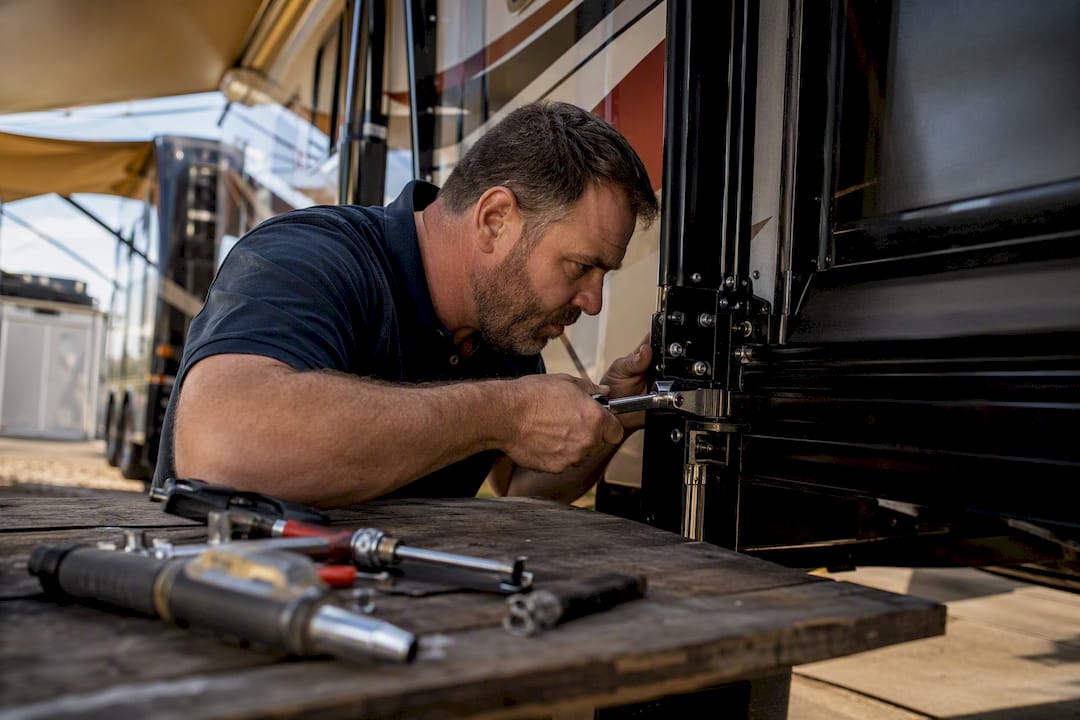
A “complex” RV lemon law case means your claim involves more than one manufacturer’s warranty, extended time out of service for repairs, or overlapping coverage between the chassis and the living quarters, all of which affect your rights under the Song-Beverly Consumer Warranty Act and the new filing deadline under California AB 1755. If your case fits that description, the practical stakes go up, not down.
Three scenarios show up again and again. First, the chassis manufacturer (say, a Ford or Freightliner base) points to the coach builder, and the coach builder points right back, while your slide-out or plumbing problem sits unresolved. Second, your RV has spent weeks at a repair facility waiting on backordered parts, and those cumulative days start to matter for an out-of-service threshold often cited around a month. Third, a generator, appliance, or awning carries its own separate supplier warranty that never quite lines up with the main vehicle warranty.
If any of that sounds familiar, the case usually needs specialized RV lemon law counsel early, before repair records get muddled or a filing deadline slips past.
Key Takeaways
Complex RV cases hinge on multiple overlapping warranties, extended out-of-service time, and consistent documentation, and both factors determine which remedies and deadlines apply.
| Point | Details |
|---|---|
| Multiple manufacturers create disputes | Chassis and coach makers often blame each other, so pin down warranty boundaries in writing early. |
| AB 1755 sets a one-year deadline | File your claim within one year of warranty expiration to preserve your state law remedies. |
| Documentation wins complex cases | Keep separate, consistent repair orders from every service center plus a personal drop-off and pickup log. |
| Remedies vary by defect type | Expect repurchase, replacement, cash settlement, or civil penalties depending on manufacturer conduct. |
| The Law Offices of Jeffrey Le Pere focuses on complex RV claims | Jeff Le Pere’s 11 years defending manufacturers inform how the firm builds multi-warranty RV cases on contingency. |
Table of Contents
- What Makes RV Lemon Cases More Complex Than Standard Vehicle Claims
- Key Legal Deadlines and Statutes That Shape a Complex RV Claim
- What Evidence a Judge or Arbitrator Expects in a Complex RV Case
- Remedies You Can Realistically Recover in a Complex RV Case
- Common Defenses Manufacturers Use and Why Defense Experience Matters
- When to Call an RV Lemon Law Attorney and What to Ask
- Your 30-Day Action Checklist for a Potentially Complex RV Claim
- A Straight Answer From Jeff Le Pere on Complex RV Cases
- If Your RV Case Looks Complex, Here Is How to Move Forward
- Frequently Asked Questions
- Sources
What Makes RV Lemon Cases More Complex Than Standard Vehicle Claims
RVs almost always involve at least two manufacturers instead of one. A chassis maker builds the engine, transmission, and drivetrain, while a separate coach builder handles the slide-outs, plumbing, electrical systems, and cabinetry, and each one issues its own warranty with its own boundaries. That structure alone is why RVs occupy an unusually messy corner of consumer warranty law compared to a car or truck, where a single manufacturer stands behind the whole vehicle.
Repair logistics compound the problem. Authorized RV service centers are far less common than auto dealerships, so owners often drive hours to reach one, and parts for coach components can take weeks to arrive. That combination routinely pushes cumulative out-of-service time past the point where a standard car repair would have been long since finished.
Certain defect categories show up constantly in complex claims:
- Slide-out mechanisms that fail to extend or retract properly, sometimes repeatedly, after supposed fixes
- Persistent water leaks around roof seams, windows, or slide-out seals that cause hidden damage
- Integrated electrical systems that control lighting, leveling, and appliances and fail in ways hard to isolate to one component
Pro Tip: Ask every repair facility to write the exact same description of the defect on each repair order. Consistent wording across visits is what proves a manufacturer had multiple chances to fix the same problem, not several unrelated ones.
Key Legal Deadlines and Statutes That Shape a Complex RV Claim
Two California laws control most RV lemon claims: the Song-Beverly Consumer Warranty Act governs the underlying repair and replace-or-refund obligations, while California AB 1755 sets a hard filing deadline that did not exist in the same form before. Under AB 1755, consumers generally must file a lemon law claim within one year of the warranty’s expiration date, which makes early legal review far more valuable than it used to be.
Several numeric triggers matter in a complex case:
- Cumulative days out of service, often analyzed against a 30-day threshold within the warranty period
- The number of repair attempts on the same defect, generally three or four depending on severity
- The remaining length of the express warranty period when the defect first appeared
- The one-year AB 1755 filing window measured from warranty expiration
California appellate precedent in National R.V., Inc. v. Foreman treats the motorhome coach as a consumer good under Song-Beverly, meaning coach defects can qualify for replace-or-refund relief even in situations where certain Lemon Law provisions do not directly apply to the coach.
When state coverage runs thin, particularly for living-quarters components, the federal Magnuson-Moss Warranty Act can fill the gap and open a path to attorney fee recovery, a separate remedy from anything Song-Beverly provides on its own.
What Evidence a Judge or Arbitrator Expects in a Complex RV Case
A complete, consistent repair history is the single most important thing you can hand an arbitrator or judge in a complex RV case. Without it, even a genuinely defective RV can look like a series of unrelated minor issues instead of one persistent problem.
Build your file with these documents:
- The purchase agreement, financing paperwork, and every applicable warranty booklet
- Every repair order from both the chassis service center and the coach service center, kept separately
- Parts order confirmations showing when a component was ordered and when it actually arrived
- Dated photos and videos of the defect, taken at each occurrence
- Receipts for towing, lodging, or campground fees lost because the RV was in the shop
- Written correspondence with the manufacturer, especially anything sent by certified mail
If time or resources are limited, start with your VIN, the repair orders themselves, and any certified mail receipts. Those three items alone let an attorney reconstruct a rough timeline fast. Keep a personal log alongside the official paperwork, recording every drop-off and pickup date in your own words, since documenting drop-off and pickup dates yourself closes the gap when a shop’s own paperwork is incomplete.
Remedies You Can Realistically Recover in a Complex RV Case
Successful complex RV claims typically end in one of four outcomes: a full repurchase (refund), a replacement RV, a negotiated cash settlement, or a civil penalty of up to two times actual damages when a manufacturer willfully ignored its warranty obligations.
A buyback calculation generally adds up:
- The full purchase price of the RV
- Sales tax, registration fees, and finance charges paid
- Minus a mileage or usage offset for the time you had reasonable use before the defect became clear
Complex cases produce some unusual outcome shapes. A multi-warranty RV might settle with the coach manufacturer buying back the living-quarters defect while the chassis issue resolves separately. Others recover incidental costs, like towing bills and lost campground deposits, on top of the core remedy. When state remedies fall short, Magnuson-Moss fee shifting can make pursuing the claim in court financially realistic even when the numbers involved would otherwise be too small to justify litigation.
Common Defenses Manufacturers Use and Why Defense Experience Matters
Manufacturers and dealers lean on three defenses more than any others: shifting blame between the chassis maker and the coach builder, alleging owner misuse or improper maintenance, and pointing to inconsistent complaint descriptions across your repair orders.
Each defense has a direct countermeasure:
- Warranty boundary disputes: pin down in writing which manufacturer is responsible for which system before repairs start
- Inconsistent repair order language: insist on identical, precise wording describing the same defect at every visit
- Denial of cumulative out-of-service days: log every drop-off and pickup date yourself, independent of the shop’s own records
A lawyer who spent years on the defense side knows exactly which gaps in a chronology a manufacturer’s team will search for, because building that same argument used to be the job.
When to Call an RV Lemon Law Attorney and What to Ask
Call an attorney as soon as multiple warranties, extended shop time, or manufacturer finger-pointing enter the picture, rather than after a year of frustration. Waiting rarely improves your position, and it can push you closer to the AB 1755 filing deadline.
On the first call, ask directly:
- Is representation contingency-based, and what happens financially if the case does not succeed?
- Does the firm regularly handle multi-manufacturer RV cases, or mostly standard car claims?
- Will you speak directly with your attorney, or primarily with a case manager?
- What timeline should you expect given the AB 1755 filing window?
Also ask whether the firm advances case costs and how it tracks days-in-shop records across multiple service centers. Before you dial, gather your VIN, every repair order you can find, your purchase paperwork, and a one-page timeline of events. A well-organized attorney evaluation depends heavily on how clearly a new case is presented at intake, so a tight timeline saves everyone time.
Your 30-Day Action Checklist for a Potentially Complex RV Claim
Preserve every piece of paperwork you have and send written notice to the manufacturer now, before memories fade or documents go missing.
- Collect and photocopy every repair order from both the chassis and coach service centers
- Photograph or film each defect the moment it appears, with a visible date
- Log every drop-off and pickup date in a simple personal notebook or spreadsheet
- Send a certified written demand to the manufacturer, and to both the chassis and coach manufacturers separately if the defects fall on different sides
- Request a free case review from an attorney who specializes in California RV lemon law
Pro Tip: Track out-of-service days on a calendar the moment your RV goes into the shop, and ask the service writer to use the same wording you used to describe the problem. That single habit prevents most of the defenses manufacturers rely on later.
With AB 1755’s one-year filing window now in effect, certified mail documentation created today becomes the backbone of a claim filed months from now.
A Straight Answer From Jeff Le Pere on Complex RV Cases
I spent 11 of my 25 years in lemon law working the other side, defending manufacturers and dealerships, and that experience is exactly why I take on the RV cases most firms turn away. Complex cases scare off attorneys who only know how to process a standard car claim, but multi-manufacturer disputes are where defense-side knowledge actually pays off for the client. Every case at my firm runs on contingency, and you talk to me directly, not a rotating case manager. When a complex RV case succeeds, owners typically recover a refund, a replacement, reimbursement for costs like towing, or a civil penalty when a manufacturer’s conduct was willful, though no outcome is ever guaranteed.
If Your RV Case Looks Complex, Here Is How to Move Forward
If your RV involves more than one manufacturer’s warranty or has spent weeks in and out of the shop, a free case review is the fastest way to find out where you stand. Bring your VIN, every repair order you can find, and your original purchase agreement, and you will get a direct answer instead of a form letter.
The Law Offices of Jeffrey Le Pere built its practice specifically around the RV cases other firms decline, because coordinating chassis and coach manufacturers, preserving evidence across multiple repair facilities, and drafting a written demand that actually holds up takes RV-specific experience most lemon law mills never develop. The firm handles the full arc of a complex claim: evidence preservation, formal written demands, litigation when negotiation stalls, and recovery of incidental damages and attorney fees where the law allows it. Every case runs on contingency, so if the firm does not recover for you, you owe nothing. Start your free RV lemon law case review today and speak directly with an attorney who has seen these cases from both sides of the table.
Frequently Asked Questions
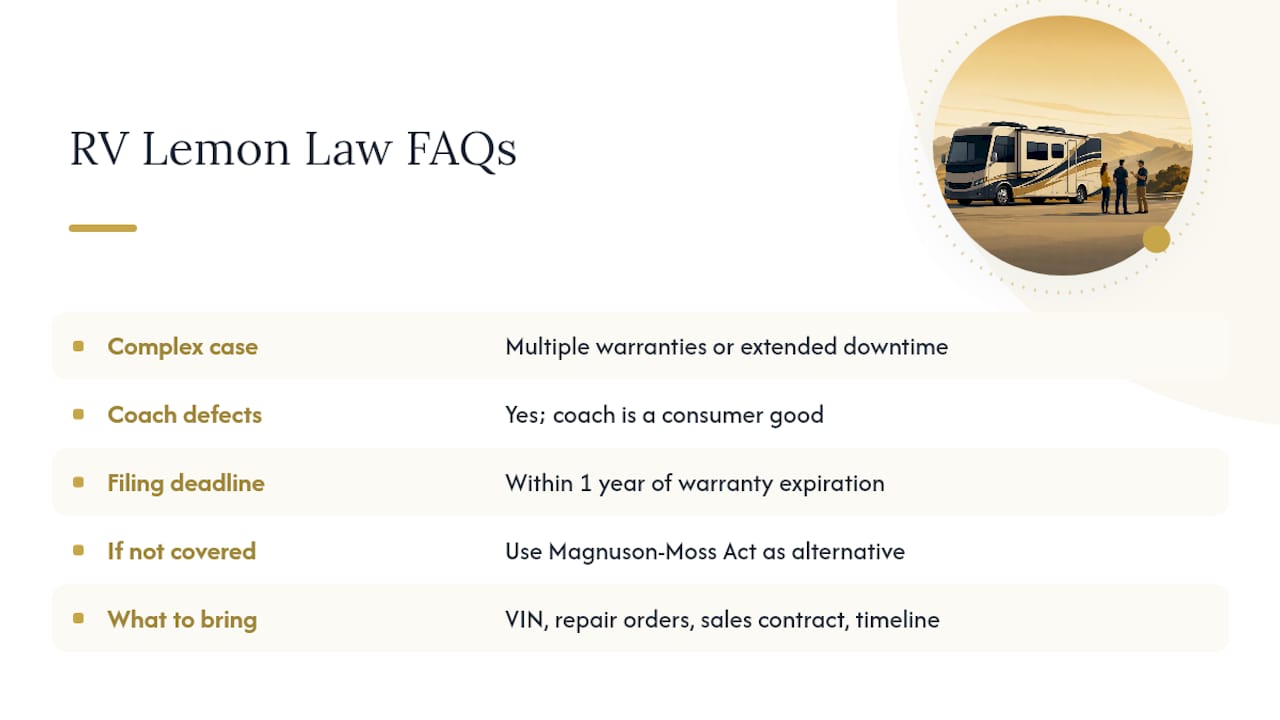
What does it mean when an RV lemon law case is called complex? It means the claim involves more than one manufacturer’s warranty, extended cumulative time out of service, or overlapping coverage between the vehicle chassis and the coach, all of which change how Song-Beverly and AB 1755 apply.
Does California’s Song-Beverly Act cover RV coach defects? Yes. Appellate precedent in National R.V., Inc. v. Foreman treats the coach as a consumer good, so coach defects can qualify for replace-or-refund relief under Song-Beverly.
How long do I have to file an RV lemon law claim in California? Under California AB 1755, you generally must file within one year of the warranty’s expiration date, making early documentation and legal review important.
What if my RV’s living-quarters defect isn’t covered by state lemon law? The federal Magnuson-Moss Warranty Act can offer an alternative remedy, including recovery of attorney fees, when state coverage is unclear for coach components.
What should I bring to a free RV lemon law case review? Bring your VIN, every repair order from both chassis and coach service centers, your purchase agreement, and a written timeline of drop-off and pickup dates.
This article is general information, not a substitute for advice from a qualified lawyer. Consult a qualified legal professional about your own circumstances before acting on anything here.
Sources
These sources cover the statutory framework, appellate precedent, and practical filing steps referenced throughout this guide.
- Findlemonlaw
- RV Lemon Law: What Qualifies and How to File a Claim - LegalClarity
- National R.V., Inc. v. Foreman (1995)
- Why RV Lemon Law Cases Are Harder Than Standard Vehicle Claims