What Incidental Damages Lemon Law Covers in California

Incidental damages under California Lemon Law are the out-of-pocket expenses you pay because your vehicle is defective and repeatedly in the shop. The California Song-Beverly Consumer Warranty Act defines these as costs separate from your vehicle’s purchase price, covering expenses like towing charges, rental cars, and rideshare fees tied directly to repair visits. Knowing what incidental damages lemon law covers changes how much money you recover. These costs are added to your refund or buyback calculation before the statutory mileage offset is applied. Documentation is the deciding factor between a full recovery and leaving money on the table.
What types of incidental damages does California Lemon Law cover?
California Lemon Law covers incidental costs including towing charges and rental or alternate transportation expenses incurred because your vehicle is out of service. These are immediate, verifiable, out-of-pocket costs with a direct link to your defect and repair history. The law treats them as reimbursable separate from the core vehicle refund.
For RV and vehicle owners, the most common qualifying expenses include:
- Towing charges: Towing a broken-down motorhome or fifth wheel to a dealership costs significantly more than towing a car. Every tow receipt counts.
- Rental car fees: If you rented a vehicle while your car or truck sat at the dealership, those daily rental charges are reimbursable.
- Rideshare costs: Uber and Lyft receipts tied to repair drop-offs and pickups qualify as alternate transportation costs.
- Registration fees: Fees paid to re-register a vehicle that was never properly repaired are sometimes considered incidental costs.
- Repair-related lodging: If a repair delay forced you to stay overnight near a dealership, that lodging expense may qualify with proper documentation.
Expenses that generally do not qualify include routine maintenance costs unrelated to the defect, personal property lost inside the vehicle, and costs you cannot tie directly to a specific repair visit. The causal link between the defect and the expense is what the manufacturer will scrutinize.
RV owners face a particular challenge here. Towing a 40-foot motorhome is not a $75 roadside call. A single tow can run several hundred dollars. Those costs add up across multiple repair attempts, and every dollar is recoverable if you have the receipt.
Pro Tip: Keep a dedicated folder, physical or digital, for every expense tied to your vehicle’s defect. Label each receipt with the repair visit date and the dealership name. That organization alone can prevent disputes.

How are incidental damages calculated in a California Lemon Law refund?
The California Song-Beverly buyback formula adds incidental damages to your total recovery before applying the mileage offset deduction. California Lemon Law refunds include the purchase price, sales tax, registration fees, finance charges, and incidental damages, with the mileage offset subtracted from the combined total.
The mileage offset is calculated using the miles you drove before your first qualifying repair visit, divided by 120,000, then multiplied by the purchase price. That number is subtracted from your total recovery. Incidental damages are added to the recovery pool before this deduction, which means they directly increase the base from which the offset is subtracted.
Here is how a simplified buyback calculation looks in practice:
| Component | Example Amount |
|---|---|
| Vehicle purchase price | $55,000 |
| Sales tax and registration | $5,200 |
| Finance charges paid | $1,800 |
| Incidental damages (towing, rentals) | $1,400 |
| Subtotal before offset | $63,400 |
| Mileage offset deduction | ($4,200) |
| Final refund | $59,200 |
Manufacturers sometimes omit incidental damages entirely from their initial buyback offers, or they misapply the mileage offset to reduce the payout. Itemizing every reimbursable component including incidental damages is the difference between accepting a low offer and recovering what the law actually provides.
The mileage offset is a common friction point, but it does not eliminate incidental damage recovery. The mileage deduction applies to usage before the first repair attempt, not to the incidental costs you accumulated during the repair process.
Pro Tip: Organize your incidental damage receipts by repair visit, not by expense type. When you present them in chronological order tied to each repair attempt, the causal chain is clear and harder for a manufacturer to dispute.
What steps should you take to document incidental damage claims?
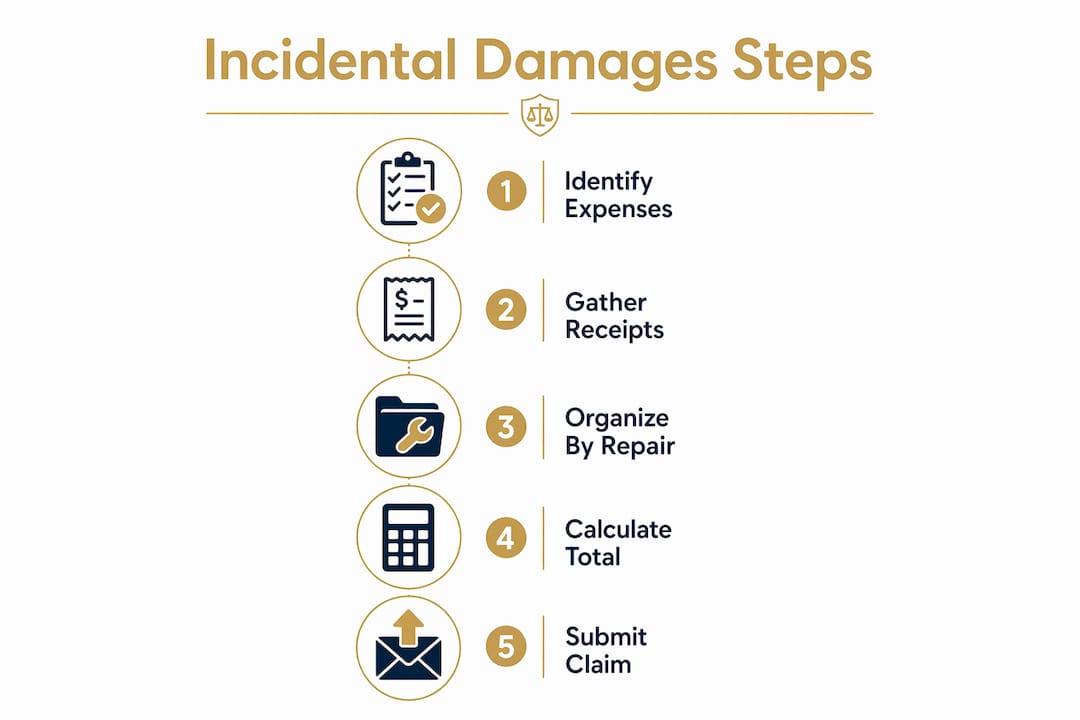
Documentation is the foundation of every successful incidental damages claim. Keeping detailed logs and all receipts for towing, rental cars, rideshare, and other out-of-pocket expenses creates the causal chain you need to prove your claim.
Follow these steps from the first repair visit forward:
- Record every out-of-service date. Write down the exact date you dropped off your vehicle and the date you picked it up. This establishes loss-of-use periods that support your incidental costs.
- Save every receipt immediately. Towing invoices, rental car agreements, rideshare app screenshots, and hotel bills should go into your claim folder the same day you receive them.
- Link each expense to a specific repair visit. Note the repair order number on each receipt. This connection is what transforms a pile of receipts into a documented claim.
- Log your communications with the dealership. Save text messages, emails, and voicemails about repair timelines. Delays that extend your rental car period are documented proof of extended incidental costs.
- Request written repair orders every time. A repair order is your official record that the vehicle was in for a defect-related repair. Without it, the expense loses its anchor.
A running log with dates, repair visits, and related expenses reduces disputes and speeds up claims processing. The most common pitfall is waiting until you file your claim to reconstruct expenses from memory. By then, receipts are gone and dates are fuzzy.
California consumers filing under AB 1755 must also watch the clock. The law requires you to file within one year of your warranty’s expiration date. Reviewing the one-year warranty filing requirements early protects your right to recover incidental damages at all.
How do incidental damages differ from consequential damages?
Incidental damages are immediate, out-of-pocket expenses with a direct link to your vehicle’s defect and repair visits. Consequential damages cover broader, downstream losses that result from the defect but require more proof to establish. Treating these as separate claim categories produces simpler, faster reimbursement.
The practical difference matters for your claim strategy:
- Incidental damages include towing, rental cars, rideshare fees, and repair-related lodging. They are straightforward to prove with receipts and repair orders.
- Consequential damages include lost wages from missing work due to repair appointments, diminished resale value of the vehicle, and business losses caused by the defect. These require additional documentation and legal argument to recover.
- Foreseeability standard: Consequential damages require you to show the manufacturer could have foreseen the loss. Incidental damages carry no such burden.
- Settlement speed: Manufacturers settle incidental damage claims faster because the amounts are verifiable and the legal standard is lower.
- Litigation risk: Pursuing consequential damages like lost wages or diminished value increases litigation complexity. Incidental damages rarely trigger the same resistance.
Incidental damages are straightforward to prove compared to consequential damages, which require demonstration of foreseeability and additional documentation. For most California consumers, maximizing incidental damage recovery is the faster and more reliable path to full compensation.
For fifth wheel and travel trailer owners, the incidental damage category is especially valuable. A fifth wheel owner who paid for multiple tows, weeks of rental vehicles, and campground cancellation fees has a concrete, documentable claim that does not require complex legal arguments. The fifth wheel lemon law process and travel trailer claims both benefit from this focused approach.
Key Takeaways
Incidental damages are a legally distinct, reimbursable category under California Lemon Law that consumers must document from the first repair visit to maximize their total recovery.
| Point | Details |
|---|---|
| Incidental damages defined | Immediate out-of-pocket costs like towing, rental cars, and rideshare fees tied to repair visits. |
| Added before mileage offset | Incidental damages increase your recovery base before the statutory mileage deduction is applied. |
| Documentation is required | Every receipt must link to a specific repair visit to establish the causal chain manufacturers will challenge. |
| Easier to prove than consequential | Incidental damages require no foreseeability argument, making them faster to settle than lost wages or diminished value. |
| Manufacturers undercount them | Initial buyback offers frequently omit incidental damages; itemizing them yourself closes that gap. |
What I’ve learned after 25 years of lemon law on both sides
I spent 11 years defending manufacturers in lemon law cases before switching to represent consumers. That experience taught me exactly how manufacturers approach incidental damage claims: they ignore them in the first offer and hope you do not notice.
The consumers who recover the most are the ones who treated their defective vehicle like a legal case from day one. They kept every receipt. They logged every date. They saved every text from the service advisor. When I review a file and see that level of organization, the manufacturer’s position weakens immediately because there is nothing to dispute.
RV owners have the most to gain here. A motorhome tow is expensive. A week in a rental while your rig sits at a dealership adds up fast. I have seen clients with $3,000 or more in documented incidental costs that the manufacturer’s initial offer completely ignored. Those costs belong in your recovery, and the law says so.
My advice is simple: start your log today, not when you decide to file. The causal chain you build from the first repair visit is the foundation of your entire claim. Waiting until you hire an attorney means reconstructing that chain from incomplete records, and manufacturers know how to exploit those gaps.
— Jeff Le Pere
How The Law Offices of Jeffrey Le Pere can help with your claim
Recovering incidental damages requires knowing what to document, how to calculate the full refund, and when a manufacturer’s offer falls short of what California law requires.
The Law Offices of Jeffrey Le Pere represents California vehicle and RV owners in lemon law claims statewide, with no upfront cost. Every case runs on contingency, meaning the manufacturer pays attorney fees when you win. Jeff Le Pere’s background defending manufacturers for 11 years means he knows exactly which incidental costs manufacturers try to exclude and how to push back. Whether you own a car, truck, motorhome, or fifth wheel, a free case review through the California RV Lemon Law practice or the California auto lemon law page is the fastest way to find out what your claim is worth.
FAQ
What counts as an incidental damage under California Lemon Law?
Incidental damages include towing charges, rental car fees, rideshare costs, and other out-of-pocket expenses directly caused by your vehicle’s defect and repair visits. Registration fees paid on a vehicle that was never properly repaired may also qualify.
Are incidental damages added before or after the mileage offset?
Incidental damages are added to your total recovery before the mileage offset is subtracted. This means they increase the base amount from which the deduction is calculated, raising your final refund.
Do I need receipts to recover incidental damages?
Yes. Receipts tied to specific repair visits are required to prove the causal link between your vehicle’s defect and the expense. Without documentation, manufacturers will dispute or deny the costs.
Can RV owners claim incidental damages for towing a motorhome?
Yes. Towing a motorhome or fifth wheel to a dealership for a defect-related repair qualifies as an incidental damage under California Lemon Law. These towing costs are often substantial and fully reimbursable with proper receipts.
What is the deadline to file a lemon law claim in California?
Under California AB 1755, consumers must file their lemon law claim within one year of the warranty’s expiration date. Missing this deadline eliminates your right to recover incidental damages and all other remedies under the Song-Beverly Act.