What Happens When the Lemon Deadline Passes in California

Missing the lemon law deadline means losing your legal right to seek a refund, replacement, or civil penalty for a defective RV under California law. The statute of limitations is not a suggestion. Once it expires, a manufacturer can file a motion to dismiss your claim regardless of how serious the defect is or how many repair attempts failed. California’s Song-Beverly Consumer Warranty Act and the newer AB 1755 framework each impose distinct filing windows, and RV owners face an added layer of complexity because motorhomes, fifth wheels, and travel trailers often carry separate warranties from the chassis and coach manufacturers. Understanding what happens when the lemon deadline passes is the first step toward protecting whatever rights you still have.
What are the lemon law deadlines under California law?
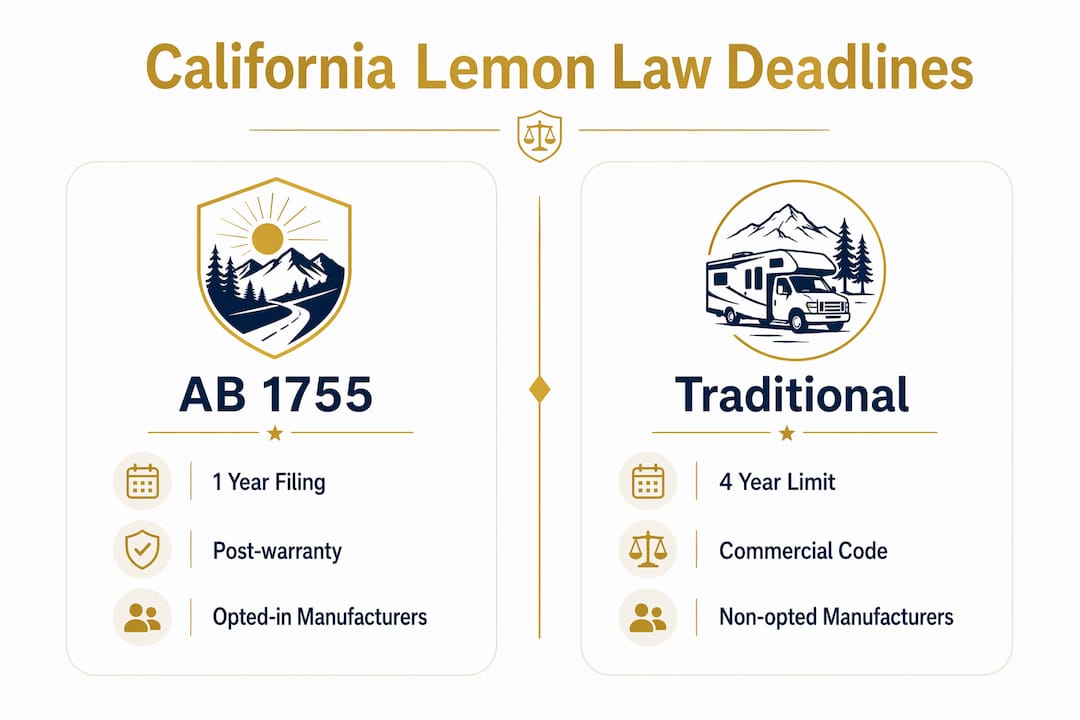
California operates under two parallel deadline frameworks, and which one applies to your RV depends entirely on whether your manufacturer opted into AB 1755.
For manufacturers that opted in, AB 1755 imposes a one-year filing deadline measured from the date your express warranty expires. There is also an outer cap: no claim can be filed more than six years after the original delivery date. Opted-in manufacturers must also receive a 30-day pre-suit notice before you file, and mandatory mediation must occur within 150 days after the manufacturer files its answer. The California Department of Consumer Affairs publishes the list of opted-in manufacturers, so you can check your RV’s brand directly.
For manufacturers that have not opted in, the traditional four-year statute of limitations under California Commercial Code § 2725 applies. That clock typically starts from the date of delivery or from the date you discovered the breach, depending on the warranty type.
RVs create a tracking problem that cars and trucks do not. A motorhome or fifth wheel usually carries separate warranties from the chassis manufacturer and the coach manufacturer. Those two warranties may expire on different dates, which means two independent deadlines run simultaneously. Missing one does not affect the other, but failing to track both means you could lose a valid claim against one manufacturer while preserving a claim against the other.
| Deadline Framework | Applies When | Filing Window |
|---|---|---|
| AB 1755 (opted-in manufacturers) | Manufacturer on Dept. of Consumer Affairs list | 1 year after warranty expires, max 6 years from delivery |
| Commercial Code § 2725 (non-opted-in) | Manufacturer not on AB 1755 list | 4 years from delivery or breach discovery |
| RV chassis warranty | Separate from coach warranty | Tracked independently from coach deadline |
| RV coach warranty | Separate from chassis warranty | Tracked independently from chassis deadline |
Pro Tip: Check the California Department of Consumer Affairs website to confirm whether your RV’s chassis and coach manufacturers have each opted into AB 1755. They may be on different lists, which means different deadlines apply to the same vehicle.
What are the consequences if the lemon law deadline passes?
The consequences of a missed lemon deadline are immediate and severe. Claims filed after the statute of limitations expires can be dismissed by the manufacturer, and courts will typically grant that dismissal regardless of the underlying defect’s severity. You lose the right to a full repurchase, a replacement vehicle, a cash settlement, and the civil penalty of up to two times actual damages that California law allows when a manufacturer willfully ignores its warranty obligations.
The procedural bar is absolute in most cases. A manufacturer’s attorney will raise the statute of limitations as an affirmative defense at the earliest opportunity. That defense does not require the manufacturer to prove your RV was not defective. It only requires proof that you filed too late.
Missing the lemon law deadline does not mean your RV suddenly works. It means the law can no longer force the manufacturer to make it right. The defect is real. The remedy is gone.
The lemon deadline passed implications extend beyond the courtroom. Once your claim is time-barred, your negotiating leverage with the manufacturer drops sharply. Manufacturers know that a consumer without a viable legal claim has little power to compel a settlement. Informal resolution is still possible, but the manufacturer holds all the cards.
The consequences of missing lemon deadlines also include the loss of attorney fee recovery. Under Song-Beverly, a prevailing consumer recovers attorney fees from the manufacturer. When the claim is barred, that fee-shifting provision disappears, which means any attorney willing to help you pursue alternatives may require out-of-pocket payment.

Are there any exceptions or tolling provisions after a deadline is missed?
California law recognizes a limited set of circumstances where the statute of limitations may be extended or tolled. These exceptions are narrow, and none of them are guaranteed to apply without a careful legal review.
- Fraudulent concealment: Equitable tolling may apply if the manufacturer actively concealed the defect. The clock pauses until you discovered, or reasonably should have discovered, the problem. This requires proof of intentional concealment, not just a manufacturer’s failure to volunteer information.
- Repair attempts as new breaches: Each failed repair attempt can be argued as a new breach of warranty, which may restart or toll the limitations period. This argument is strongest when the manufacturer repeatedly promised a fix and failed to deliver one.
- Written manufacturer acknowledgments: Manufacturer letters or Technical Service Bulletins that acknowledge a known defect can support an argument for tolling or an extended filing period. Save every piece of written communication from the manufacturer and dealership.
- The Mexia rule: California courts apply the delayed discovery doctrine from Mexia v. Rinker Boat Co., which permits the statute of limitations to run from the date you discovered the defect when the warranty extends to future performance. This is particularly relevant for latent defects that do not appear immediately after purchase.
- Minority or disability: Standard civil tolling rules apply if the claimant was a minor or legally incapacitated during part of the limitations period.
None of these exceptions work automatically. Each requires factual support and legal argument. An RV owner who believes tolling applies should get a legal review before concluding the claim is dead.
Pro Tip: Gather every repair order, warranty document, and written communication from both the chassis and coach manufacturers before speaking with an attorney. That paper trail is what makes or breaks a tolling argument.
What steps should you take if your lemon law deadline has passed or is close?
If the deadline has not yet expired, the single most important step is to act immediately. Every day of delay narrows your options.
-
Identify your exact deadlines. Pull the original purchase contract, warranty booklets, and repair orders for both the chassis and coach. Calculate the warranty expiration date for each manufacturer separately. Confirm whether each manufacturer is on the AB 1755 opted-in list.
-
Document every repair attempt. Your repair attempt history is the foundation of any lemon law claim. Each repair order should show the date, the complaint you reported, and the work performed. Gaps in documentation weaken tolling arguments and reduce claim value.
-
Seek a legal review immediately. The Law Offices of Jeffrey Le Pere handles California RV lemon law cases for motorhomes, fifth wheels, and travel trailers. An attorney experienced in RV lemon law can assess whether your deadline has truly passed, whether a tolling exception applies, and what alternatives remain.
-
Consider dealer fraud claims as an alternative. If your lemon law claim is time-barred, dealer fraud claims under California consumer protection statutes may still be available. These apply when a dealer misrepresented the vehicle’s condition, concealed known defects, or sold a vehicle as “certified” in violation of California law.
-
Use AB 1755 pre-suit procedures if the deadline is still open. If your manufacturer has opted into AB 1755 and your deadline has not expired, the mandatory 30-day pre-suit notice and mediation process can resolve your claim faster and at lower cost than full litigation. The Law Offices of Jeffrey Le Pere can send that notice on your behalf.
-
Do not negotiate alone. Manufacturers and their attorneys handle lemon law claims every day. An RV owner negotiating without legal representation is at a structural disadvantage, especially when the manufacturer knows the limitations period is close to expiring.
Pro Tip: Even if you believe the deadline has passed, contact an attorney before giving up. The Mexia rule, fraudulent concealment, and repair-based tolling arguments have saved claims that appeared time-barred on the surface.
Key takeaways
Missing the lemon law deadline under California’s Song-Beverly Act or AB 1755 eliminates your right to a refund, replacement, or civil penalty, though limited tolling exceptions may preserve claims in specific circumstances.
| Point | Details |
|---|---|
| Two deadline systems exist | AB 1755 opted-in manufacturers face a 1-year post-warranty window; others face a 4-year limit under § 2725. |
| RVs carry dual deadlines | Chassis and coach warranties expire independently, requiring separate deadline tracking for each manufacturer. |
| Missed deadline bars recovery | A late claim can be dismissed regardless of defect severity, eliminating refund, replacement, and civil penalty rights. |
| Tolling exceptions are narrow | Fraudulent concealment, failed repairs, and the Mexia rule may extend deadlines but require factual proof and legal argument. |
| Alternatives may still exist | Dealer fraud claims under California consumer protection law can sometimes substitute when lemon law claims are time-barred. |
What I’ve learned defending manufacturers about deadline enforcement
I spent 11 years on the other side of these cases, building the defense for manufacturers and dealerships. The single most effective tool manufacturers used against consumers was the statute of limitations. Not the merits. Not the repair history. The clock.
The dual deadline system that AB 1755 created makes this worse for RV owners specifically. I see owners who correctly tracked the coach warranty but forgot the chassis manufacturer operates on a completely different timeline. By the time they realize the chassis claim is gone, the manufacturer’s attorney has already flagged it. That is not a mistake you can undo.
The confusion around AB 1755’s opt-in structure is real and deliberate from the manufacturer’s perspective. If you do not know which framework applies to your RV’s brand, you cannot calculate your deadline accurately. I have seen owners assume the four-year window applied when their manufacturer had opted into AB 1755, which cut their actual deadline to one year post-warranty. That gap cost them everything.
My honest advice is this: the moment your RV goes back to the dealer for the same problem a second time, start the clock in your head. Do not wait for a third or fourth repair attempt. Do not wait until the warranty is about to expire. Get a legal review early, when your options are still open and your claim still has full value. A free consultation costs nothing. A missed deadline costs everything.
— Jeff Le Pere
California RV owners deserve deadline clarity, not guesswork
If your lemon law deadline is approaching or has already passed, The Law Offices of Jeffrey Le Pere offers free case reviews for California RV owners dealing with defective motorhomes, fifth wheels, and travel trailers.

Jeff Le Pere’s 25 years of lemon law experience, including 11 years defending manufacturers, means he knows exactly how deadline arguments are built and how to challenge them. The firm handles California RV lemon law cases on a full contingency basis, so you pay nothing unless you recover. Whether your deadline is still open or you need to explore dealer fraud alternatives, the firm can assess your specific situation and tell you exactly where you stand. Contact The Law Offices of Jeffrey Le Pere for a free review at rvautolegalteam.com.
FAQ
What happens when the lemon law deadline passes in California?
When the lemon law deadline passes, your claim is typically barred and a manufacturer can have it dismissed in court. You lose the right to a refund, replacement vehicle, and civil penalties under California’s Song-Beverly Consumer Warranty Act.
Is there a grace period after the lemon law deadline expires?
California lemon law does not provide a formal grace period. Limited tolling exceptions, such as fraudulent concealment or the Mexia delayed discovery rule, may extend the deadline in specific circumstances, but these require legal proof and are not automatic.
How does AB 1755 change the lemon law deadline for RV owners?
AB 1755 shortens the deadline for opted-in manufacturers to one year after the express warranty expires, with a six-year cap from delivery. Owners whose RV manufacturer has opted in face a significantly tighter window than the traditional four-year limit under Commercial Code § 2725.
Can I still file a claim if my lemon law deadline has passed?
A standard lemon law claim is likely barred, but dealer fraud claims under California consumer protection statutes may still be available depending on how the vehicle was sold. A legal review is the only way to confirm which remedies remain open.
Why do RV owners face more deadline complexity than car owners?
RVs carry separate warranties for the chassis and coach, often from different manufacturers with different opt-in statuses under AB 1755. Each warranty generates its own independent deadline, requiring RV owners to track multiple expiration dates simultaneously.