What Direct Attorney Access Means Legally in California

Direct attorney access is defined as a client’s right to communicate confidentially and directly with the attorney responsible for making key legal decisions in their case. For California vehicle and RV owners pursuing lemon law claims, understanding what direct attorney access means legally is the difference between a well-managed case and one where critical decisions fall through the cracks. California attorney-client privilege law and ethical conduct rules together create the legal framework that governs this access. Knowing how that framework works helps you hold your attorney accountable from day one.
What does direct attorney access mean legally?
Direct attorney access means the attorney personally receives your communications, personally evaluates the facts, and personally directs the legal strategy. It is not a separately codified concept in California statutes. Instead, California defines access through attorney-client privilege rules and the California Rules of Professional Conduct. That distinction matters because it means your rights are real and enforceable, but you have to know where to find them.
The legal foundation sits in two places. First, California Evidence Code sections 952 and 954 protect confidential communications between client and attorney, including authorized assistants, from disclosure. Second, California Rule of Professional Conduct 1.4 requires attorneys to keep clients reasonably informed and respond promptly to requests for information. Together, these rules define what meaningful attorney access actually looks like in practice.

For RV and vehicle owners, this matters immediately. A lemon law claim under California’s Song-Beverly Consumer Warranty Act involves specific repair attempt thresholds, warranty deadlines, and the newer AB 1755 deadline requiring claims to be filed within one year of warranty expiration. Missing those windows because your attorney was not personally engaged with your case is a real and preventable harm.
How attorney-client privilege shapes direct access in lemon law cases
Attorney-client privilege is the legal protection that makes direct attorney access meaningful. California Evidence Code section 952 defines a confidential communication as one made in confidence between the client and the attorney, including those transmitted through authorized representatives. Section 954 gives the client the right to prevent disclosure of those communications. The client holds the privilege and controls it.
This has practical consequences for lemon law clients:
- Who qualifies as a client: Any person who consults an attorney for legal advice, even before a formal engagement letter is signed, may qualify. California courts recognize that attorney-client duties can attach before formal engagement if discussions go beyond preliminary contact.
- Who can be included in privileged communications: The attorney, the client, and authorized assistants such as paralegals acting under attorney supervision. Communications stay privileged as long as confidentiality is preserved.
- What breaks the privilege: Voluntary disclosure to third parties outside the relationship, or use of insecure communication channels, can constitute a waiver under California Evidence Code section 912.
- Crime and fraud exception: Privilege does not protect communications made to further a crime or fraud. This is a narrow but important limit.
The privilege also has a waiver risk that most clients do not anticipate. Discussing your lemon law claim details in a group chat, on social media, or with someone outside the attorney-client relationship can destroy the confidentiality that makes direct access legally protected. Once waived, the protection cannot be restored.
Pro Tip: Never discuss the specific facts of your lemon law or RV defect claim with anyone other than your attorney or their authorized staff. Even well-meaning conversations with family or friends can inadvertently waive your privilege.
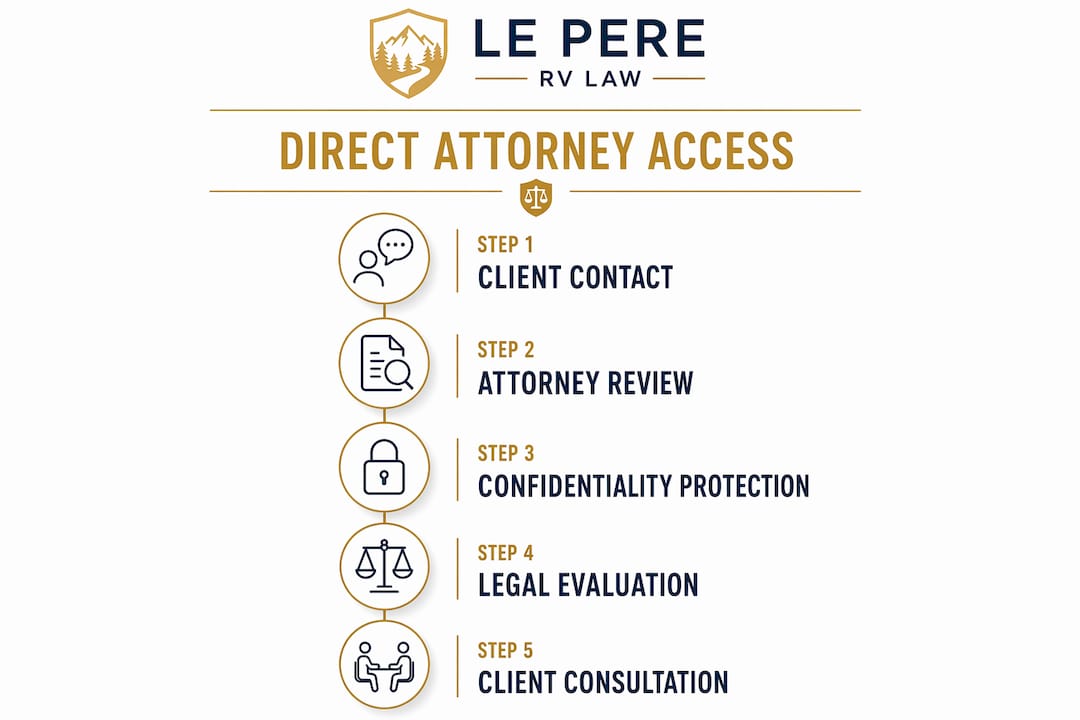
What California ethical rules say about attorney communication duties
California Rule of Professional Conduct 1.4 is the ethical rule that turns direct attorney access from a concept into a legal duty. The rule requires attorneys to keep clients reasonably informed of significant developments and to respond promptly to reasonable requests for information. This is not a courtesy standard. It is a professional obligation with disciplinary consequences.
The practical difference between attorney and staff communication is significant:
- A paralegal can gather facts and relay information.
- Only the attorney can provide legal advice, evaluate litigation risk, and make binding strategic decisions.
- Staff communication that substitutes for attorney judgment does not satisfy Rule 1.4.
- Timely attorney input on material facts, such as a manufacturer’s repair history or a warranty denial letter, directly affects case outcomes.
In a California lemon law case, the attorney must personally evaluate whether your vehicle meets the Song-Beverly threshold, whether the manufacturer had a reasonable number of repair attempts, and whether a civil penalty for willful violation is warranted. That analysis requires attorney judgment, not case manager summaries. When staff filters information before it reaches the attorney, the attorney cannot make informed decisions. The client suffers the consequence.
Common misconceptions vs. legal realities about direct attorney access
The most common misconception is that speaking with a paralegal or case manager is the same as having attorney access. It is not. Here is how the legal reality compares to what many clients experience:
-
Misconception: Staff communication equals attorney representation. Reality: Staff can relay information, but only the attorney can provide legal advice and make strategic decisions. A case manager telling you “things look good” is not legal counsel.
-
Misconception: Direct access requires constant attorney availability. Reality: Direct access means the attorney personally controls key decisions and communicates material developments. It does not mean the attorney answers every routine call.
-
Misconception: You only get attorney access after signing a contract. Reality: Attorney-client obligations can form early, before a formal engagement letter, if substantive legal matters are discussed. Your first consultation may already carry legal weight.
-
Misconception: High-volume lemon law firms provide the same access as smaller practices. Reality: Large advertising-driven firms often route clients through case managers to handle volume. The attorney may never personally review your file until a settlement offer arrives.
-
Misconception: Direct access is guaranteed by hiring any licensed attorney. Reality: Direct access is a service model. The engagement agreement and the firm’s internal practices determine whether you actually get it.
Pro Tip: Ask directly during your first consultation: “Who will make the key legal decisions in my case, and how will I communicate with that person?” The answer tells you more about the firm than any advertisement.
How engagement agreements define and enforce direct access expectations
The engagement letter is the clearest legal tool for making direct attorney access concrete and enforceable. The California Lawyers Association advises that well-drafted engagement letters should clearly define communication expectations and scope of representation. California Rule of Professional Conduct 1.2 governs the scope of representation and requires that scope to be defined in writing for most matters.
The table below shows the difference between a weak and a strong engagement letter on the question of attorney access:
| Engagement letter element | Weak language | Strong language |
|---|---|---|
| Communication protocol | “We will keep you informed of developments.” | “Your attorney will personally contact you within 48 hours of any material development.” |
| Decision authority | Not addressed. | “All legal strategy decisions are made by your assigned attorney.” |
| Staff role | Not defined. | “Paralegals may gather information; only your attorney provides legal advice.” |
| Response time | Not specified. | “Your attorney will respond to substantive inquiries within two business days.” |
| Scope of representation | General reference to “lemon law claim.” | Specific reference to Song-Beverly Act claims, warranty analysis, and civil penalty evaluation. |
Clients should read engagement letters carefully before signing. Engagement letter scope and communication clauses create enforceable rights to direct attorney communication. If the letter is vague on who communicates with you and who controls decisions, ask for clarification in writing before you sign.
Practical tips for ensuring meaningful direct attorney access in your California lemon law claim
Meaningful direct attorney access does not happen automatically. You protect it by asking the right questions and setting clear expectations at the start of your case.
- Ask who makes key legal decisions. Confirm the attorney personally reviews your repair history, warranty documents, and any manufacturer correspondence before any demand is sent.
- Request communication protocols in writing. Your engagement letter should specify response times and identify who contacts you for routine updates versus material developments.
- Preserve your privilege. Keep all case communications within the attorney-client relationship. Do not forward attorney emails to third parties or discuss case strategy on social media.
- Confirm who receives material facts. When your RV or vehicle has a new repair attempt or a manufacturer denial, confirm that information goes directly to your attorney, not just a case intake system.
- Recognize warning signs. If weeks pass without attorney contact during active case phases, or if you have never spoken directly with the attorney assigned to your case, that is a problem worth addressing immediately.
For RV owners specifically, the complexity of California RV lemon law claims involving motorhomes, fifth wheels, and travel trailers makes direct attorney involvement even more critical. Multiple warranties covering different components require attorney-level analysis, not staff triage.
Key takeaways
Direct attorney access in California lemon law cases is legally grounded in attorney-client privilege under Evidence Code sections 952 and 954, and in the communication duties of Rule 1.4, making it an enforceable right, not a courtesy.
| Point | Details |
|---|---|
| Legal definition of direct access | Direct access means the attorney personally controls decisions and receives privileged communications, not just staff. |
| Privilege protects access | California Evidence Code sections 952 and 954 protect confidential attorney-client communications, including those through authorized assistants. |
| Rule 1.4 creates a duty | Attorneys must keep clients reasonably informed and respond promptly; this is a professional obligation, not optional service. |
| Engagement letters enforce access | Clear contract language specifying communication protocols and attorney decision authority creates enforceable rights. |
| Early duties can attach | Attorney-client obligations may form before a formal engagement letter if substantive legal matters are discussed in consultation. |
Why direct access is the one thing I never compromise on
I spent 11 years defending manufacturers and dealerships in lemon law cases. I know exactly how the other side builds its defense. One pattern I saw repeatedly was this: consumer attorneys who ran high-volume operations would let cases drift for months because no attorney was actually watching the file. By the time a real attorney reviewed the matter, deadlines had passed or the client had made statements that hurt the case.
The real test of direct attorney access is not whether you can reach someone at the firm. It is whether the attorney personally controls the legal decisions, drafts the substantive demands, and frames the settlement posture. Staff cannot do that. A case manager cannot do that. Only the attorney can.
I have seen clients come to me after spending months with a firm where they never once spoke to their attorney. Their cases were not lost yet, but they were damaged. Key facts had not been preserved. Repair records had not been properly documented. The manufacturer’s defense team had already framed the narrative.
When you have a defective RV or vehicle in California, the clock starts running the moment your warranty expires. AB 1755 gives you one year from that date to file. That is not a long window. You need an attorney who is personally engaged with your case from the first call, not someone who reviews a summary prepared by staff six months in.
— Jeff Le Pere
The Law Offices of Jeffrey Le Pere: direct attorney access for California lemon law clients

The Law Offices of Jeffrey Le Pere is built around one principle: you speak with your attorney, not a case manager. Jeff Le Pere personally handles California lemon law and RV defect claims for owners of motorhomes, fifth wheels, travel trailers, cars, trucks, and SUVs. Every case runs on contingency, meaning you pay nothing out of pocket because the manufacturer covers attorney fees when you win. Recovery options include a full repurchase, a replacement vehicle, or a cash settlement, plus a civil penalty of up to two times actual damages for willful warranty violations. If your vehicle or RV has a defect that the manufacturer has failed to fix, request a free case review with Jeff directly to understand your rights under California’s Song-Beverly Consumer Warranty Act.
FAQ
What is direct attorney access in a legal context?
Direct attorney access means a client communicates confidentially with the attorney who personally makes legal decisions in their case. In California, this right is grounded in attorney-client privilege under Evidence Code sections 952 and 954, and in the communication duties of Rule of Professional Conduct 1.4.
Does California have a specific law on direct attorney access?
California does not have a standalone statute called “direct attorney access.” The concept is defined and enforced through attorney-client privilege rules and the California Rules of Professional Conduct, particularly Rules 1.2 and 1.4.
Can attorney-client privilege attach before I sign an engagement letter?
Yes. California courts recognize that attorney-client duties can arise before a formal engagement letter if substantive legal matters are discussed during a consultation.
How does direct attorney access affect my California lemon law case?
Direct attorney access ensures the attorney personally evaluates your repair history, warranty terms, and manufacturer conduct before any demand is sent. Delays caused by staff filtering information risk missing critical deadlines, including the AB 1755 one-year filing window after warranty expiration.
How do I confirm I have real direct attorney access with my firm?
Ask your attorney to specify in the engagement letter who makes legal decisions, who communicates material developments, and what the response time standard is. Clear written protocols are the strongest indicator that direct access is enforceable and not just a marketing claim.