What CLRA Covers for California Vehicle Owners

The California Consumers Legal Remedies Act (CLRA) prohibits unfair and deceptive acts in the sale or lease of vehicles and authorizes actual damages, restitution, injunctive relief, civil penalties, and attorney fees under Cal. Civ. Code §1780. Section 1770 lists the specific prohibited acts, §1780 sets out what you can recover, and §1782 requires written notice at least 30 days before you can sue for damages. For vehicle owners, typical recoveries include a full repurchase, a replacement vehicle, a cash settlement, and civil penalties when a seller’s conduct was willful.
Table of Contents
- What deceptive acts does the CLRA prohibit in vehicle sales?
- Who qualifies as a consumer under the CLRA?
- What remedies can you recover under the CLRA?
- How do you satisfy the mandatory 30-day notice under §1782?
- What deadlines govern CLRA claims, and how does the discovery rule help?
- What evidence should you gather for a vehicle or RV CLRA claim?
- How does a CLRA case move from demand to resolution?
- When should you contact a CLRA attorney for your vehicle or RV?
- Key Takeaways
- Why specialized experience changes the outcome in CLRA vehicle claims
- A free case review for California vehicle and RV owners
What deceptive acts does the CLRA prohibit in vehicle sales?
The CLRA targets conduct that distorts a buyer’s decision, whether the seller said something false or stayed silent about something material. Section 1770 covers both categories, and courts treat them differently at trial.
Common prohibited acts in vehicle and RV transactions include:
- Misrepresenting a vehicle’s condition, history, or characteristics
- False advertising of features, warranties, or certified status
- Bait-and-switch tactics: advertising one vehicle, delivering another
- Failing to disclose known recurring defects or safety issues
- Selling a vehicle as “certified” when it does not meet certification standards
- Misrepresenting odometer readings or prior accident history
- Concealing a salvage or rebuilt title
Three concrete examples illustrate how these play out. A dealer who rolls back an odometer or fails to disclose a prior flood title violates §1770 through affirmative misrepresentation. A dealer who promises in writing to repair a slide-out mechanism on an RV and never performs that repair has made a false representation about services. A dealer who markets a used truck as “certified pre-owned” without completing the required inspection process has violated California law on dealer fraud.
The distinction between active misrepresentations and omissions matters in litigation. An active misrepresentation is easier to prove because there is a document, recording, or witness. An omission claim requires showing the seller knew the fact, that the fact was material, and that a reasonable buyer would have wanted to know it. Courts apply a higher burden to omission claims, so documentation of what the dealer knew and when becomes critical.
| Type | What it means | Vehicle example |
|---|---|---|
| Active misrepresentation | Seller stated a false fact | “This RV has never been in an accident” (it had) |
| Omission | Seller concealed a material fact | Dealer knew of recurring transmission failure, said nothing |
Who qualifies as a consumer under the CLRA?
The CLRA applies to individuals who acquire goods or services primarily for personal, family, or household use in a qualifying transaction. The statutory definitions in §§1761(d) and 1761(e) define both “consumer” and “transaction” and set the outer limits of who can sue.
Covered transactions include new and used vehicle purchases and leases from dealers where the buyer dealt directly with the seller. If you bought a motorhome from a dealership for personal travel, you are a consumer in a qualifying transaction.
Common exclusions narrow the field. Business-to-business purchases do not qualify, because the buyer is not acquiring goods for personal use. Certain downstream claims against manufacturers can also be contested when no direct transaction existed between the plaintiff and the defendant. Real property transactions fall outside the CLRA entirely. Courts have split on the transaction requirement when buyers sue manufacturers rather than dealers, and establishing a dealer-supplier nexus or agency relationship can be essential to maintaining those claims.
What remedies can you recover under the CLRA?
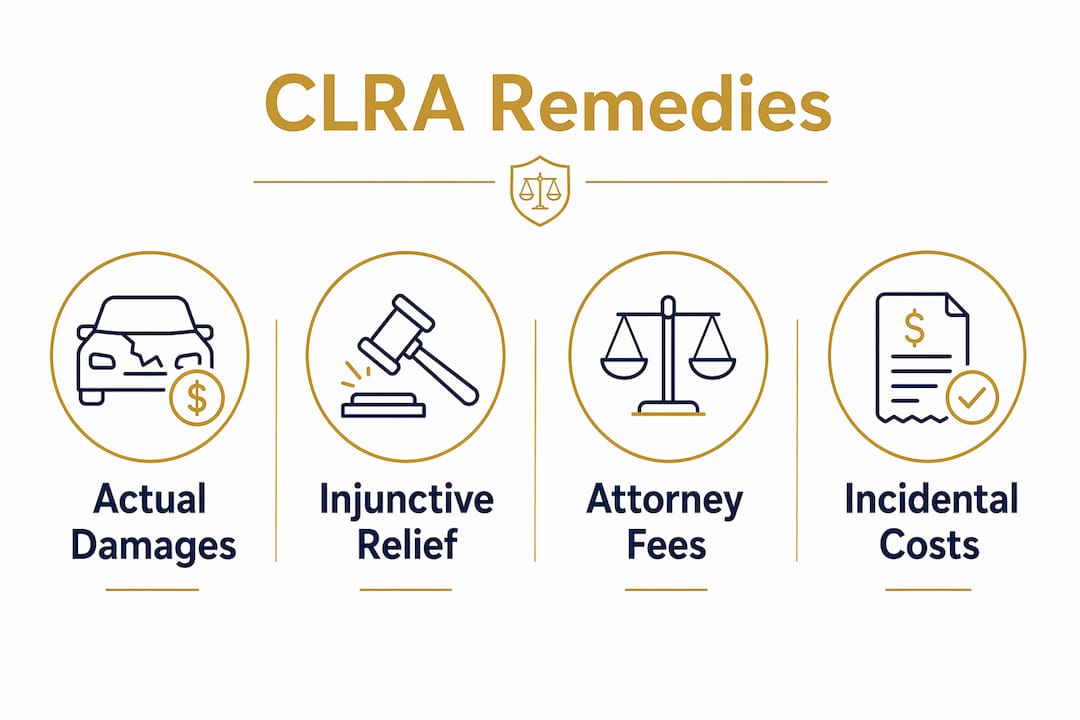
Section 1780 gives prevailing consumers a strong menu of relief. Attorney fees are available to the winning plaintiff, which is what makes CLRA claims financially viable even for consumers with modest losses.
| Remedy | Statutory basis | How it appears in vehicle cases |
|---|---|---|
| Actual damages | §1780(a)(1) | Out-of-pocket losses, repair costs, diminished value |
| Restitution | §1780(a)(3) | Return of purchase price or down payment |
| Injunctive relief | §1780(a)(2) | Court order stopping the deceptive practice |
| Civil penalties | §1780(b) | An additional civil penalty may be awarded for senior or disabled consumers in certain cases |
| Attorney fees | §1780(d) | Paid by the losing defendant |
In practice, vehicle CLRA claims often run alongside California lemon law (Song-Beverly Consumer Warranty Act) claims. The two statutes can complement each other: Song-Beverly governs warranty repair obligations and the repurchase remedy, while the CLRA addresses deceptive conduct in the sale itself. When both apply, remedies can stack, though courts watch for duplication. Incidental damages, such as towing, rental cars, and storage fees, are recoverable under both frameworks.
How do you satisfy the mandatory 30-day notice under §1782?
You must send a written notice specifying the alleged CLRA violations and demanding correction at least 30 days before filing suit for damages. Skipping this step or sending a defective notice can be fatal to a damages claim and may bar attorney fee recovery under §1780.
A proper §1782 notice should include:
- Your full name and contact information
- The date and location of the transaction
- A description of the vehicle (year, make, model, VIN)
- The specific acts you allege violated §1770, cited by subsection
- The dates those acts occurred
- The correction you demand (repair, replace, refund, or rescind)
- A deadline of at least 30 days for the seller to respond
Send the notice by certified mail with return receipt requested, or by overnight courier requiring a signature. Keep the tracking number, the signed return receipt, and a copy of the letter itself. A process server is also acceptable and creates a clean proof-of-service record.
Pro Tip: If the dealer or manufacturer offers a correction within the 30-day window, evaluate it carefully before accepting. Under Benson v. Southern California Auto Sales, a genuine cure offer can defeat a damages claim, but a cure that does not fully address the defect leaves your rights intact. Document every communication during that window.
What deadlines govern CLRA claims, and how does the discovery rule help?
CLRA claims are generally subject to a three-year statute of limitations, but the discovery rule can delay when that clock starts. Under Medina v. St. George Auto Sales (2024), the limitations period begins when the consumer discovered, or reasonably should have discovered, the facts giving rise to the claim.
That distinction matters most in dealer fraud cases. If a dealer concealed a salvage title and you did not discover it until a later inspection, the three-year clock may start from the date of discovery, not the date of purchase. The same logic applies to latent mechanical defects where a dealer repeatedly assured you the vehicle was fine despite recurring warning lights.
| Deadline or threshold | Rule | Notes |
|---|---|---|
| Pre-suit notice | 30 days before filing for damages | §1782; certified mail recommended |
| General statute of limitations | 3 years | Subject to discovery rule |
| Senior/disabled civil penalty | An additional civil penalty may be awarded for senior or disabled consumers in certain cases | |
| AB 1755 lemon law filing deadline | 1 year after warranty expiration | Applies to Song-Beverly claims running alongside CLRA |
To preserve your discovery date, document every repair visit with the shop order number and date, note every dealer statement that minimized your concern, and record when recurring symptoms first appeared. That paper trail is what courts examine when deciding whether the discovery rule applies.
What evidence should you gather for a vehicle or RV CLRA claim?
The strongest CLRA claims are built on dates, documents, and a clear paper trail showing what the seller said, what you paid, and what went wrong. Start collecting evidence the moment you suspect a problem.
Your evidence checklist:
- Signed purchase or lease agreement and all addenda
- Window sticker, Monroney label, or dealer advertisement
- Warranty booklet and any extended service contract
- All repair orders and receipts, in chronological order
- Written communications with the dealer or manufacturer (emails, texts, letters)
- Photos and videos of defects, warning lights, and damage
- Vehicle history report (Carfax or AutoCheck) showing prior accidents or title issues
- OBD-II scan records and any Technical Service Bulletins the dealer acknowledged
- Names and contact information of witnesses to dealer statements
Build a simple incident timeline: date, location, what happened, who you spoke with, what they said, and what remedy was attempted. That format maps directly onto what an attorney needs to draft a §1782 notice and what a court needs to evaluate your claim. For guidance on common dealer fraud tactics that generate this kind of evidence, the firm’s resource page is a useful starting point.
Electronic records matter too. Screenshot text messages, save email threads to PDF, and back up OBD scan data before a dealer visit wipes the codes.

How does a CLRA case move from demand to resolution?
A typical CLRA path runs from written demand through a 30-day response window, then to filing if the seller does not cure, followed by discovery, possible mediation, and settlement or trial.
The procedural flow, supported by dealer compliance and dispute-resolution services, includes:
- Send the §1782 notice and begin the 30-day clock.
- Evaluate any cure offer the seller makes within that window.
- If no adequate cure is offered, file the complaint in superior court.
- Conduct discovery: depositions, document requests, expert vehicle inspections.
- Engage in motion practice if the defendant challenges standing or the transaction requirement.
- Attend mediation, which resolves the majority of consumer vehicle cases before trial.
- Proceed to trial if mediation fails.
Possible outcomes include a full repurchase, a replacement vehicle, repair with reimbursement of incidental costs, civil penalties, injunctive relief, and attorney fee recovery. Under Benson v. Southern California Auto Sales, a defendant who makes a genuine correction offer within 30 days can defeat the damages claim, which is why the quality of the initial notice and the adequacy of any cure offer are both strategically significant.
Attorney fees are paid by the losing defendant under §1780, which is what makes contingency representation practical. You pay nothing out of pocket; the firm recovers its fees from the other side when the case resolves in your favor.
When should you contact a CLRA attorney for your vehicle or RV?
Consult an attorney when you have recurring defects, a substantial repair history, safety concerns, evidence of dealer fraud, or when the seller has refused to cure after receiving a §1782 notice.
Specific decision criteria:
- Two or more repair attempts for the same defect
- Vehicle out of service for an extended period
- Dealer or manufacturer denying warranty coverage without a valid reason
- Evidence the vehicle was misrepresented at sale (title, condition, certification)
- Safety-related defects such as brake failure, steering issues, or fire risk
- RV systems failures involving chassis, slide-outs, electrical, or plumbing components
A qualified attorney will preserve evidence, draft and send the §1782 notice, calculate actual and incidental damages, handle negotiations, and file suit if the seller does not respond adequately. For auto lemon law claims involving cars, trucks, and SUVs, the same framework applies alongside Song-Beverly.
The Law Offices of Jeffrey Le Pere handles every case on contingency. If the case does not resolve in your favor, you owe nothing. The firm takes RV cases that most lemon law firms decline, because motorhomes, fifth wheels, and travel trailers involve multiple warranty systems and a level of complexity that requires specific experience.
Key Takeaways
The CLRA gives California vehicle owners a direct path to damages, restitution, and attorney fees when a dealer or manufacturer uses deceptive practices in a vehicle sale or lease.
| Point | Details |
|---|---|
| What CLRA covers | Unfair or deceptive acts in vehicle sales and leases, including misrepresentation, omissions, and false certification. |
| Mandatory pre-suit notice | Send a written §1782 notice at least 30 days before filing for damages; a defective notice can bar recovery. |
| Available remedies | Actual damages, restitution, injunctive relief, civil penalties, and attorney fees under §1780. |
| Discovery rule | The three-year limitations period can start from when you discovered the defect, not the purchase date. |
| The Law Offices of Jeffrey Le Pere | Handles RV and vehicle CLRA claims on contingency, with long lemon law experience including 11 years defending manufacturers. |
Why specialized experience changes the outcome in CLRA vehicle claims
Most CLRA articles treat vehicle cases as a footnote to the broader consumer protection statute. That framing misses what actually drives outcomes in RV and dealer fraud claims: the complexity of the proof.
RV cases are a good example of where generic legal experience falls short. A motorhome involves a chassis warranty, a coach warranty, appliance warranties, and sometimes a separate powertrain warranty, each from a different manufacturer. When a slide-out fails or a roof delamination appears, the question of which warranty applies and which party is liable is not obvious. Dealers exploit that ambiguity. They bounce owners between manufacturers, run out the clock on repair attempts, and count on the owner giving up before the claim matures into a viable lawsuit.
The 11 years I spent defending manufacturers taught me exactly how that strategy works from the inside. I know which arguments manufacturers use to deny claims, how they document repair attempts to minimize liability, and where the weaknesses in their position actually are. That background does not just help me understand the law. It helps me anticipate the defense and build a claim that holds up under pressure.
The §1782 notice is another area where experience matters more than most guides acknowledge. A notice that is technically compliant but strategically weak gives the dealer room to make a cosmetic cure offer and walk away. A notice that is precise about the statutory violations, specific about the demanded remedy, and clearly documented puts the dealer in a position where any response short of a full cure strengthens your case. That is not a drafting technicality. It is the difference between a case that settles well and one that drags on for years.
A free case review for California vehicle and RV owners
If you have a recurring defect in a car, truck, SUV, motorhome, fifth wheel, or travel trailer, or if you suspect a dealer misrepresented the vehicle you bought, The Law Offices of Jeffrey Le Pere offers a free case review with no obligation.
The review covers your eligibility under the CLRA and Song-Beverly, the likely remedies available, whether a §1782 notice is needed, and the relevant deadlines including AB 1755. Every case is handled on contingency: no upfront cost, no hourly fees, and attorney fees are recovered from the other side when the case resolves in your favor.
This article is educational information, not legal advice, and does not guarantee any outcome. For a review of your specific situation, request a free case evaluation or visit the firm’s auto lemon law page if your claim involves a car, truck, or SUV.