Used Car Fraud vs Lemon Law Difference in California

California lemon law covers used vehicles still under the original manufacturer’s express warranty with unfixable defects, while used car fraud applies to deceptive sales practices that can exist even when a vehicle is sold “as is.” These are two separate legal claims with different standards, different remedies, and different deadlines. Knowing the used car fraud vs lemon law difference is the first step toward recovering your money. California consumers have two powerful legal tools available under the Song-Beverly Consumer Warranty Act and common law fraud doctrine, but using the wrong one can cost you time, money, and leverage.
What criteria determine if a used vehicle qualifies for California lemon law?
California lemon law protections apply to used vehicles still covered by the original manufacturer’s express warranty at the time the defect occurs. Certified Pre-Owned vehicles are the most common example, because they typically carry a manufacturer-backed warranty that transfers to the new buyer. A private used car sold without any active manufacturer warranty does not qualify for lemon law relief, no matter how many times it breaks down.
The Tanner Consumer Protection Act sets specific thresholds that create a legal presumption your vehicle is a lemon. A vehicle is presumed to qualify if repair thresholds are met within 18 months or 18,000 miles: four repair attempts for a general defect, two attempts for a safety defect, or 30 cumulative days out of service. These numbers matter because they shift the burden onto the manufacturer to prove the vehicle is not defective.
Qualifying defects must substantially impair the vehicle’s use, value, or safety. Minor annoyances do not meet the bar. The defect must be one the manufacturer or its authorized dealer has failed to fix within a reasonable number of attempts. You can review the auto lemon law qualifying defects list to understand what California courts consider substantial.
California’s AB-1755, effective 2024, added pre-suit notice and right-to-cure provisions to the lemon law process. This means you must notify the manufacturer before filing suit, giving them a final opportunity to resolve the claim. Missing this step can delay or complicate your case, so timing matters from the moment you identify a recurring defect.
Pro Tip: Document every repair visit with written repair orders, even when the dealer says the problem is “normal.” Those repair orders are your evidence for meeting the Tanner Act thresholds.
How does used car fraud differ legally from lemon law in California?
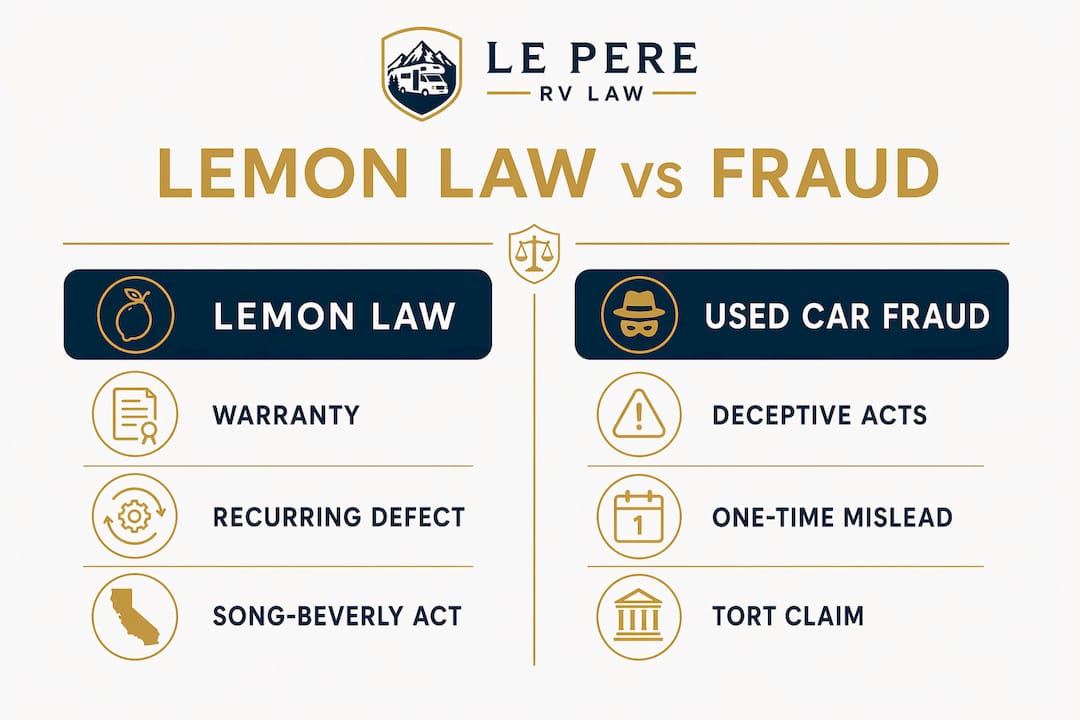
Used car fraud is a tort claim, not a warranty claim. Fraud focuses on deceptive sales practices such as misrepresentations, concealment of known defects, or false statements made during the sale. The legal basis is entirely different from lemon law, which rests on the manufacturer’s failure to honor a warranty obligation.

Common used car fraud examples include a dealer concealing a prior accident, rolling back an odometer, falsely describing a vehicle as “certified” when it does not meet certification standards, or hiding a salvage title. Fraud remedies include rescission and damages that differ from the buyback or replacement remedies available under lemon law. Rescission means the sale is unwound entirely and you get your money back as if the transaction never happened.
The “as is” sticker does not protect a dealer who committed fraud. An “as is” disclaimer does not bar fraud claims where the dealer knowingly concealed or misrepresented the vehicle’s condition. This is one of the most misunderstood points in California consumer protection law. Many buyers walk away from valid fraud claims because they assume the “as is” language ended their rights.
| Feature | Lemon law | Used car fraud |
|---|---|---|
| Legal basis | Warranty breach (Song-Beverly Act) | Tort: misrepresentation or concealment |
| Warranty required? | Yes, active manufacturer warranty | No |
| “As is” sales covered? | No | Yes, if fraud occurred |
| Primary remedy | Buyback, replacement, civil penalty | Rescission, actual damages, punitive damages |
| Who is liable? | Manufacturer | Dealer or seller |
| Defect type required | Substantial, recurring defect | Any knowing misrepresentation |
Pro Tip: If a dealer told you the vehicle had never been in an accident and you later find Carfax or AutoCheck records showing otherwise, that is a fraud claim. Save every written and verbal representation made during the sale.
When should California consumers choose lemon law vs fraud claims?
The presence of an active manufacturer warranty is the clearest decision factor. If your used vehicle is still under the original warranty and you have experienced repeated repair failures, lemon law is almost always the stronger path. Civil penalties of up to two times actual damages apply when a manufacturer willfully ignores its warranty obligation. That penalty doubles your recovery and creates enormous settlement leverage that a fraud claim alone cannot match.
Fraud claims become the stronger option in four specific scenarios:
- The vehicle was sold outside any active manufacturer warranty, leaving lemon law unavailable.
- The dealer made false statements about the vehicle’s history, condition, or title status before the sale.
- The vehicle was sold “as is” but the dealer concealed a known defect or prior accident.
- You need rescission, meaning you want the entire transaction reversed rather than a partial buyback.
Overlap exists where a used vehicle can qualify under both lemon law and fraud simultaneously. A Certified Pre-Owned vehicle with a recurring transmission defect that the dealer also failed to disclose could support both claims. Choosing the wrong path, or pursuing only one when both apply, can reduce your total recovery. An attorney experienced in both claim types is the only reliable way to evaluate which path, or which combination, fits your facts.
Preserve evidence from day one. Keep all sales contracts, window stickers, verbal promises in writing, repair orders, and any communications with the dealer. Under California’s one-year warranty filing guide, AB-1755 now requires lemon law claims to be filed within one year of the warranty’s expiration date. Missing that window eliminates your lemon law option entirely, which may force you into a weaker fraud-only claim.
What remedies can California consumers recover under each claim type?
Lemon law remedies under the Song-Beverly Consumer Warranty Act are specific and well-defined. A successful claim produces one of three outcomes: a full vehicle repurchase, a replacement vehicle of comparable value, or a negotiated cash settlement. The manufacturer also pays your attorney fees, which is why lemon law cases run on contingency with no out-of-pocket cost to you.
The buyback calculation is not simply the purchase price. Mileage offset under California lemon law reduces the buyback value based on miles driven before the first repair attempt, calculated using a statutory formula. The formula divides miles driven before the first repair attempt by 120,000, then multiplies that fraction by the purchase price. Getting this calculation right matters. An incorrect mileage offset calculation can significantly reduce what you recover, so verify the math against the statute before accepting any settlement offer.
Fraud remedies operate differently. Rescission returns you to your pre-sale financial position. Actual damages cover costs you incurred because of the fraud, including repair bills, rental cars, and lost use. Punitive damages are available in egregious cases where the dealer’s conduct was intentional and malicious. California’s consumer protection statutes also allow statutory penalties in certain fraud scenarios, which can add to your total recovery.
Settlement timelines differ between the two claim types. Lemon law cases often resolve faster because the statutory framework gives manufacturers clear incentives to settle rather than face civil penalties. Fraud cases can take longer because they require proving the dealer’s intent, which demands more discovery and evidence gathering.
Key takeaways
The used car fraud vs lemon law difference in California comes down to warranty coverage, the nature of the wrong, and the remedy that best fits your situation.
| Point | Details |
|---|---|
| Warranty determines lemon law eligibility | Lemon law applies only when an active manufacturer warranty covers the defect at the time it occurs. |
| Fraud claims survive “as is” sales | A dealer’s knowing concealment or misrepresentation voids the protection of an “as is” disclaimer. |
| Civil penalties double lemon law recovery | Willful manufacturer noncompliance triggers up to two times actual damages under Song-Beverly. |
| Mileage offset reduces buyback value | California’s statutory formula subtracts pre-repair miles from the total buyback amount. |
| Both claims can apply simultaneously | A vehicle with a warranty defect and a dealer misrepresentation may support lemon law and fraud claims together. |
What 25 years of these cases actually taught me
After spending 11 years defending manufacturers and dealerships, I can tell you exactly how they think when a consumer files a claim. Manufacturers look first at whether the warranty was active, then at whether the repair attempts meet the Tanner Act thresholds. If either element is weak, they push back hard. Dealers facing fraud claims look immediately for the “as is” clause and hope the buyer does not know it does not protect them from intentional concealment.
The biggest mistake I see California consumers make is waiting too long. AB-1755 changed the clock. You now have one year from the warranty’s expiration date to file a lemon law claim. Many people spend months trying to work things out with the dealer or manufacturer directly, and by the time they call an attorney, the window has closed. At that point, a strong lemon law case becomes a weaker fraud-only case, and the civil penalty leverage disappears.
The second mistake is assuming the claims are mutually exclusive. I have handled cases where pursuing both lemon law and fraud simultaneously produced a significantly better result than either claim alone. The key is early documentation and understanding your sales documents. Read every line of your purchase contract. If the dealer told you something verbally that contradicts what is written, write it down immediately and save any texts or emails.
My advice is simple: do not try to diagnose your own claim type. The line between lemon law and fraud is fact-specific and deadline-driven. Get a case evaluation before you decide which path to take.
— Jeff Le Pere
How The Law Offices of Jeffrey Le Pere can help with your claim
California consumers dealing with a defective used vehicle deserve an attorney who has been on both sides of these cases.
The Law Offices of Jeffrey Le Pere represents California consumers in auto lemon law claims covering cars, trucks, and SUVs, as well as auto dealer fraud cases including vehicles illegally sold as certified. Jeff Le Pere spent 11 years defending manufacturers and dealerships before switching sides, which means he knows exactly how the other side builds its defense. Every case runs on contingency. You pay nothing because the manufacturer or dealer covers all fees and costs when you win. If you are unsure whether your situation is a lemon law claim, a dealer fraud case, or both, contact The Law Offices of Jeffrey Le Pere for a free case review and get a direct answer from an attorney, not a case manager.
FAQ
What is the main difference between lemon law and used car fraud?
Lemon law applies when a vehicle has a recurring defect covered by an active manufacturer warranty. Used car fraud applies when a dealer made false statements or concealed defects during the sale, regardless of warranty status.
Can I file a fraud claim if my used car was sold “as is”?
Yes. An “as is” disclaimer does not protect a dealer who knowingly concealed defects or made false representations about the vehicle’s condition before the sale.
Does California lemon law cover used cars?
California lemon law covers used vehicles that are still under the original manufacturer’s express warranty when the defect occurs. Certified Pre-Owned vehicles are the most common qualifying category.
What is the Tanner Consumer Protection Act threshold?
Under the Tanner Act, a vehicle is presumed a lemon if it has had four repair attempts for a general defect, two attempts for a safety defect, or 30 days out of service, all within 18 months or 18,000 miles of purchase.
How does AB-1755 affect my lemon law claim deadline?
California AB-1755 requires consumers to file a lemon law claim within one year of the manufacturer’s warranty expiration date. Missing this deadline eliminates the lemon law option and may leave only a fraud claim available.