RV Owners: 5 Checks Technicians Run First for Generator Problems
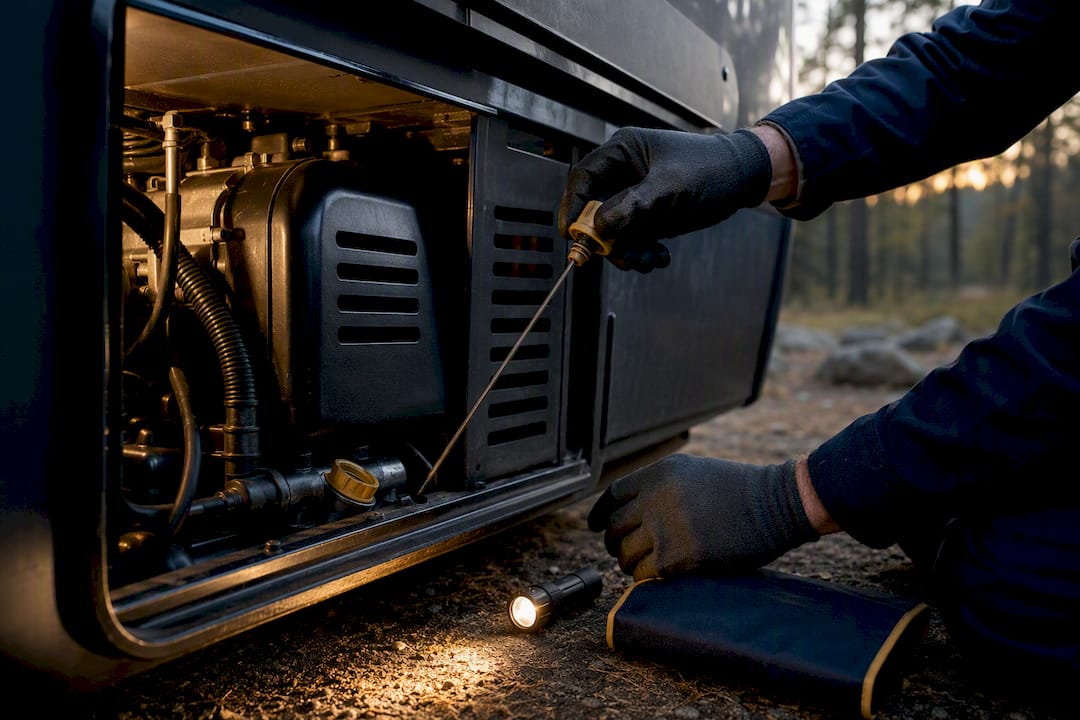
Most RV generator problems trace back to four things: fuel, battery, oil, or a clogged filter. Before you call anyone, check the fuel level, pull the oil dipstick, test the 12V battery connections, and reset the breakers while reading any fault code on the panel. Watch for exhaust smells or a hard-to-place fuel odor while you work. Those can signal a carbon monoxide or fire hazard that needs immediate shutdown, not more troubleshooting.
TL;DR:
- Most RV generator issues are caused by stale fuel, low oil, or weak battery connections, and proper maintenance can prevent these problems.
- When a generator starts but quickly shuts down, it usually results from faulty sensors, fuel delivery issues, or safety shutoffs triggered by control boards.
- Electrical faults such as tripped breakers or faulty transfer switches are the primary cause when the generator runs but appliances have no power.
- Overloading appliances or poor ventilation can lead to temperature-related shutdowns or noise problems, which often require load management or vent clearance.
- Repeated failures despite repairs may indicate a manufacturing defect, especially if safety hazards are involved, and documenting this pattern can support warranty claims.
Table of Contents
- Why Won’t My RV Generator Start?
- It Starts But Dies After a Few Seconds — What’s Going On?
- Generator Runs but Appliances Have No Power
- Surging, Rough Running, or Unstable RPM Under Load
- Shuts Down When You Turn On Heavy Appliances
- Control Panel Fault Codes: What They Actually Mean
- Quick Troubleshooting Checklist: The Order of Checks Every RV Owner Should Run
- Maintenance and Prevention: What Stops Most Generator Problems
- When Repeated Generator Failures May Be a Defect
- How Load and Power Demands Affect Generator Performance
- Noise Issues and Solutions
- Fuel Type Compatibility and Related Problems
- Effects of Altitude and Temperature on Generator Operation
- Safe Operation and Shutdown Procedures
- Technician-First Perspective: What Usually Saves Time and Money
- When Generator Failures Signal a Bigger Warranty Problem
- Manufacturer Manuals and Trusted Repair Guides to Consult Next
- Sources
- FAQ
Why Won’t My RV Generator Start?
Most no-start problems come down to fuel, power, or oil, checked in that order. Work through these five steps before you assume the starter or the engine itself has failed.
- Check the fuel supply first. Generators often draw fuel from a pickup point higher in the tank than the coach engine, so your motorhome gauge can show a quarter tank while the generator sees nothing. Most manufacturers require a minimum tank level, often around a quarter full, before the generator will draw fuel at all. If the RV has sat for months, stale gasoline can gum up the carburetor bowl and block flow entirely.
- Test the battery voltage. A generator starter needs a strong charge to crank the flywheel, and a weak or corroded connection can mimic a dead starter. Battery systems typically need at least 12.4 to 12.6 volts to start reliably. Check both the chassis and house battery, since some models split starting power between them, and clean the terminals if you see white or green corrosion.
- Listen for the solenoid. A single loud click with no crank usually points to a bad starter or a seized engine. No click at all often means the problem is upstream, in the battery or wiring, not the starter itself.
- Pull the oil dipstick. Nearly every RV generator has a low oil shutdown that will refuse to start or crank rather than run dry. If oil is low or looks like sludge, top it off or change it before trying again.
- Check the air filter. A filter packed with dust or debris can starve the engine of air on start up, especially on older units without electronic fuel injection.
If the battery tests strong, the fuel is fresh, oil is full, and the generator still will not crank or fires briefly and dies, you are likely looking at a starter, solenoid, or internal mechanical fault. These repairs need a certified RV technician with the manufacturer’s service manual in hand, since guessing at internal engine components rarely ends well.
It Starts But Dies After a Few Seconds — What’s Going On?
A generator that fires and then quits within seconds is almost always a control board reacting to a missing safety signal, not a dead engine. Onan and similar control boards are built to shut down automatically if they don’t see the right inputs.
- Fuel delivery gaps. A clogged in-line filter or a weak pump can deliver just enough fuel to start combustion, then starve the engine the moment it needs sustained flow. Tap the fuel line gently while a helper cranks the unit; a hesitant, sputtering catch usually points here.
- Low oil pressure shutdown. Control boards require a valid oil pressure signal to keep running, and if that sensor doesn’t confirm pressure within seconds, the board cuts power even with plenty of oil in the pan. A failing sensor can trigger this just as easily as genuinely low oil.
- No AC output detected. Some models monitor output voltage during startup and shut down if they don’t detect a live circuit, which points toward a stator or AVR issue rather than the engine itself.
- Fault code capture. Before you reset anything, write down or photograph any code on the display. A repeating oil-related code narrows the problem fast; an output or voltage code sends you toward the electrical side instead.
If the generator dies at the same runtime every time, that consistency is a clue. It usually means a sensor or fuel-delivery threshold, not a random fluke. Repeated cranking without a fix risks flooding the engine or draining the battery, so stop after two or three attempts and move to diagnosis instead of brute force.
Generator Runs but Appliances Have No Power
If the engine runs smoothly but your outlets and appliances stay dead, the fault is almost always electrical, not mechanical, so stop chasing fuel and oil issues. Start with the simplest explanations before assuming internal generator damage.
- Check both sets of breakers. Generators have an internal output breaker separate from the RV’s main panel, and either one can trip without an obvious sign.
- Inspect the transfer switch. This component decides whether your coach draws power from shore, battery, or generator, and a stuck or failed switch can leave the generator running with nowhere to send its output.
- Test the output directly. Use a multimeter at the generator’s receptacle. A healthy unit should read close to 120V AC, and you should confirm that reading holds once you plug in a modest load like a lamp, not just at idle.
RV Generator Runs but No Power: Quick Diagnostic Order
- Internal generator breaker
- RV main panel breaker
- Automatic transfer switch
- Multimeter reading under load
Common culprits behind a no-output reading include a failing automatic voltage regulator (AVR), worn brushes on the stator assembly, or an internal breaker that keeps tripping under any load at all. These are wear-and-tear parts, and none of them are something you can diagnose by ear. If your multimeter shows no voltage, or voltage that sags badly under a small load, that is your signal to call an RV electrician or certified technician rather than opening the generator housing yourself.
Surging, Rough Running, or Unstable RPM Under Load
Unstable RPM almost always comes from one of three sources: bad fuel, restricted air, or a governor that can’t hold speed under a changing load. Work through them in this order.
- Rule out stale fuel first. Gasoline that has sat for months breaks down and leaves varnish deposits inside the carburetor, which causes exactly the kind of surging and hunting that feels like the engine can’t decide what speed to run. A carb that’s lightly varnished can sometimes be cleaned with a carburetor cleaner spray; heavy varnish usually means a full rebuild.
- Check for air restriction. A dirty air filter, a cracked vacuum line, or a leaf-clogged intake screen all starve the engine of the steady air supply it needs to hold a stable RPM.
- Watch the load response. If the surging only appears once you turn on the air conditioner or another large appliance, the governor itself may not be regulating fuel delivery fast enough to match the new demand, which is a mechanical adjustment issue rather than a fuel problem.
- Log what you see. Note the RPM behavior, which appliance was running when it started, and any fault code on the display. A short video clip of the surge is often more useful to a technician than a verbal description.
Surging that only shows up under specific loads, rather than at idle, points toward the governor. Surging at idle and under load alike points toward fuel or air.
Shuts Down When You Turn On Heavy Appliances
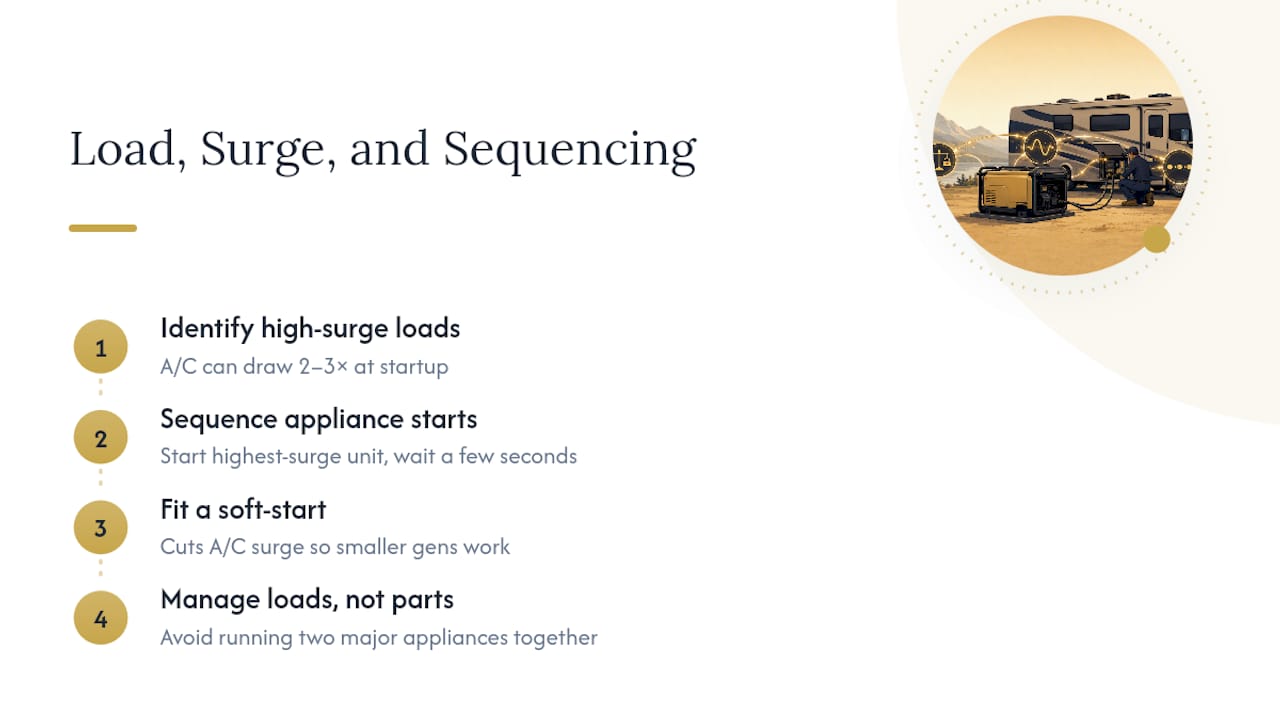
A generator that dies the moment you run the air conditioner or microwave is usually being asked for more power than it has, not failing outright. Add up the startup surge of everything you’re running, since air conditioners and other motor-driven appliances can pull two to three times their running wattage for the first second or two, and compare that total against your generator’s rated output on its data plate.
- Confirm overload isn’t the answer. If the math is close, stagger your appliances instead of switching them on together, starting the AC first and waiting before adding the microwave or coffee maker.
- Check for overheating. Generators need clear airflow around the compartment vents and exhaust; anything blocking that clearance, gear, tote bags, a closed compartment door, can trigger a heat-based shutdown under sustained load.
- Rule out fuel starvation. A weak fuel pump or a low tank can supply enough fuel for light use but fail the moment the engine demands more under a heavy load.
Pro Tip: Keep the generator compartment clear of stored items even when you’re not running it to avoid damage and ensure effective protection, as recommended by Motorhome Ceramic Protection guidelines. A blocked vent is one of the easiest problems to fix and one of the most common reasons for a heat shutdown under load.
Control Panel Fault Codes: What They Actually Mean
Fault codes exist to point you toward one of three categories: oil, electrical output, or the control board itself, and reading them correctly saves a wasted service call. Most panels display a numeric or letter code rather than plain text, so check the manufacturer’s fault code table before you reset anything.
- Low oil codes almost always mean exactly what they say, low oil level or a failed pressure sensor, and are usually the cheapest fix on this list.
- Overtemp codes point to airflow blockage, a failing cooling fan, or, less often, a genuine internal mechanical problem.
- Over or under voltage codes point toward the AVR, stator, or wiring, not the engine.
- ECU or control board fault codes are the most serious of the group and usually mean a technician needs to test the board directly rather than a part you can swap yourself.
Write the code down before you press reset. Codes tied to sensors, like oil pressure or temperature, are often worth a second startup attempt after a quick check. Codes tied to the control board or output rarely clear on their own and tend to reappear on the next run.
Quick Troubleshooting Checklist: The Order of Checks Every RV Owner Should Run
Run these checks in order, every time, before you decide the generator needs a shop visit.
- Step outside and check for exhaust smell or visible venting near the generator compartment before doing anything else.
- Confirm fuel level and check for a fuel odor near the tank or lines.
- Pull the dipstick and check oil level and color.
- Test battery voltage and inspect terminal connections for corrosion.
- Check both the generator’s internal breaker and the RV’s main panel breaker.
- Inspect or replace the air and fuel filters if either looks dirty.
- Use a multimeter to confirm AC output once the engine is running.
- Record every fault code, along with the date, runtime, and symptoms, before resetting the panel.
| Check | Tool Needed | Target Result |
|---|---|---|
| Battery voltage | Multimeter | 12.4V to 12.6V or higher |
| AC output | Multimeter at receptacle | Around 120V AC under load |
| Oil level | Dipstick | Full, not overfull |
| Fault code | Panel display | Recorded before reset |
Photograph the fault code display and the dipstick reading every time. That habit becomes valuable fast if the same failure repeats and you eventually need service records for a warranty claim.
Maintenance and Prevention: What Stops Most Generator Problems
Most RV generator failures are preventable with three habits: regular oil changes, monthly exercise runs, and using the right filters. Owners who skip these end up chasing the same problems repeatedly.
Maintenance Numbers to Know Standard service intervals call for an oil and filter change roughly every 100 hours of run time, and spark plug replacement every 400 to 500 hours. Hot climates, dusty roads, or consistently heavy loads can shorten both intervals.
- Run it monthly under an actual load. Exercising the generator with an air conditioner or another appliance running, not just idling, helps prevent fuel varnish and keeps the battery charged.
- Use fuel stabilizer for storage. Any time the RV sits for more than a month, stabilized fuel prevents the gumming that causes most no-start calls in spring.
- Stick to manufacturer-specified filters. Some Cummins-specified oil filters use bypass valves sized for the generator’s specific oil pressure, and a generic filter can restrict flow enough to cause oil starvation over time.
- Keep a simple parts kit on hand. Spare spark plugs, an extra oil filter, and a quart of the correct oil weight cover most roadside fixes.
Repair shops that service RVs regularly say most of the generators they see fail from skipped maintenance, not manufacturing defects, which means a disciplined service log is the cheapest insurance you can buy for this component.
When Repeated Generator Failures May Be a Defect
Repeated, unresolved generator failures despite multiple repair attempts can signal a manufacturing defect rather than a maintenance problem. If your RV has been to the shop for the same generator issue more than twice, or spent 30 days or more in the shop across those visits, start building a paper trail.
- Collect every repair order, with dates, mileage or engine hours, the shop’s name, and the specific fault code or complaint written on the invoice.
- Photograph the fault codes each time they appear, along with the odometer or hour meter reading.
- Note any safety hazard directly, including exhaust smell, visible fuel leaks, or smoke, since these carry more weight than a simple performance complaint.
- Keep every text, email, or call log with the dealer or manufacturer’s service department.
A technician can often tell you whether a failure pattern looks like normal wear or a recurring design issue. If it’s the latter, that documentation is exactly what a motorhome warranty claim or legal review will ask for first.
How Load and Power Demands Affect Generator Performance
Every generator has a continuous power rating and a separate, higher surge rating for the first second or two of a motor starting up. Confusing the two is the single most common reason owners think their generator is failing when it’s actually just overloaded.
Air conditioners are the biggest offender. A rooftop AC unit that draws 13 to 15 running amps can briefly demand two to three times that amount the instant its compressor kicks on. Run that same AC alongside a microwave and a coffee maker, and you’ve likely exceeded what a mid-size onboard generator can deliver, even though the math on paper looked fine for running loads alone.
The fix isn’t a bigger generator in most cases. It’s sequencing. Start the highest-surge appliance first, let it stabilize for a few seconds, then add the next item. Many RVs also benefit from a soft-start device on the air conditioner, which reduces that surge draw significantly and lets a smaller generator carry a load it couldn’t handle on a hard start.
Chronic overloading has a cost beyond nuisance shutdowns. Running a generator consistently near or above its rated capacity accelerates wear on the stator windings, the AVR, and the engine itself, which shortens the interval before you’re facing one of the electrical failures covered earlier in this guide. If your generator trips every time you run two major appliances together, treat that as a load management problem to solve with habits, not a defect to chase with a new part.
Noise Issues and Solutions
A generator that’s suddenly louder than usual, or makes a new rattling or knocking sound, is telling you something specific about what’s wearing out. Most RV generators run in the 58 to 72 decibel range depending on load, and any sound outside a smooth, steady drone is worth investigating before it becomes a bigger repair.
A rattling metallic noise often points to a loose heat shield, exhaust bracket, or muffler baffle that has come loose from vibration over thousands of miles of towing or driving. These are usually a quick fix: tighten the mounting hardware or replace a worn bracket.
A deep knocking sound under load is more serious and can indicate connecting rod or bearing wear inside the engine, which is not something to run through repeatedly while you decide what to do. Shut it down and have a technician inspect it.
A high-pitched whine that changes with RPM often comes from a cooling fan or alternator bearing starting to fail, rather than anything in the fuel or electrical system covered elsewhere in this guide.
For everyday noise reduction rather than a fault, a generator sound enclosure or additional foam insulation in the compartment can meaningfully cut noise without affecting airflow, as long as you don’t block the ventilation the engine needs to avoid overheating.
Fuel Type Compatibility and Related Problems
Gasoline, propane, and diesel generators each fail in different ways, and knowing which fuel your unit runs on changes what you should suspect first. Most towable RVs run gasoline generators, while diesel motorhomes commonly run diesel generators that share a fuel source with the coach engine, and some smaller units run on propane drawn from the RV’s LP tank.
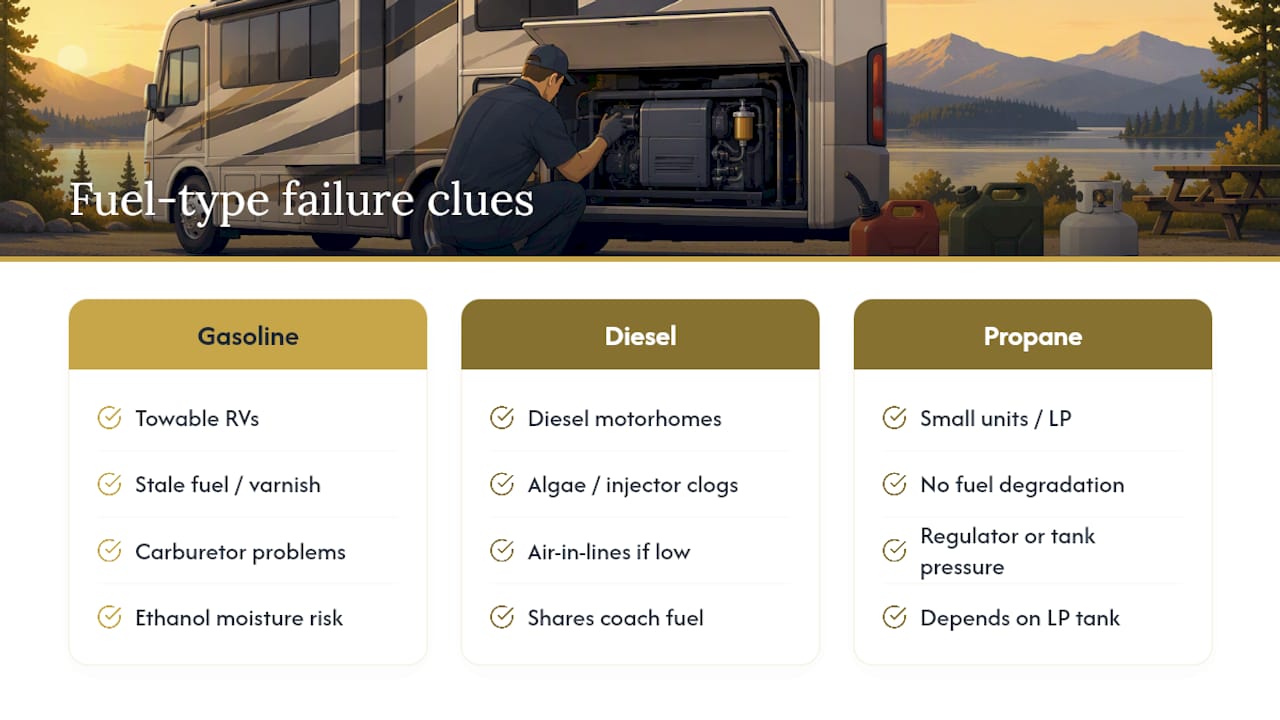
Gasoline generators are the most prone to stale fuel problems because gasoline breaks down chemically within a few months, especially with ethanol blends that attract moisture. This is the fuel type behind most of the varnish and carburetor issues covered earlier.
Diesel generators avoid the varnish problem but introduce their own risk: algae growth in fuel that sits too long, and injector clogging from low-quality fuel. Diesel systems are also more sensitive to running a tank low, since drawing air into the fuel lines requires a full manual priming process to fix, unlike gasoline systems that often self-prime.
Propane generators sidestep the stale fuel problem entirely, since propane doesn’t degrade in storage, but they depend entirely on adequate LP tank pressure and a clear regulator. A propane generator that struggles to reach full output is often a regulator or tank-level issue rather than an engine problem.
Whatever fuel your generator uses, never assume compatibility across types. Running the wrong fuel, or contaminated fuel, through a system built for another type causes damage that basic troubleshooting won’t fix.
Effects of Altitude and Temperature on Generator Operation
Altitude and heat both change how much power your generator can safely deliver, and ignoring that math is a common reason owners think their unit is failing. Most generators lose roughly 3 to 4 percent of their rated output for every 1,000 feet above sea level, since the engine has less oxygen available for combustion. A generator rated for a lower elevation can genuinely struggle to run a full air conditioner load once you’re camped at 7,000 or 8,000 feet.
Heat works against you differently. High ambient temperatures reduce the cooling efficiency of the engine and increase the risk of an overtemp shutdown, especially if the generator compartment already has restricted airflow. Desert camping in summer is the classic scenario where a generator that ran fine all spring suddenly starts tripping on heat-related faults.
Cold weather introduces its own issues, mainly around fuel and battery performance. Gasoline vaporizes less readily below freezing, which can make cold starts harder, and battery capacity itself drops in cold temperatures, which is exactly when you need full cranking power.
None of this means your generator is broken. It means the environment is asking more of it than its rated numbers assume. If you’re consistently camping at altitude or in extreme heat, build in a wider safety margin between your load and the generator’s rated output rather than running it at the edge of its capacity.
Safe Operation and Shutdown Procedures
Running an RV generator safely comes down to ventilation, load management, and a proper shutdown sequence every single time. Never run a generator inside an enclosed space, and always maintain clear airflow around the exhaust and intake vents, since carbon monoxide from a generator’s exhaust is odorless and can be fatal in an enclosed or poorly ventilated area.
Before starting, confirm the fuel level meets the manufacturer’s minimum, check the oil, and make sure nothing is blocking the compartment vents. Start the generator with all major appliances off, then bring loads on one at a time, largest surge first, to avoid tripping the breaker or the overload protection.
While it’s running, periodically glance at the panel for any fault indicator, and trust your nose. Any hint of fuel or exhaust odor inside the RV means shut it down immediately and investigate before restarting.
Shutting down correctly matters as much as starting up. Turn off major appliances first to remove the load, let the generator run for a minute unloaded to stabilize internal temperatures, then power it down from the panel rather than cutting fuel or battery power abruptly. This cool down step protects the internal components from thermal stress that builds up from an abrupt shutdown under load, and it’s a habit that costs you sixty seconds but adds real life to the unit.
Technician-First Perspective: What Usually Saves Time and Money
Most owners jump straight to replacing parts when the real fix is a basic check they skipped. Start with fuel, oil, and battery every time, and document what you find before you touch anything, because a fault code written down today is worth more than a memory next month.
Monthly exercise runs under a real load catch small problems before they become expensive ones, and a shop can usually confirm a diagnosis in minutes once they have your notes and codes in hand. If a safety issue like an exhaust smell or fuel leak shows up more than once, stop troubleshooting and escalate immediately.
— Jeff Le Pere
When Generator Failures Signal a Bigger Warranty Problem
If your RV’s generator has failed the same way more than once despite repair attempts, that pattern deserves a second look beyond the service bay. California’s Song-Beverly Consumer Warranty Act gives owners real leverage when a manufacturer can’t fix a substantial defect within a reasonable number of attempts, and a recurring generator failure, especially one tied to a safety hazard like exhaust leaks or fuel odor, often qualifies.
A distinguishing feature of this law office is the attorney’s 11 years of experience defending manufacturers and dealerships in these exact disputes. This provides inside knowledge of manufacturer practices and arguments that sets it apart from high-volume lemon law firms where case managers, not attorneys, handle files.
If your generator has been back to the shop repeatedly, or you’re facing the tightened filing window under California’s AB 1755, which now requires most lemon law claims to be filed within one year of the warranty’s expiration, don’t wait to find out where you stand. Gather your repair invoices, fault code photos, and any written communication with the dealer, then request a free case review to find out whether your RV qualifies for a repurchase, replacement, or cash settlement, plus a civil penalty of up to two times your actual damages if the manufacturer acted willfully. Motorhome owners can start directly on the motorhome lemon law page, and fifth wheel owners have a dedicated resource as well.
Manufacturer Manuals and Trusted Repair Guides to Consult Next
For fault codes specific to your unit, go straight to the source. The Onan RV generator service manual lists exact fault code tables and safety warnings that generic troubleshooting guides can’t match.
For step-by-step diagnostic walkthroughs written for RV owners rather than certified technicians, the Camping World generator troubleshooting guide and the NRVTA breakdown of common generator problems both cover real-world symptoms in plain language. Keep both bookmarked before your next trip.
Sources
- RV Generator Repairs: Complete Guide for New RVers 2025
- Onan RV generator service manual (Cummins)
- RV generator won’t start — Camping World blog
FAQ
What Is the Average Life Expectancy of an RV Generator?
Most RV generators last over 1,000 hours of run time before needing a major overhaul, though longevity depends heavily on maintenance habits. A unit that gets regular oil changes every 100 hours and monthly exercise runs under load tends to perform better over time.
What Is the Most Common Problem With RV Generators?
Stale fuel is the single most common cause of RV generator problems, followed closely by low oil and weak battery connections. Most owner-reported failures trace back to these three issues plus dirty filters, all of which are preventable with routine maintenance.
How Much Does It Cost to Replace an RV Generator?
Replacement generator costs vary widely by size, fuel type, and installation complexity, and current pricing depends on your specific unit and RV class. If a defective generator is part of a broader pattern of unresolved RV problems, a free case review can clarify whether a manufacturer, rather than you, should be covering that cost.
Why Won’t My RV Generator Start After It’s Been Sitting for a While?
Extended storage almost always means stale fuel, a discharged battery, or both. Gasoline degrades within a few months and can gum up the carburetor, while batteries lose charge naturally when unused, so draining old fuel and testing battery voltage before cranking is the right first move.
How Do I Know If My Generator Problem Is a Manufacturing Defect?
A pattern of the same failure recurring despite multiple repair attempts, or a generator issue tied to a safety hazard like exhaust leaks, is worth documenting closely. If your RV has been in the shop repeatedly for the same generator complaint, review your repair records with a firm that handles California motorhome lemon law claims to see whether the pattern supports a warranty claim.