Documenting RV Cumulative Repair Days for a Lemon Law Claim
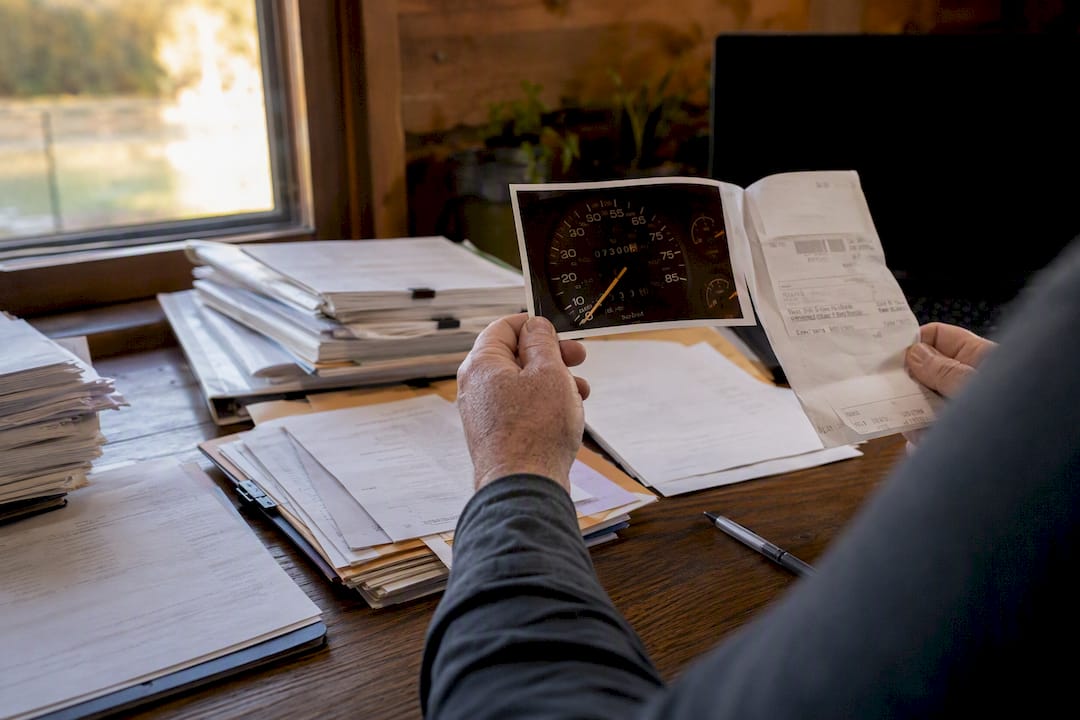
Proving your RV’s cumulative repair days means assembling dated repair orders and building a single master timeline that shows how many total days your motorhome, fifth wheel, or travel trailer sat out of service for the same defects. That timeline is what an attorney checks against California’s repair thresholds before filing anything.
Start with these two moves, in this order:
- Pull every repair order, work order, and service invoice you have and confirm each one shows an “in” date and an “out” date.
- Build a master timeline spreadsheet that lists every visit chronologically, with the facility name, repair-order number, and days out for each entry.
Two statutes matter here. The Song-Beverly Consumer Warranty Act governs California lemon law claims, and a common industry benchmark is a 30-day cumulative out-of-service threshold for repairs to the same nonconformity. AB 1755 shortened the filing window, so you generally have one year from the warranty’s expiration to file. Keep every original document and request a free case review from The Law Offices of Jeffrey L. Le Pere before you make any decisions about timing.
Key Takeaways
Proving cumulative repair days requires dated repair orders organized into one master timeline that separates chassis and coach repairs before an attorney checks the total against the statutory threshold.
| Point | Details |
|---|---|
| Collect every repair order | Get dated in and out records from each visit, plus parts, towing, and storage receipts. |
| Build one master timeline | Log date in, date out, days out, facility, chassis versus coach, and a repair order number per row. |
| Count days correctly | Use inclusive counting and never double count overlapping visits or split subsystems. |
| Watch the deadlines | Song-Beverly sets the repair standard and AB 1755 generally gives one year from warranty expiration to file. |
| Get a free review | The Law Offices of Jeffrey Le Pere reviews your timeline and repair orders on a contingency fee basis before you file. |
Table of Contents
- What Documents Prove RV Cumulative Repair Days?
- How Do You Build a Master Timeline for RV Repair Days?
- How Do You Obtain Official Repair Records From Dealers?
- How Many Cumulative Repair Days Trigger a Lemon Law Claim?
- Why Does an RV Lemon Law Attorney’s Background Matter?
- What Should You Do Right After Assembling Your Documentation?
- How the RV Auto Legal Team Reviews Your Case
- Where to Find Related Records and Legal Resources
- Frequently Asked Questions
- Sources
What Documents Prove RV Cumulative Repair Days?
Repair orders with dated “in” and “out” fields are the backbone of any RV cumulative repair days documentation file. Everything else you collect exists to confirm or fill gaps in what those orders show.
Start with the paperwork the shop generates on its own. Every repair order, work order, and service invoice should list the date you dropped the RV off, the date you picked it up, the shop’s name and contact information, and a description of the defect. If a repair order is missing a date, get it corrected before you leave the lot. Dealer intake forms, appointment confirmations, and pickup receipts back up those same dates from a different angle, which matters if a manufacturer later disputes when a repair actually started or ended.
Parts delays deserve their own folder. Parts order confirmations, backorder notices, and any email showing a multiweek wait for a component are often the single biggest driver of cumulative days. Limited chassis repair centers and long parts lead times are common bottlenecks that push RV cases past the 30-day cumulative threshold, so those records carry real weight.
If your RV had to be towed or stored while awaiting repair, keep those receipts. They establish that the vehicle was immobile or involuntarily parked at a facility, not simply available and unused. Timestamped photos showing the RV at the repair site, with the VIN, license plate, or shop signage visible, add another layer of proof. Save every text and email exchange with the shop, too. Status updates, even casual ones, corroborate the paper trail when a formal document is thin.
Pro Tip: Photograph the odometer and the shop’s posted hours or signage together in one frame every time you drop off or pick up your RV. It creates a timestamped, location specific record that is hard for a defense attorney to argue against.
How Do You Build a Master Timeline for RV Repair Days?
A master timeline turns a pile of receipts into a document an attorney or adjudicator can read in five minutes and trust. Build it as a spreadsheet with one row per repair visit, not one row per defect, since a single visit often addresses several problems at once.
Include these columns at minimum:
- Date in and date out
- Days out for that visit
- Repair facility name and location
- Chassis or coach designation
- Defect description
- Repair order number
- Location or file name of the supporting document
Count days inclusively, meaning the drop off day and the pickup day both count toward the total for that visit. If two repair visits overlap, or if the RV went back in the same day it was picked up for an unrelated issue, do not count those days twice. Treat overlapping date ranges as a single continuous out of service period.
Separate chassis repairs (engine, transmission, brakes) from coach repairs (slide outs, appliances, electrical systems) in their own column, then total each category before adding them into one combined cumulative figure. The 30-day repair shop claim guide recommends this separation specifically because manufacturers sometimes argue that chassis and coach problems should be evaluated as unrelated claims rather than aggregated together.
| Column | Purpose |
|---|---|
| Date in / date out | Establishes the exact span of each repair visit |
| Days out | Running total per visit, added inclusively |
| Chassis vs coach | Prevents subsystem-splitting disputes later |
| Repair order number | Ties each row to one verifiable document |
Before you finalize anything, check that every row has a matching document and a unique repair order number. Rows without a document are weak points a defense attorney will find. Once the timeline is complete, export it to PDF along with copies of the underlying repair orders so it arrives as one clean packet for legal review.
Pro Tip: Sort your timeline by repair order number, not just date, before sending it anywhere. Owners frequently list the same visit twice under different descriptions, and a repair order sort catches that instantly.
How Do You Obtain Official Repair Records From Dealers?
Request repair orders in writing, reference the specific dates of service, and ask for a copy at the time of pickup rather than waiting weeks later. Most dealers and independent shops will hand over a copy immediately if you ask before you leave the counter.
If a shop is slow to respond or refuses, a written request that cites your right to your own vehicle’s service records often gets results. Keep a copy of that request and any response, since a documented refusal is itself useful evidence. Partner resources like Loturn’s guide to dealer forms can help you identify the specific state forms tied to a records request if a dealer stalls.
A few practical notes on gathering evidence:
- Towing and storage receipts matter most when they show the RV could not be driven, which supports an immobility argument beyond what the repair order alone proves.
- Parts backorder emails from the manufacturer or a parts supplier corroborate multiweek delays even when the shop’s own paperwork is vague about the wait.
- If a shop never issues a formal work order, timestamped photos, texts, and emails can still corroborate that the RV was there on a given day.
- Keep original documents in a physical folder and create timestamped digital scans as a backup, logging where each copy came from.
When a dealer stonewalls a records request outright, that is usually the point to bring in an attorney, who can send a formal demand letter or, if necessary, subpoena the records directly.
How Many Cumulative Repair Days Trigger a Lemon Law Claim?
Cumulative days out of service for the same defect is the benchmark most California RV lemon law cases are measured against under the Song-Beverly Act. Every day the shop legitimately held your RV for repair of that nonconformity counts toward that total, based on the dated repair orders in your file.
Travel time to a distant repair facility usually does not count toward the statutory total, since it is not technically repair time. Log it anyway. Even when it does not move the number, logging the travel burden helps illustrate how badly the defect impaired your use of the RV, which can carry weight in settlement discussions.
Two statutes anchor the calculation and the filing window. Song-Beverly sets the substantive standard for what counts as an unreasonable number of repair attempts or days out of service. AB 1755 sets the clock, generally giving you one year from the warranty’s expiration date to file.
Manufacturers commonly push back by splitting one long visit into separate subsystem repairs, or by claiming that concurrent repairs to different systems should not stack. A timeline that clearly separates chassis and coach totals, with a repair order number for every line, preempts both arguments before they get traction.
Why This Matters: RV repair facilities are limited in number, and parts orders for RV specific components can take weeks to arrive. That combination of scarce shops and slow parts is one of the most common reasons RV cases reach the 30-day threshold faster than a typical car or truck claim.
Why Does an RV Lemon Law Attorney’s Background Matter?
An attorney who spent years defending manufacturers knows exactly which gaps in your documentation they will try to exploit. Jeff Le Pere has practiced lemon law and dealer fraud for about 25 years, including 11 years as a defense attorney representing manufacturers and dealerships, which shapes how he reviews a timeline before it ever reaches a manufacturer’s legal team.
RVs complicate this further because a single unit often carries separate warranties for the chassis and the coach, built by different manufacturers entirely. The Law Offices of Jeffrey Le Pere pursues several outcomes depending on the facts, including:
- A full repurchase or refund
- A replacement vehicle
- A cash settlement
- Civil penalties of up to two times actual damages when a manufacturer willfully ignored its warranty obligations
- Attorney fee recovery paid by the manufacturer under the statute
Send your master timeline, repair orders, and VIN for a free review, and the firm will check your totals against the statutory thresholds before you file anything.
What Should You Do Right After Assembling Your Documentation?
Preserve your originals first, then create timestamped digital copies of every repair order, parts notice, and receipt before anything gets lost or damaged. A single missing repair order can create a gap in your timeline that a manufacturer’s attorney will notice immediately.
Assemble your packet around the master timeline, then attach the supporting documents behind it: repair orders, parts backorder notices, towing and storage receipts, and lodging expenses if the defect forced you out of the RV. Contact The Law Offices of Jeffrey Le Pere for a free review, and mention AB 1755 specifically if you are unsure how close you are to the filing deadline.
One habit undermines cases more than any other: agreeing to informal, verbal only repairs with no paperwork. If a shop offers to “just take a quick look” without opening a work order, insist on documentation anyway. An undocumented day is a day that may not count.
How the RV Auto Legal Team Reviews Your Case
The Law Offices of Jeffrey Le Pere, operating as the RV Auto Legal Team, works on a contingency fee basis, so a free case review costs you nothing and you owe nothing unless the case results in a recovery.

RV lemon law cases are a category most firms avoid, because a single RV can carry separate chassis and coach warranties from different manufacturers, and most consumer attorneys never learn to untangle that structure. This firm handles RV lemon law as a primary focus, not a side practice, and reviews cases with the added perspective of 11 years spent on the manufacturer’s side of these disputes.
To get a free review, send your master timeline, your repair orders, photos of the RV at the shop, your VIN, and your warranty start and end dates. The team will check whether your cumulative days meet the statutory threshold and how close you are to the AB 1755 filing deadline. Start that review through the RV Auto Legal Team’s case review page, and if your situation also involves a dealer misrepresenting the RV’s condition at sale, mention it. That may point toward a dealer fraud claim running alongside the lemon law case.
Where to Find Related Records and Legal Resources
These resources go deeper on the documents and timing covered above.
- Repair Attempt Evidence That Wins a Lemon Law Case: what qualifies as strong repair evidence
- 30-Day Repair Shop Lemon Claim: California RV Guide: chassis versus coach aggregation rules
- Loturn’s dealer forms directory: official state forms for records requests
Frequently Asked Questions
How many cumulative repair days does an RV need to qualify for lemon law in California?
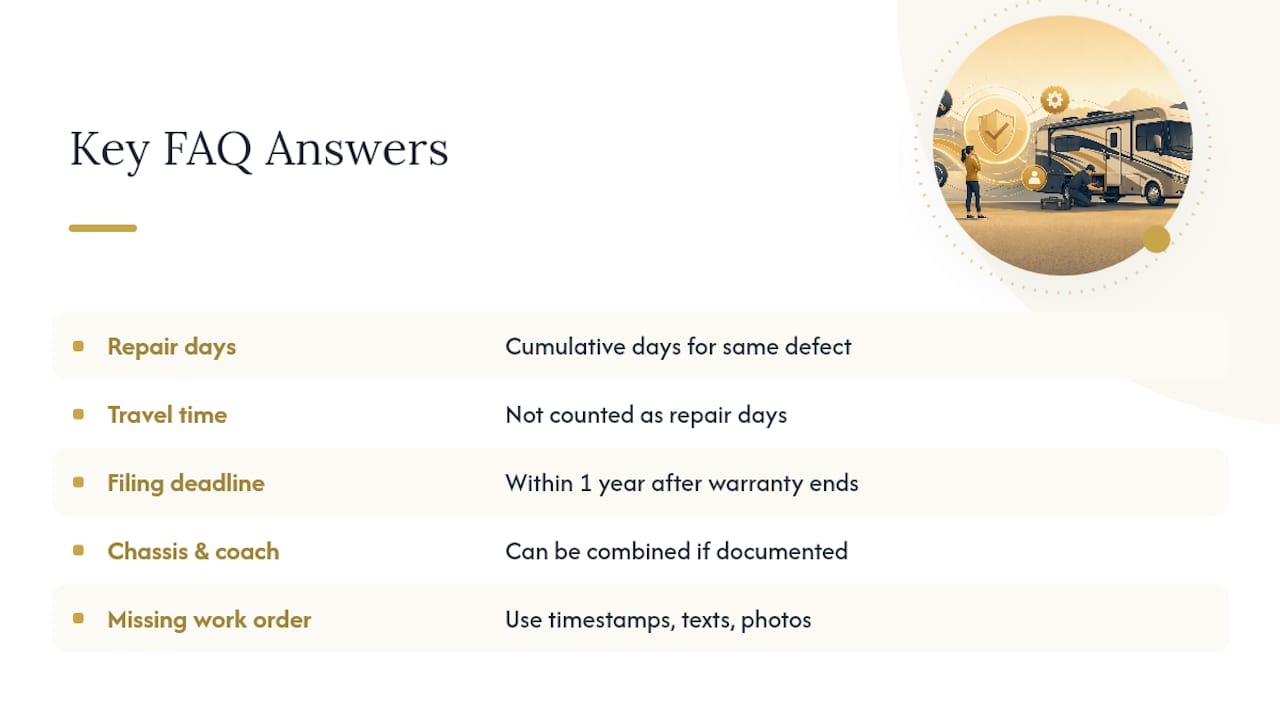
Cumulative days out of service for the same defect is the commonly cited benchmark under the Song-Beverly Act, based on dated repair orders showing the vehicle was actually held for repair.
Does travel time to a repair shop count toward cumulative repair days?
Travel time is not normally counted as a repair day under the statute, but logging it still helps document how the defect affected your ability to use the RV.
What is the deadline to file an RV lemon law claim in California?
AB 1755 generally requires you to file within one year of your warranty’s expiration date, so check that date against your timeline as soon as documentation is assembled.
Do chassis and coach repairs count together toward the 30-day threshold?
They can be aggregated when properly documented, which is why separating chassis and coach repairs in your timeline before combining the totals matters.
What if the repair shop never gave me a formal work order?
Timestamped photos, texts, and emails with the shop can corroborate a repair visit even without a stamped work order, though a written request for the missing paperwork is still worth sending.
This article is general information, not a substitute for advice from a qualified lawyer. Consult a qualified legal professional about your own circumstances before acting on anything here.
Sources
- Findlemonlaw