How Purchase Date Affects Your California Lemon Filing
Your purchase date is the foundation of every California lemon law claim. Under the Song-Beverly Consumer Warranty Act and AB 1755, you must file a lawsuit seeking repurchase or replacement within the filing windows specified by law, which depend on the warranty expiration and original delivery date. Miss either window and your right to restitution can be gone. Three actions matter most right now:
- Locate and preserve your sales contract, title, and DMV registration.
- Pull every repair order showing dates, mileage, and days your vehicle sat in the shop.
- If you plan to seek civil penalties, send the manufacturer the required AB 1755 pre-suit written notice before filing suit.
The Law Offices of Jeffrey Le Pere evaluates purchase-date exposure as the first step in every free case review, because that date controls whether you still have a claim at all.
Table of Contents
- How does the purchase date interact with California lemon law deadlines?
- How do dated timelines play out for RVs and complex vehicles?
- What if you are near or past a deadline?
- What documents prove your purchase date and warranty start?
- The Law Offices of Jeffrey Le Pere handles your purchase-date exposure
- Key Takeaways
- A lawyer’s view on purchase dates and missed deadlines
- Statutes and documents to check
How does the purchase date interact with California lemon law deadlines?
The original delivery date and the express warranty expiration are the two anchors that govern every filing window under California lemon law. AB 1755 codified a clear rule: an action for restitution or replacement must commence within one year after the applicable express warranty expires and in no event later than six years after the date of original delivery. Both limits apply simultaneously, so whichever arrives first controls.
A compact timeline shows how this plays out in practice. Suppose your motorhome was delivered on January 1, 2022, with a two-year factory warranty expiring January 1, 2024. Your one-year lawsuit window runs from the warranty expiration date up to the deadline prescribed by law. The six-year outer limit runs for a specific period from the date of original delivery. You must file before whichever deadline occurs first. The outer limit only matters when a warranty is unusually long or when tolling extends the one-year window past the six-year mark.
The California Air Resources Board summary of AB 1755 confirms these filing windows and the pre-suit notice requirement. AB 1755 also requires a consumer to give the manufacturer a pre-suit written notice before filing for civil penalties, with prescribed response and completion periods following notice.
How do dated timelines play out for RVs and complex vehicles?
Three concise scenarios show how purchase and delivery dates shape filing windows for RV owners.
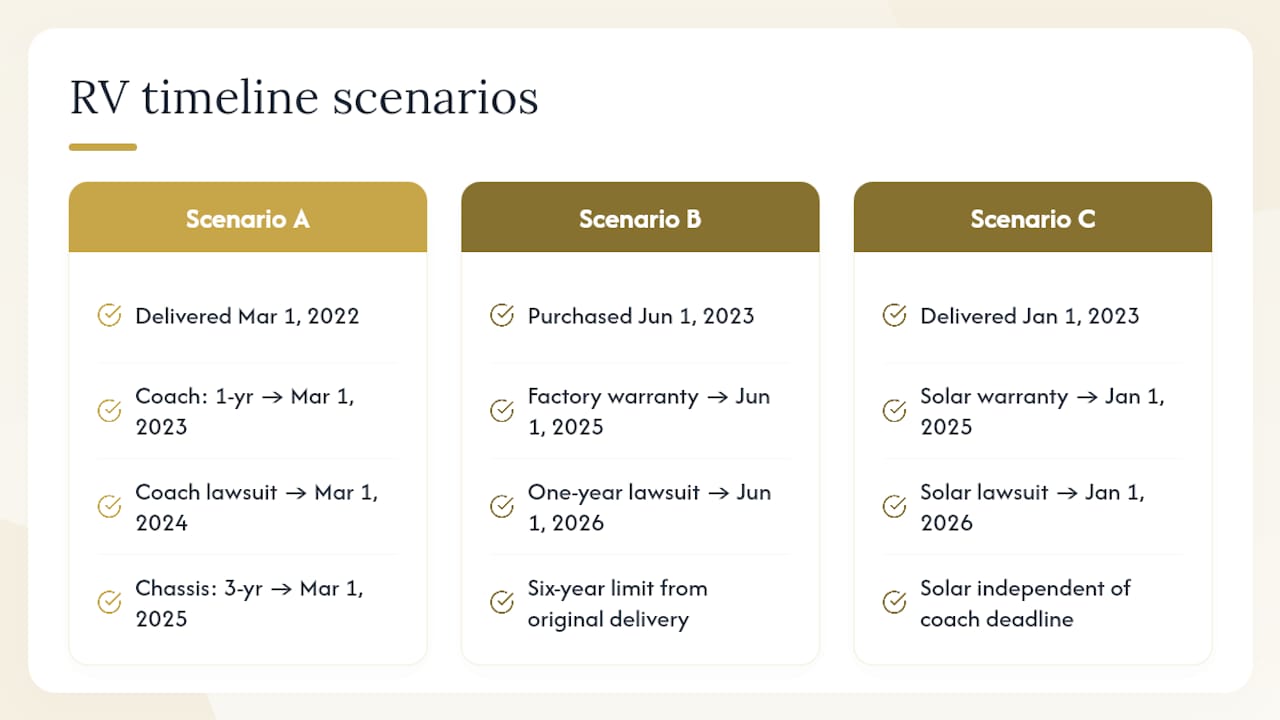
Scenario A: New motorhome with factory express warranty. A Class A motorhome is delivered March 1, 2022, with a one-year factory coach warranty and a three-year chassis warranty. The coach warranty expires March 1, 2023; the one-year lawsuit window for coach defects closes March 1, 2024. The chassis warranty expires March 1, 2025; the lawsuit window for chassis defects closes March 1, 2026. Two separate deadlines, both anchored to the same delivery date.
Scenario B: Used RV sold with remaining factory warranty. A fifth wheel is purchased from a dealer on June 1, 2023, with two years remaining on a transferable factory warranty expiring June 1, 2025. The one-year lawsuit window runs through June 1, 2026. The six-year outer limit runs from the original delivery date to the first owner, not the resale date, which could shorten the available window significantly.
Scenario C: RV with dealer-added aftermarket equipment. A travel trailer is delivered January 1, 2023. The dealer installs a solar system with a separate two-year manufacturer warranty starting January 1, 2023. Defects in the solar system have their own one-year lawsuit window running through January 1, 2026, independent of the coach warranty deadline.
The California DCA lemon law Q&A sets the Lemon Law Presumption thresholds that feed into these scenarios: the problem must first occur within 18 months or 18,000 miles of delivery, with four or more repair attempts for the same defect, two attempts for a safety defect, or 30 or more cumulative days in the shop.
What if you are near or past a deadline?
Missed windows are not always fatal. Tolling doctrines can pause or extend the clock in several situations.
- Out-of-service tolling: The Assembly Bill Policy Committee Analysis confirms that the filing window is tolled for the time your vehicle is out of service for repair of the nonconformity.
Pro Tip: Add up every day your vehicle spent in the shop and every day spent in a dispute resolution program. Those days reduce the effective time that has run against your filing window, and an attorney can calculate the net exposure precisely.
If you suspect you are close to a deadline, the immediate steps are: preserve all repair orders, confirm the exact warranty expiration date from the warranty booklet, check whether any dispute resolution time applies, and contact an RV lemon law attorney before taking any further action.
What documents prove your purchase date and warranty start?
The sales contract or dealer invoice showing the original delivery date is the single most important document in any lemon filing. Preserve it before anything else.
- Sales contract or retail installment contract (shows delivery date, VIN, purchase price)
- Certificate of title and DMV registration (corroborates delivery date and ownership)
- Odometer disclosure statement (ties mileage to delivery date)
- All repair orders, with dates, mileage, and days in shop clearly noted
- Manufacturer warranty booklet (confirms warranty start rule and duration)
- Warranty registration card or in-service confirmation
- All written communications with the manufacturer or dealer, including pre-suit notices
- Photos and videos of defects, timestamped when possible
Pro Tip: Request your complete dealer service history in writing. Dealers are required to provide repair records, and those records often contain internal notes about known defects that manufacturers prefer to keep quiet.
The LA County DCBA guidance specifically emphasizes repair documentation and warranty coverage as the two elements most likely to determine whether a consumer qualifies for relief.
The Law Offices of Jeffrey Le Pere handles your purchase-date exposure
When your RV has recurring defects and you are not sure whether your filing window is still open, the worst move is to wait. The Law Offices of Jeffrey Le Pere reviews purchase-date exposure as the first step in every free case review, checking the original delivery date, warranty expiration, repair history, and any tolling that applies. The firm pursues repurchase, replacement, cash settlement, civil penalties, and statutory attorney fees, and sends the AB 1755 pre-suit notice immediately when the facts support a penalty claim.
Every case is handled on contingency. You speak directly with Jeff Le Pere, not a case manager. The firm’s RV lemon law practice covers motorhomes, fifth wheels, and travel trailers statewide. Request a free case review at rvautolegalteam.com and get a clear answer on whether your purchase date still gives you a viable claim.
Key Takeaways
Your purchase or original delivery date sets both the six-year outer limit and the starting point for calculating when your express warranty expires under California lemon law.
| Point | Details |
|---|---|
| Purchase date controls deadlines | The original delivery date starts the six-year outer limit; warranty expiration starts the one-year lawsuit window. |
| AB 1755 filing windows | File within one year after warranty expiration and no later than six years after original delivery. |
| Tolling can extend your window | Out-of-service repair days, dispute resolution time, and the pre-suit notice period all toll the filing clock. |
| Evidence to preserve now | Sales contract, all repair orders with dates and mileage, warranty booklet, and any written manufacturer correspondence. |
| The Law Offices of Jeffrey Le Pere | Reviews purchase-date exposure in a free case review and represents RV owners on contingency statewide. |
A lawyer’s view on purchase dates and missed deadlines
The purchase date is the fact manufacturers attack first when they want to kill a claim before it reaches the merits. I have seen it from both sides. Spending 11 years defending manufacturers taught me exactly which documents they subpoena and how they argue that a warranty started earlier than the consumer believes, or that the filing window closed before the lawsuit was filed.
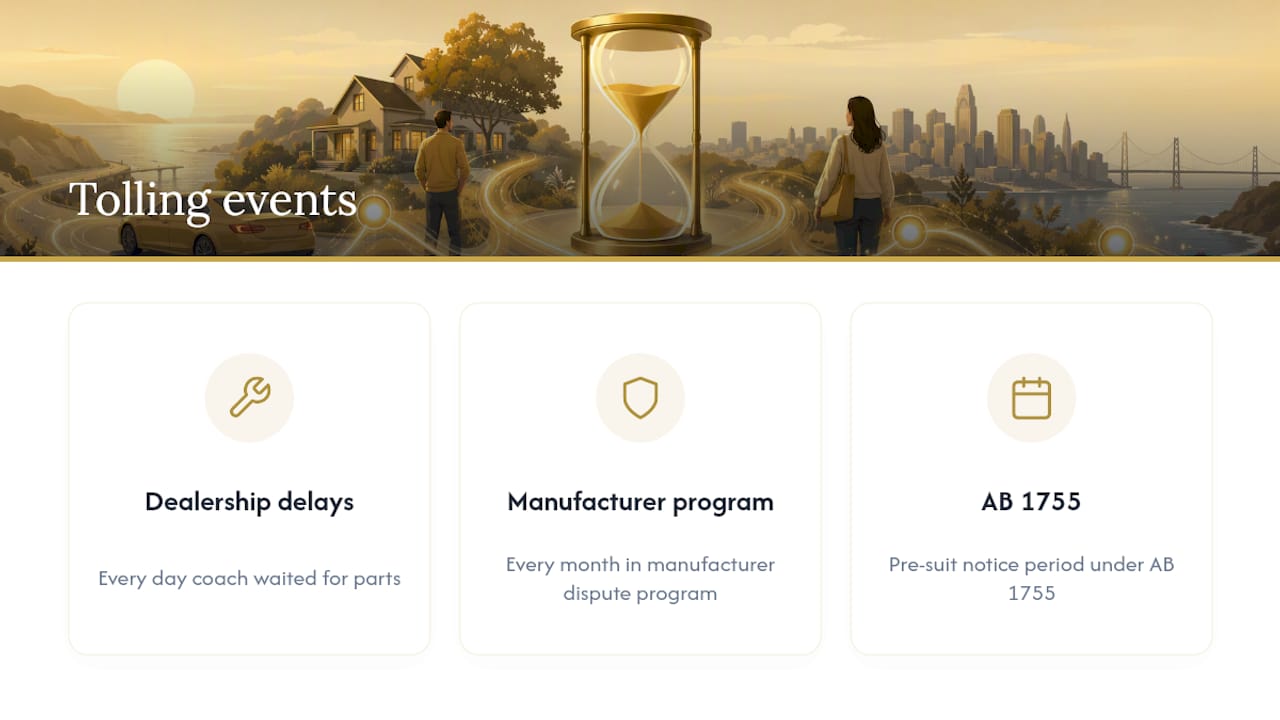
What most RV owners do not realize is that tolling provisions can meaningfully extend a window that looks closed on paper. Every day your coach sat at a dealership waiting for parts, every month spent in a manufacturer dispute resolution program, and the pre-suit notice period under AB 1755 all reduce the effective time that has run against you. The AB 1755 deadline guide walks through those mechanics in detail.
The contingency model exists precisely for situations like this. You should not have to pay out of pocket to find out whether your claim is still alive. Call before you assume the window is closed.
Statutes and documents to check
The primary sources below contain the actual deadline language and procedural requirements. Consult an attorney for interpretation specific to your facts.
- Song-Beverly Consumer Warranty Act — (California Civil Code §§ 1790 et seq.): the controlling California lemon law statute governing warranties, repair obligations, and consumer remedies.
- AB 1755 bill text: the one-year-after-expiration and six-year outer limit filing windows, pre-suit notice requirements, and civil penalty provisions.
- Assembly Bill Policy Committee Analysis: tolling rules, discovery timelines, and mandatory mediation procedures under AB 1755.
- California DCA Lemon Law Q&A: Lemon Law Presumption thresholds (18 months or 18,000 miles, four repair attempts, 30 days in shop).
- LA County DCBA Lemon Law Summary: plain-language overview of presumption criteria and the role of repair documentation.
- AB 1755 Lemon Law Deadline Guide: firm-level practical guidance on filing windows, pre-suit notice, and evidence preservation steps.
This article is general educational information, not legal advice. Confirm current deadlines and procedural requirements with the primary sources above or a qualified California lemon law attorney.