How Defense Experience Changes the Outcome of RV Claims
Prior defense experience gives an RV lemon law attorney a decisive edge because it reveals exactly how manufacturers build their defense before they build it. Jeff Le Pere spent 11 years defending manufacturers and dealerships before switching sides, and that background now works for California owners filing Song-Beverly claims and racing the deadlines tightened by AB 1755. The Law Offices of Jeffrey Le Pere applies that inside knowledge directly to motorhome, fifth wheel, and travel trailer cases.
What that experience typically delivers for RV owners:
- A full repurchase or refund of the vehicle
- A replacement RV of comparable value
- A negotiated cash settlement
- Civil penalties up to double the actual damages when a manufacturer willfully ignored its warranty obligations
Attorney fees are generally paid by the manufacturer under California Civil Code § 1794(d), which is why an experienced California lemon law attorney can take a case on contingency. Clients pay nothing unless the case succeeds. That fee structure, paired with Jeff Le Pere’s extensive experience in this practice area, is the foundation everything else in this article builds on.
Key Takeaways
Defense experience shortens negotiation cycles and increases recovery odds because it lets an attorney anticipate manufacturer tactics rather than react to them.
| Point | Details |
|---|---|
| Defense background changes strategy | Knowing how manufacturers build denials lets an attorney counter blame-shifting and delay tactics early. |
| RV warranties need coordination | Chassis, coach, and component warranties often overlap, and uncoordinated claims recover less. |
| Deadlines are strict | Song-Beverly presumptions and AB 1755 filing windows can cut off a valid claim if missed. |
| Contingency removes cost risk | Attorney fees shift to the manufacturer under § 1794(d), so clients pay nothing unless the case wins. |
| The Law Offices of Jeffrey Le Pere applies insider knowledge | Jeff Le Pere’s 11 years defending manufacturers inform every RV lemon law and dealer fraud case the firm takes. |
Table of Contents
- How Defense Experience Changes RV Claim Strategy
- What Defense Tactics Look Like, and How They Get Countered
- Why RV Warranties Are More Complicated Than Car Warranties
- What to Ask Before You Hire an RV Lemon Law Attorney
- What You Can Recover and the Deadlines That Matter Most
- Can Hiring a Former Defense Attorney Create a Conflict of Interest?
- A Firm Built Around Defense Insight
- Get a Free Case Review for Your RV Claim
- Sources
How Defense Experience Changes RV Claim Strategy
A lawyer who has sat across the table representing manufacturers strategizes differently than one who has only ever filed claims. That difference shows up early, and it compounds.
Here is what defense experience actually changes in practice:
- Reading the defense playbook before it’s played. An attorney who wrote denial letters for manufacturers knows which arguments get raised first, which get raised only when pressed, and which are bluffs designed to stall.
- Identifying the real responsible party fast. RVs have chassis manufacturers, coach manufacturers, and component vendors all pointing fingers at each other. Someone who defended these entities knows within days which one actually owns the defect.
- Calibrating the demand letter for maximum leverage. A demand that cites the exact civil penalty exposure a manufacturer faces under Song-Beverly lands differently than a generic complaint letter.
- Targeting discovery at known weak points. Defense-side experience means knowing exactly which documents manufacturers hate producing, and asking for those first.
- Shortening the negotiation cycle. Recognizing a real settlement offer versus a delay tactic saves months.
Consider a common scenario: a slide-out mechanism fails repeatedly, and the failure traces back to wiring routed through the chassis rather than a coach-level problem. A generalist attorney might spend weeks negotiating with the coach manufacturer’s warranty department before realizing the chassis maker is the real target. Someone who has defended these companies recognizes that pattern from the repair order sequence almost immediately, because manufacturers use similar internal escalation patterns and Technical Service Bulletins tend to repeat across model years.
Pro Tip: Ask your attorney to request direct routing to manufacturer defense counsel instead of the customer service line. Defense-experienced attorneys often know exactly who handles Song-Beverly disputes internally, and going straight to that person can cut weeks off the process.
What Defense Tactics Look Like, and How They Get Countered
Manufacturers and dealers rely on a fairly predictable set of tactics to delay or shrink a claim, and an attorney who used to build those defenses knows the counters cold.
The tactics show up again and again across RV cases:
- Tactic: Blame “improper use” or owner modification. Counter: reconstruct the repair timeline from the first reported symptom and match it against the manufacturer’s own Technical Service Bulletins, which often confirm the defect was known before the owner ever touched the RV.
- Tactic: Claim the defect is “cosmetic” or doesn’t substantially impair use. Counter: document how the defect affects safety, value, or use, since Song-Beverly’s substantial impairment standard doesn’t require the RV to be undrivable.
- Tactic: Drag out repair scheduling to avoid hitting the 30 days out-of-service threshold. Counter: track every drop-off and pickup date in writing, because service delays caused by the manufacturer’s own authorized dealer still count against them.
- Tactic: Argue the component (generator, refrigerator, slide-out) falls under a third-party vendor’s warranty, not the coach manufacturer’s. Counter: pull the master warranty booklet and correspondence showing which entity accepted repair responsibility during actual service visits.
Intermittent problems create the hardest fights. A generator that fails only under load, or a refrigerator that cycles unpredictably, gives manufacturers room to claim the defect “couldn’t be reproduced.” Defense-experienced attorneys counter this with targeted subpoenas for the manufacturer’s own internal complaint database and focused deposition questions aimed at service technicians who documented the same pattern in other owners’ files. That history of prior complaints is often the single most persuasive piece of evidence in a Song-Beverly claim, and it rarely surfaces without someone knowing exactly where to look.
Why RV Warranties Are More Complicated Than Car Warranties
RVs typically carry two or three separate, overlapping warranties, and failing to coordinate them is the single most common reason owners recover less than they should.
The typical warranty layers break down like this:
- Chassis warranty, usually from a separate manufacturer than the RV brand itself, covering the engine, transmission, and drivetrain
- Coach warranty, from the RV manufacturer, covering the living space, slide-outs, and structural components
- Component warranties, from third-party makers of generators, appliances, and electrical systems
RV cases frequently involve all three, and coordinating those overlapping obligations is what prevents one manufacturer from blaming another indefinitely. A motorhome with a powertrain fault that also trips coach electrical systems needs a single, coordinated demand naming both the chassis and coach manufacturers, not two separate half-claims that each get denied.
Mileage offset calculations differ for motorhomes, which have their own engines, versus fifth wheels and travel trailers, which don’t. Pulling repair orders from every responsible party matters here too.
What to Ask Before You Hire an RV Lemon Law Attorney
The right vetting question is specific and measurable, not “do you handle lemon law cases.”
Ask a prospective attorney these things directly:
- How many years did you spend defending manufacturers or dealerships? This tells you whether they’ve actually seen a defense file from the inside, not just read about one.
- How many RV cases have you handled specifically? Auto lemon law and RV lemon law are different enough that general experience isn’t a substitute.
- Do you understand the difference between chassis and coach warranty claims? A competent RV attorney should answer this without hesitation.
- Are you tracking Song-Beverly presumption windows and AB 1755 deadlines on my case? Missing a filing deadline can end a valid claim regardless of the underlying facts.
- What types of recoveries have you obtained in similar cases? Look for specifics: repurchase, replacement, or civil penalty amounts tied to willful violations.
- Will I speak directly with you, or with a case manager? This distinguishes boutique representation from high-volume lemon law mills.
- Do you advance costs, and is representation on contingency? Confirm you owe nothing unless the case succeeds.
A firm confident in its RV experience should answer every one of these without deflecting. Vague answers about “handling all types of vehicles” are a signal to keep looking.
What You Can Recover and the Deadlines That Matter Most
Song-Beverly claims typically result in one of four outcomes: a full repurchase, a replacement RV, a cash settlement, or civil penalties up to two times actual damages for willful violations.
Beyond the RV’s purchase price, recoverable costs often include:
- Sales tax and registration fees paid at purchase
- Towing costs tied to the defect
- Alternate lodging expenses, which matter significantly when the RV serves as a primary residence and the owner has to find other housing during repairs
- Mileage offsets, calculated differently for motorhomes than for towable fifth wheels and travel trailers
Attorney fees are paid by the manufacturer under Civil Code § 1794(d), which is why contingency representation is standard rather than exceptional.
Watch these deadlines closely. California’s Song-Beverly presumption generally applies in an early period after purchase and typically requires multiple repair attempts for the same problem or a significant amount of time out of service. AB 1755 has introduced changes to filing deadlines in some circumstances, so confirm your specific deadline with an attorney rather than assuming the old timeline still applies.
Can Hiring a Former Defense Attorney Create a Conflict of Interest?
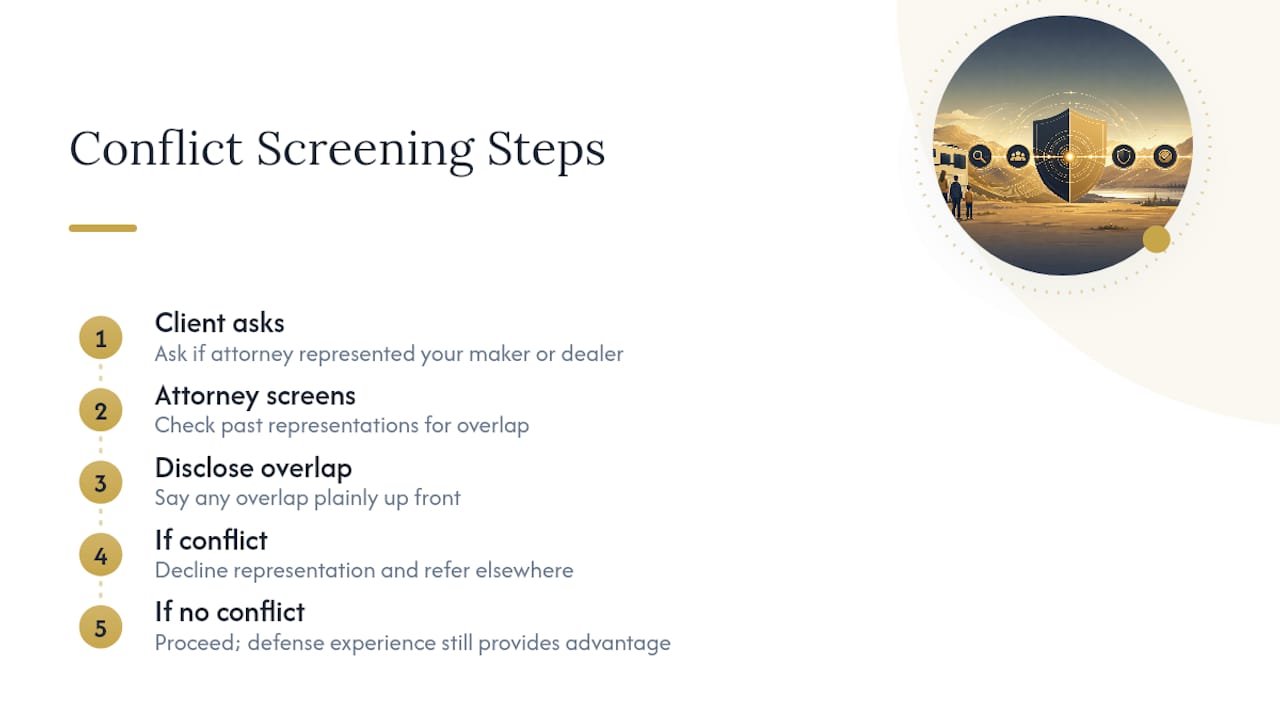
A former defense attorney representing consumers must screen every new case against every company they previously represented, and a responsible firm declines representation the moment a genuine conflict exists.
This isn’t a theoretical concern. An attorney who once represented a specific manufacturer generally cannot turn around and sue that same manufacturer on a matter connected to that prior representation, and California’s rules of professional conduct treat this seriously. The practical safeguard is disclosure up front: before taking your case, a former defense attorney should check whether they personally worked on matters involving your RV’s chassis or coach manufacturer, and say so plainly if there’s any overlap.
What this means for you as a prospective client is straightforward. Ask directly whether the attorney has represented the manufacturer or dealer you’re pursuing a claim against. A trustworthy answer is specific, not reassuring in a generic way. If a real conflict exists, the ethical path is a referral elsewhere, not a workaround.
The upside of defense experience doesn’t disappear just because conflict screening exists. Knowing how a manufacturer’s legal department thinks doesn’t require having personally represented that exact company. Most defense-experienced attorneys built their knowledge across dozens of manufacturers and dealer networks over a decade or more, which means the strategic advantage transfers broadly even after screening removes any single conflicted case. The knowledge of tactics, timelines, and negotiation patterns is industry-wide, not client-specific.
A Firm Built Around Defense Insight
Our approach to every RV case starts with what we learned on the other side of the table. Jeff Le Pere spent 11 of his 25 years in this field defending manufacturers and dealerships before shifting entirely to representing consumers, and that experience now shapes how the RV Auto Legal Team builds every Song-Beverly and dealer fraud claim. Every case runs on contingency, every client gets a free case review, and every client speaks directly with the attorney handling their case rather than a case manager. If a genuine conflict of interest exists with a specific manufacturer, we say so and decline the case rather than risk a compromised outcome.
Get a Free Case Review for Your RV Claim
The Law Offices of Jeffrey Le Pere represents California RV owners on contingency, and that defense background is what turns a slow manufacturer denial into leverage for a real settlement or trial outcome.
Our work covers RV lemon law claims for motorhomes, fifth wheels, and travel trailers, plus dealer fraud cases involving vehicles misrepresented as certified or sold with concealed defects. We coordinate warranty claims across chassis and coach manufacturers so one company can’t simply point at another, and we handle discovery directly against manufacturers using tactics learned from the defense side.
You pay nothing unless the case succeeds, since manufacturers typically cover attorney fees under § 1794(d) once a claim is won. If your RV has been in the shop repeatedly, or you suspect you were sold a lemon under a certified label, request a free case review from The Law Office of Jeffrey L. Le Pere / RV Auto Legal Team today.
Sources
For statute thresholds and arbitration steps, see the DCA’s Lemon Law Q&A. For general Song-Beverly guidance, review the Attorney General’s consumer car page. For RV-specific warranty complexity, read FindLemonLaw’s RV page. Then visit our RV lemon law practice page to apply these facts to your case.
This article is general information, not a substitute for advice from a qualified lawyer. Consult a qualified legal professional about your own circumstances before acting on anything here.
- Buying and Maintaining a Car | State of California - Department of Justice - Office of the Attorney General
- Do I Need a Lawyer for a California Lemon Law Claim? | FindLemonLaw
- Your RV has its own warranty and legal issues | Super Lawyers