Role of Case Manager vs Attorney Explained

A case manager is defined as a legal support professional who handles administrative and operational tasks, while an attorney is the only person legally authorized to provide legal advice, evaluate liability, and make strategic decisions on your behalf. The role of case manager vs attorney explained comes down to one clear line: attorneys practice law, and case managers support that practice. California Business and Professions Code §6125 reserves the practice of law exclusively for licensed attorneys. Understanding this distinction protects you from firms where non-lawyers make decisions that only attorneys should make, and it helps you know exactly who to call when your case reaches a critical moment.
What duties do case managers perform in a legal case?
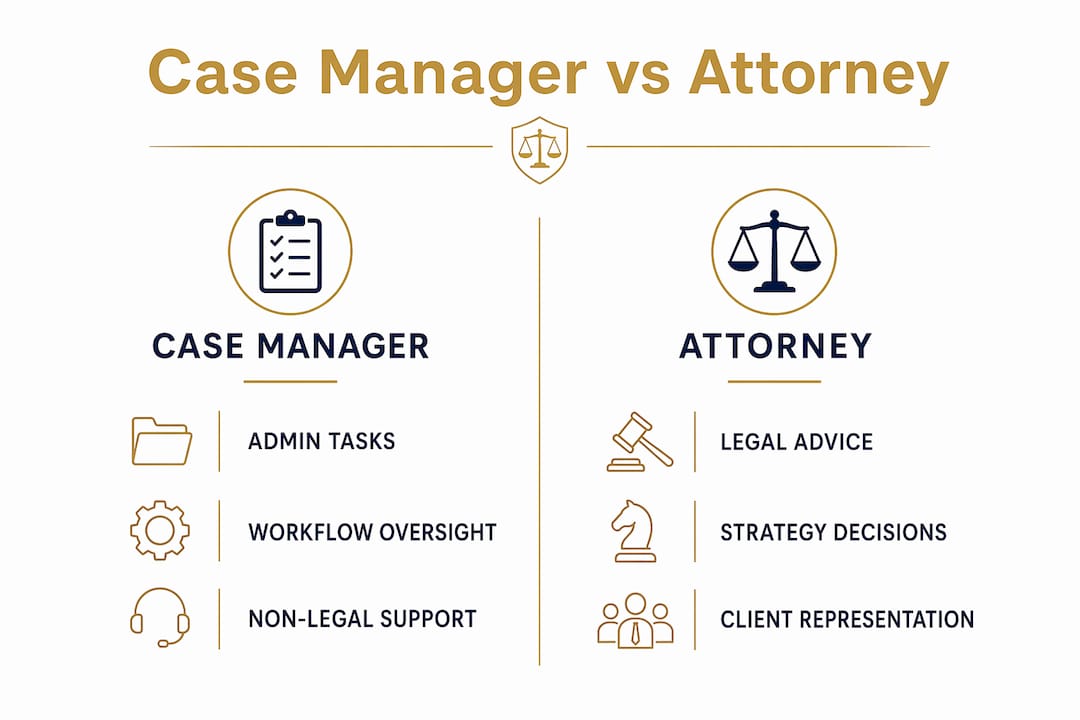
Case managers handle the operational backbone of a legal case without crossing into legal judgment. Their work keeps cases moving, deadlines met, and clients informed, but every substantive decision flows through the attorney.

Remote legal case managers have become standard in high-volume practices in 2026 to meet client expectations for speed and responsiveness. That adoption reflects how much administrative work a legal case actually generates. A single personal injury file can involve dozens of medical records requests, insurance contacts, and scheduling tasks before an attorney ever drafts a demand letter.
The core case manager duties include:
- Client intake and onboarding: Collecting personal information, signing fee agreements, and explaining the process in general terms
- Document tracking: Requesting and organizing medical records, police reports, repair orders, and correspondence
- Deadline management: Monitoring statute of limitations dates and internal case milestones under attorney supervision
- Scheduling: Coordinating medical appointments, depositions, and attorney calls
- Liaison communications: Relaying routine updates between clients, medical providers, and insurance adjusters
- Demand package support: Gathering the factual materials an attorney uses to draft the actual demand letter
Case managers oversee case workflow elements without performing legal judgment. That boundary is not a technicality. It is the legal line separating administrative support from the practice of law.
Pro Tip: Ask your case manager directly: “Who will advise me on whether to accept a settlement offer?” If the answer is not “your attorney,” that is a red flag worth addressing immediately.
A dedicated case manager allows attorneys to reclaim 10 or more hours of work per week by offloading non-billable tasks. Those recovered hours go toward legal research, strategy, and the substantive work that actually moves your case forward.
What responsibilities are unique to attorneys in legal cases?
Attorneys hold exclusive authority over every decision that requires legal judgment. No case manager, paralegal, or legal assistant can perform these functions lawfully, regardless of experience or seniority.
The attorney responsibilities that are reserved by law include:
- Legal advice: Telling you whether you have a viable claim, what your rights are, and what risks you face
- Liability evaluation: Analyzing facts, evidence, and applicable statutes to assess the strength of your case
- Settlement decisions: Advising you on whether a settlement offer is fair and what you should accept or reject
- Litigation strategy: Deciding whether to file suit, which claims to assert, and how to position your case
- Substantive legal drafting: Writing complaints, motions, demand letters, and court filings
- Legal research: Analyzing case law and statutes, either directly or through supervised paralegals
- Attorney-client privilege: Protecting your confidential communications under a privilege that only applies to licensed attorneys
Legal advice from case managers is not protected under attorney-client privilege. That fact carries serious consequences. If a case manager tells you to accept a settlement and you later discover it was inadequate, you have no privileged communication to rely on and potentially no recourse against the firm.
The difference between case managers and attorneys is not just organizational. It is a legal firewall. Attorneys carry malpractice insurance, bar licenses, and ethical obligations enforced by the State Bar of California. Case managers carry none of those protections for you.
Direct attorney access means your attorney personally reviews your file, evaluates your options, and communicates strategic decisions to you directly. That access is not a luxury. It is the minimum standard of competent legal representation.
How do case managers and attorneys collaborate to manage legal cases effectively?
The best legal teams divide responsibilities cleanly. Attorneys lead on legal judgment, and case managers execute the operational work that supports those decisions. That division produces faster case movement without sacrificing legal quality.
In volume law practices, case managers serve as the primary daily client contact but must not make substantive legal or settlement decisions. This structure works when the attorney remains genuinely involved. It breaks down when the case manager becomes the de facto decision-maker.
“A case manager’s operational role supports but does not replace the attorney’s duty. Good firms maintain clear boundaries ensuring legal advice is exclusively from attorneys. When those boundaries blur, clients pay the price.”
The warning signs of improper delegation are specific. Case managers who negotiate settlements without attorney oversight indicate “settlement mill” practices and a lack of meaningful attorney involvement. Settlement mills are high-volume operations that process cases like assembly lines, with attorneys signing off on decisions they never actually reviewed.
Clients can protect themselves by asking three direct questions before hiring any firm:
- How often will my attorney personally review my file?
- Who will advise me on whether to accept or reject a settlement offer?
- Can I speak directly with my attorney when I have a legal question?
A firm that cannot answer those questions clearly is telling you something important about how it operates.
What legal limits and risks surround non-attorneys providing legal help?
Unauthorized practice of law (UPL) is the act of providing legal services without a valid attorney license. California treats UPL as a criminal offense, not just a professional violation.
| Violation | Penalty under California law |
|---|---|
| Providing legal advice without a license | Up to 12 months in county jail |
| Drafting substantive legal documents | Fines up to $1,000 per offense |
| Holding out as an attorney | Criminal prosecution under Business and Professions Code §6125 |
| Unauthorized settlement negotiation | Potential civil liability and voided agreements |
Unauthorized practice of law in California carries penalties including up to 12 months in county jail and fines up to $1,000. Those penalties apply to the non-lawyer providing the advice, but the client suffers the practical consequences: bad legal guidance, unprotected communications, and potentially a settled case worth far less than it should have been.
California is actively examining the boundaries of who can provide limited legal help. The California Supreme Court has opened the door to a community justice worker proposal that would allow supervised non-lawyers to provide limited legal assistance in certain contexts. That proposal reflects a nuanced approach to expanding access to justice while maintaining consumer protections. It does not change the current rule: only licensed attorneys practice law.
Pro Tip: Before signing with any law firm, verify your attorney’s bar license at the State Bar of California’s public website. A valid license number confirms the person advising you is legally authorized to do so.
Non-lawyer staff, even with years of experience, are prohibited by law from providing legal advice, and their communications lack attorney-client privilege protections without direct attorney supervision. Experience does not create legal authority. Only a bar license does.
Key Takeaways
Attorneys hold exclusive legal authority over advice, strategy, and settlement decisions, while case managers handle the operational work that keeps cases moving efficiently.
| Point | Details |
|---|---|
| Attorneys hold exclusive legal authority | Only licensed attorneys can give legal advice, evaluate liability, and advise on settlements under California law. |
| Case managers handle operations, not law | Case manager duties include scheduling, document tracking, and client communication, not legal judgment. |
| UPL carries criminal penalties | Non-lawyers who provide legal advice in California face up to 12 months in jail and $1,000 in fines. |
| Attorney-client privilege requires an attorney | Communications with case managers do not carry the same legal protections as communications with your attorney. |
| Direct attorney access is a baseline standard | Clients should confirm their attorney personally reviews their file and advises on all strategic decisions. |
Why attorney oversight is the one thing I never compromise on
I spent 11 years on the defense side, representing manufacturers and dealerships. That experience showed me exactly how cases get undervalued, and the most common reason was not weak facts. It was clients who never had real attorney contact. Their cases were managed by staff who were well-intentioned but legally unauthorized to evaluate what those cases were actually worth.
When I moved to the plaintiff side, I made one structural decision that has never changed: every client at The Law Offices of Jeffrey Le Pere speaks with me, not a case manager, when a legal decision needs to be made. Case managers on my team handle the operational work they are trained and authorized to do. I handle the law.
The industry trend toward remote case managers is not inherently bad. Widespread adoption of remote case managers supports case flow and client communication when the attorney remains genuinely involved. The problem is the firms that use case managers to replace attorney involvement rather than support it. I have seen those operations from the inside. Clients in those firms often settle for a fraction of what their case is worth because no one with a law license ever sat down and actually evaluated the claim.
Clients should ask how frequently their attorney personally reviews case files and makes strategic decisions. That question alone separates firms that take your case seriously from firms that process it. You deserve a direct answer, and if you do not get one, keep looking.
— Jeff Le Pere
The Law Offices of Jeffrey Le Pere puts attorneys in charge of your case

At The Law Offices of Jeffrey Le Pere, attorney oversight is not a policy statement. It is how every case runs. Jeff Le Pere personally evaluates each claim, advises on settlement decisions, and remains your direct point of contact for every legal question. Case managers on the team handle scheduling, document coordination, and client updates, exactly the work they are authorized to do.
The firm handles California RV lemon law for motorhomes, fifth wheels, and travel trailers, plus auto lemon law for cars, trucks, and SUVs. Every case runs on contingency, meaning you pay nothing out of pocket. If you have a defective vehicle and want to speak with an attorney, not a case manager, request a free case review and get a direct answer about what your claim is worth.
FAQ
What is the main difference between a case manager and an attorney?
An attorney is licensed to provide legal advice, evaluate your claim, and make strategic decisions, while a case manager handles administrative tasks like scheduling, document collection, and client communication without performing any legal judgment.
Can a case manager give me legal advice about my case?
No. Providing legal advice without a bar license is unauthorized practice of law in California, a criminal offense carrying penalties including up to 12 months in jail and fines up to $1,000.
How do I know if my attorney is actually involved in my case?
Ask directly how often your attorney personally reviews your file and who advises you on settlement decisions. If a case manager is making those calls, the firm is not providing proper attorney oversight.
What is a settlement mill and why should I avoid it?
A settlement mill is a high-volume law firm that delegates substantive legal decisions to case managers rather than attorneys, often resulting in cases settled for far less than their actual value.
Does attorney-client privilege apply to my conversations with a case manager?
No. Attorney-client privilege protects communications with your licensed attorney. Conversations with case managers do not carry the same legal protection unless an attorney directly supervises the communication.