Mileage Offset in Lemon Law Repurchase: RV Owner Guide

The mileage offset is the dollar amount deducted from your lemon law buyback refund to account for miles you drove before the defect first sent you to an authorized dealer for repair. Understanding what mileage offset means in a lemon repurchase is the difference between accepting a lowball settlement and recovering what California law actually entitles you to. Under the Song-Beverly Consumer Warranty Act, this offset follows a fixed statutory formula, and manufacturers regularly get it wrong. If you own a defective motorhome, fifth wheel, or travel trailer, knowing how this calculation works protects thousands of dollars in your refund.
How is the mileage offset calculated under California lemon law?
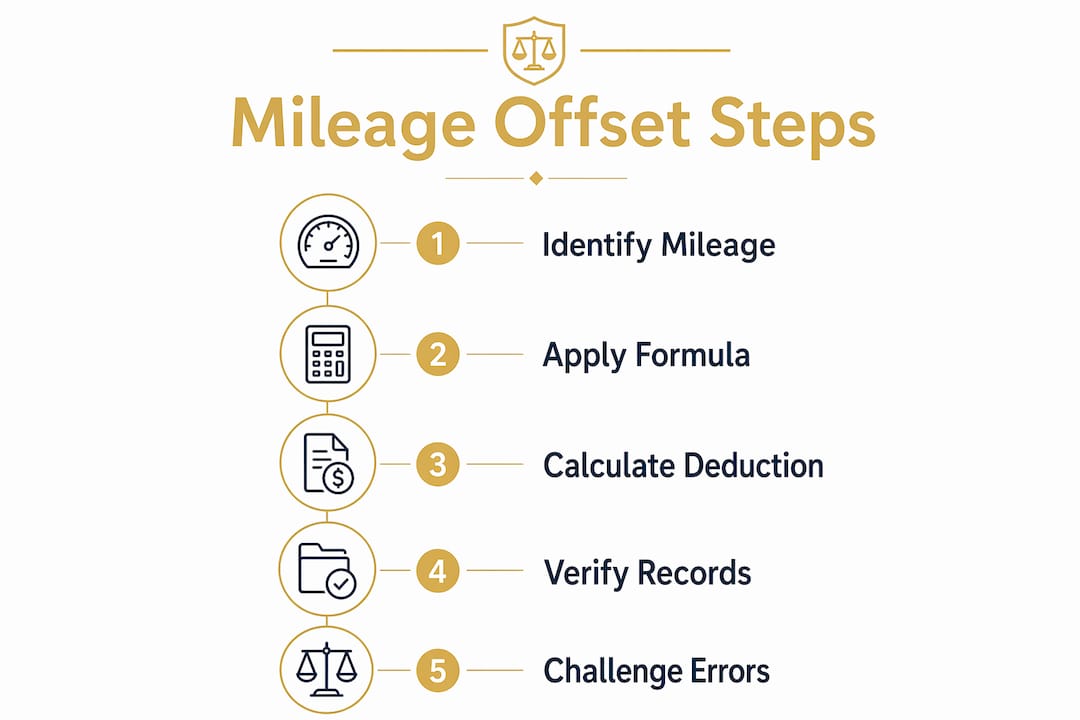
The mileage offset formula in California is: (Miles at first repair attempt ÷ 120,000) × Purchase price. The 120,000 figure is fixed by statute and represents the assumed useful life of a vehicle under California law. It does not change based on your RV’s make, model, or actual condition.
Three variables drive the result: the odometer reading at your first authorized repair visit for the specific defect, the purchase price of the vehicle, and the statutory divisor of 120,000 miles. The purchase price used is the actual vehicle purchase price, not your loan balance or any trade-in value. That distinction matters because financing amounts and trade-in credits can differ significantly from what you paid on the contract.

Here is a concrete example. Say you bought a motorhome for $120,000 and drove 6,000 miles before your first repair visit for a slide-out failure. The calculation is: (6,000 ÷ 120,000) × $120,000 = $6,000. That $6,000 is the offset deducted from your full refund. If you had driven only 1,200 miles before that first visit, the offset would drop to $1,200. The math makes clear why early reporting matters.
The following items are the only legitimate deductions a manufacturer can take under a Song-Beverly Act repurchase:
- The mileage offset calculated using the formula above.
- Any amounts already paid directly by the manufacturer toward repairs (in limited circumstances).
No other deductions are authorized. The mileage offset is the only meaningful deduction manufacturers can take from a vehicle buyback under the Song-Beverly Act. That makes it the single most contested number in any repurchase negotiation.
Pro Tip: Keep your original purchase contract separate from your financing documents. The purchase price on the sales contract, not the amount financed, is the correct figure for the mileage offset formula.
What mistakes do manufacturers commonly make calculating mileage offsets?
Manufacturers calculate the mileage offset incorrectly far more often than most RV owners realize. The most common error is using the odometer reading at the time of settlement or vehicle surrender rather than the reading at the first repair attempt. This over-deduction can cost buyers thousands of dollars and is a frequent dispute in California lemon law cases.
California Civil Code § 1793.2(d)(2)© is explicit: the offset is tied to the mileage at the first repair attempt for the specific defect, full stop. Using any later mileage reading violates the statute. If your RV logged 6,000 miles at the first repair visit but 22,000 miles by the time you settled, a manufacturer using 22,000 miles inflates the offset by more than three times.
Watch for these specific errors in any manufacturer offset calculation:
- Wrong mileage date. The manufacturer uses current mileage, settlement mileage, or the date of your last repair visit instead of the first qualifying visit.
- Wrong purchase price. The manufacturer substitutes the financed amount, residual value, or a depreciated figure instead of the original contract price.
- Wrong divisor. Any number other than 120,000 in the denominator is incorrect under California law.
- Unrelated service visits. The manufacturer counts an oil change or unrelated recall visit as the “first repair attempt” to push the mileage number higher.
- Ignoring “no problem found” visits. A visit where the dealer logs “no problem found” still counts as the first repair attempt if it was for the qualifying defect and was documented by an authorized dealer.
That last point surprises many RV owners. A “no problem found” visit documented by an authorized dealer can fix the mileage cutoff even if no actual repair was performed. This works in your favor because it locks in a lower mileage number early.
Pro Tip: Request a copy of every repair order from every dealer visit, including visits where the dealer found nothing wrong. That paper trail establishes your first repair attempt mileage and prevents manufacturers from moving the goalposts.
How does mileage offset impact California RV lemon law buybacks and refunds?
The mileage offset reduces your buyback refund, but only by the formula amount based on first repair mileage. Miles you drive after that first repair visit do not increase the offset. Driving the vehicle extensively after the first repair attempt does not increase the mileage offset deduction. The offset freezes at the mileage recorded at that first authorized dealer visit.
This has a direct practical consequence. If your case takes 18 months to resolve and you drive another 15,000 miles during that period, the manufacturer cannot add those miles to the offset calculation. Your refund is protected from deductions tied to the ongoing case timeline.
The table below shows how the offset changes with different first-repair mileage levels on a $150,000 motorhome purchase:
| First repair mileage | Offset calculation | Offset amount | Net refund (before incidentals) |
|---|---|---|---|
| 1,500 miles | (1,500 ÷ 120,000) × $150,000 | $1,875 | $148,125 |
| 6,000 miles | (6,000 ÷ 120,000) × $150,000 | $7,500 | $142,500 |
| 15,000 miles | (15,000 ÷ 120,000) × $150,000 | $18,750 | $131,250 |
| 30,000 miles | (30,000 ÷ 120,000) × $150,000 | $37,500 | $112,500 |
The difference between reporting a defect at 1,500 miles versus 30,000 miles is $35,625 on a $150,000 RV. Early defect reports with low mileage result in smaller offset deductions, preserving more of the refund for the buyer.
Beyond the offset itself, your full repurchase refund under California lemon law includes:
- The purchase price minus the mileage offset.
- All collateral charges: sales tax, registration fees, and dealer-installed options.
- Finance charges paid to date.
- Incidental costs like towing, rental vehicles, and repair-related expenses. You can review what incidental damages cover under California law for a full breakdown.
- Any outstanding loan balance, paid directly to your lender.
RV lemon law claims carry an added layer of complexity because motorhomes, fifth wheels, and travel trailers often involve multiple component warranties from different manufacturers. The chassis, appliances, and coach body may each carry separate coverage. The mileage offset formula itself does not change, but identifying which warranty covers which defect affects whether a repair attempt qualifies under the Song-Beverly Act.
What should California RV owners do to protect themselves from unfair mileage offset deductions?
The best protection against an inflated mileage offset is documentation that starts at the first authorized repair visit. California lemon law does not reward owners who wait. California lemon law claims have no mileage cap on eligibility as long as defects are reported and covered by the original warranty, but the offset grows with every mile driven before that first visit.
Follow these steps to protect your refund:
- Document the odometer at every dealer visit. Photograph the dashboard before handing over the keys. Dealer repair orders sometimes record mileage incorrectly, and your photo is independent proof.
- Use only authorized dealers for warranty repairs. Independent shops do not create qualifying repair attempts under Song-Beverly. Every visit must be to a manufacturer-authorized service center.
- Report defects promptly. The moment a defect appears, schedule a repair visit. Waiting adds miles to the offset calculation and reduces your refund.
- Collect every repair order, including “no problem found” logs. These documents establish your first repair attempt date and mileage. Solid repair attempt evidence is the foundation of any successful lemon law case.
- Review the manufacturer’s offset calculation line by line. Verify the mileage date, the purchase price figure, and the divisor. Any deviation from the first repair visit mileage is a statutory violation.
- Do not accept the manufacturer’s first calculation without review. Expert legal review can recover thousands in improperly deducted offsets and related costs.
California AB 1755 also creates a time-sensitive deadline: you must file your lemon law claim within one year of the warranty’s expiration date. Missing that window can eliminate your right to recover entirely. Review the one-year filing deadline rules before assuming you still have time.
Key Takeaways
The mileage offset in a California lemon law repurchase is calculated using first-repair mileage only, making early defect reporting the single most effective way to maximize your refund.
| Point | Details |
|---|---|
| Offset formula | (Miles at first repair ÷ 120,000) × Purchase price, with 120,000 fixed by statute. |
| Offset freezes early | Miles driven after the first repair attempt do not increase the deduction under California law. |
| Manufacturer errors are common | Using settlement mileage instead of first-repair mileage is a frequent and costly mistake. |
| Only authorized visits count | “No problem found” logs at authorized dealers still establish the first repair attempt mileage. |
| Early reporting protects refunds | Reporting a defect at low mileage can preserve tens of thousands of dollars in a buyback. |
What I’ve learned about mileage offset after 11 years defending manufacturers
I spent 11 years on the other side of these cases, building the manufacturer’s defense. Mileage offset disputes were a reliable tool for reducing settlements, and the tactic was straightforward: use the highest defensible mileage number and see if the consumer pushed back. Most did not.
The calculation error I saw most often was substituting settlement mileage for first-repair mileage. Manufacturers know the statute requires first-repair mileage. Using a later number is not an oversight. It is a deliberate starting position in a negotiation. If you accept it without question, the case closes and the manufacturer keeps the difference.
What changed my perspective was watching how much money that single error cost real people. On a $100,000 RV driven 20,000 miles between the first repair visit and settlement, the inflated offset adds roughly $16,667 to the deduction. That is not a rounding error. That is a meaningful portion of someone’s refund.
My advice to any California RV owner reviewing a manufacturer’s buyback offer is this: treat the mileage offset calculation as the first thing you verify, not the last. Get your repair orders, confirm the odometer reading at your first qualifying visit, and run the formula yourself. If the numbers do not match, that discrepancy is worth challenging. Manufacturers count on consumers not doing the math.
— Jeff Le Pere
Your California RV lemon law case deserves a real review
If a manufacturer has presented a buyback offer for your motorhome, fifth wheel, or travel trailer, the mileage offset figure in that offer deserves scrutiny before you sign anything.

The Law Offices of Jeffrey Le Pere focuses exclusively on California RV lemon law claims, including motorhomes, fifth wheels, and travel trailers. Jeff Le Pere spent 11 years defending manufacturers, which means he knows exactly which calculation errors to look for and how to challenge them. Every case runs on contingency, so there is no cost to you regardless of outcome. Contact The Law Offices of Jeffrey Le Pere for a free case review and find out whether the manufacturer’s offset calculation holds up.
FAQ
What does mileage offset mean in a lemon law repurchase?
The mileage offset is a statutory deduction from your lemon law buyback refund. It equals (miles at first repair attempt ÷ 120,000) × purchase price under California Civil Code § 1793.2(d)(2)©.
Does driving more miles after the first repair increase my mileage offset?
No. The offset freezes at the odometer reading from your first authorized repair visit for the qualifying defect. Miles driven after that date do not increase the deduction.
What mileage is used to calculate the offset?
California law requires the odometer reading at the first authorized repair attempt for the specific defect, not current mileage or settlement mileage. A “no problem found” visit at an authorized dealer also qualifies.
Is there a mileage limit to file a California lemon law claim?
California lemon law sets no fixed mileage cap on eligibility. Claims are valid as long as the defect is covered by the original warranty and you file within one year of the warranty’s expiration date under AB 1755.
Can I challenge a manufacturer’s mileage offset calculation?
Yes. If the manufacturer used the wrong mileage date, the wrong purchase price, or any divisor other than 120,000, the calculation violates California Civil Code § 1793.2(d)(2)© and can be disputed with documented repair orders.