Does Lemon Law Cover Used Cars? A State-by-State Guide
Short answer: sometimes. A used car qualifies for lemon law protection only when a written warranty is still in force at the time of sale or the state where you bought it has a statute that explicitly reaches used vehicles. There is no single national rule, which is exactly why so many used-car buyers get told “no” by a dealer who never checked the actual facts of their case.
Before you accept that answer, run three checks:
- Is the original manufacturer warranty still active on the mileage and calendar date when the defect showed up?
- Did the dealer issue its own written warranty, or was the car sold as certified pre-owned?
- Which state’s law governs the sale, since that determines whether used vehicles get separate statutory coverage?
If any of those checks come back positive, start pulling every repair order, warranty booklet, and odometer reading you have. Documentation preserved now is often the difference between a paid-off claim later and a dealer who stonewalls you.
Key Takeaways
Used-car lemon law protection depends on an active manufacturer warranty, a dealer warranty, or a state statute written specifically for used vehicles, and meticulous repair documentation decides most outcomes.
| Point | Details |
|---|---|
| Check warranty status first | Confirm whether the manufacturer’s factory warranty was still active at the date of sale. |
| Know your state’s model | California extends full coverage to used cars with active warranties; other states vary widely. |
| Track the thresholds | Four repair attempts, two for safety defects, or 30 days out of service often trigger presumption. |
| Document everything | Repair orders, odometer readings, and lender payoff statements build the strongest claim file. |
| Consider a free review | The Law Offices of Jeffrey Le Pere offers contingency-based case reviews for California used-car and RV claims. |
Table of Contents
- Does Lemon Law Cover Used Cars in Your State?
- What Warranty Coverage Makes a Used Car Eligible?
- What Repair Attempts and Timelines Trigger a Claim?
- What Can You Recover From a Used-Car Lemon Law Claim?
- What Records Do Lawyers Actually Use to Win These Cases?
- How Do You Start a Used-Car Lemon Law Claim?
- What If Lemon Law Doesn’t Apply to Your Used Car?
- Where to Verify Your State’s Used-Car Lemon Law Rules
- Get a Free Case Review From a California Lemon Law Attorney
- An Attorney’s Perspective on Used-Car Lemon Claims
- Sources
Does Lemon Law Cover Used Cars in Your State?
Coverage for used vehicles falls into three broad patterns across the country, and knowing which one your state follows tells you almost everything about your odds before you spend a dollar on a lawyer.
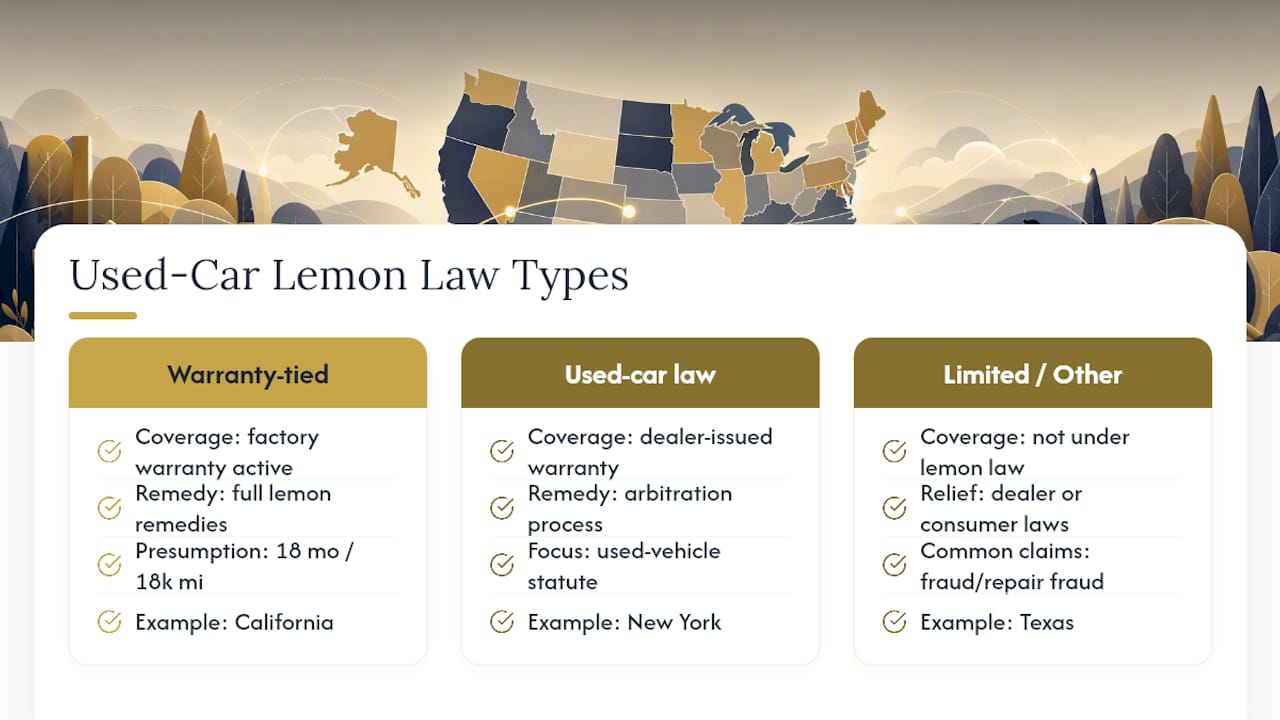
The first pattern, and the strongest for consumers, treats a used car as covered whenever the original manufacturer’s new-vehicle warranty has not expired. California runs on this model. The Song-Beverly Consumer Warranty Act extends full lemon law remedies to used vehicles as long as that factory warranty is still in effect at the point of sale, with presumption thresholds that make it easier to prove your case once certain repair counts are hit.
The second pattern involves states writing separate statutes aimed specifically at used-car sales. New York is the clearest example. Under the New York Attorney General’s used-car lemon law fact sheet, dealers must issue a written warranty on covered used vehicles, and if they cannot fix a covered defect after a reasonable number of attempts, the buyer can request arbitration.
The third pattern is thinner protection. Some states, and Texas guidance is a good illustration, build their lemon law framework mainly around new vehicles, leaving used-car buyers to lean on dealer warranty terms, general consumer protection statutes, or fraud claims instead.
Statistic callout: California’s presumption model kicks in when a defect first appears within 18 months or 18,000 miles of delivery, a threshold that applies to qualifying used vehicles the same way it applies to new ones.
Every state posts its own lemon law guidance through its attorney general or DMV. Look up your state’s page directly and read the arbitration program rules before you assume you have no case.
What Warranty Coverage Makes a Used Car Eligible?
A used car becomes eligible for lemon law protection through one of three warranty paths, and knowing which one applies changes both your strategy and your odds.
- The manufacturer’s original warranty is still running. If the factory bumper-to-bumper or powertrain warranty has not lapsed by mileage or calendar date, you generally inherit the same rights a new-car buyer would have, including repurchase or replacement remedies under statutes like Song-Beverly.
- The dealer issued its own written warranty. Independent and buy-here-pay-here dealers in California must provide a written warranty of at least 30 days or 1,000 miles under California Civil Code Section 1795.51. A dealer that skips this requirement, or that sold the car “as is” without meeting the specific disclosure steps required to make that disclaimer valid, may leave an implied warranty in place instead.
- The car carries a certified pre-owned or extended warranty. CPO programs often extend factory-backed coverage, which can preserve lemon law eligibility, but a third-party extended warranty from an unrelated administrator usually does not.
Private-party sales sit outside almost every lemon law statute, since no dealer or manufacturer warranty typically attaches. That leaves buyers with fraud or misrepresentation claims as the more realistic path.
What Repair Attempts and Timelines Trigger a Claim?
A used car crosses into likely lemon law territory once it hits specific, well-documented thresholds, not just a vague sense that “this car keeps breaking.”
California’s presumption uses the same numbers for used vehicles with an active manufacturer warranty as it does for new ones: the defect surfacing within 18 months or 18,000 miles of delivery, whichever comes first. That is a presumption, not a hard requirement. A claim can still succeed outside that window, but proving it gets harder without the presumption working in your favor.
Repair-attempt benchmarks most attorneys and state guidance rely on:
- Four repair attempts for the same recurring problem, or
- Two attempts if the defect is safety-related, such as brake or steering failure, or
- 30 cumulative days out of service for repairs during the warranty period.
Statistic callout: Manufacturers that fail to fix a defect after the fourth qualifying attempt, or the second for a safety issue, are often presumed to have violated their warranty obligations under California’s framework.
For used-vehicle buybacks, the mileage offset that reduces your refund is calculated from the miles you personally drove before the first repair attempt, not the vehicle’s total odometer reading. Every state runs its own version of these numbers, so confirm the exact thresholds through your state’s attorney general or DMV guidance before assuming California’s figures apply where you live.
What Can You Recover From a Used-Car Lemon Law Claim?
Used-car buyers who qualify typically choose between a full repurchase and a replacement vehicle, and the buyback math works differently than most people expect.
A repurchase generally returns your purchase price, sales tax, registration fees, and any remaining loan payoff to your lender, minus a mileage offset. That offset, because it is calculated from your own miles before the first repair attempt rather than the car’s full odometer reading, tends to run smaller for used-car buyers than for someone who bought the vehicle new and drove it thousands of miles before trouble started.
Remedies available to qualifying used-car buyers include:
- Full repurchase of the vehicle at the price you paid, adjusted for mileage
- A comparable replacement vehicle from the manufacturer
- A negotiated cash settlement covering incidental costs like towing, rental cars, and lost wages
- A civil penalty of up to two times actual damages when a manufacturer willfully ignored its warranty obligations under California law
Picture a used pickup bought with 40,000 miles left on its factory powertrain warranty. The transmission fails four times in eight months. The buyer’s mileage offset gets calculated only from the miles driven before that first failed repair, not the truck’s full mileage history, which is why documenting the date of that first visit matters so much.
What Records Do Lawyers Actually Use to Win These Cases?
Attorneys who handle used-car lemon law claims win or lose based almost entirely on paper, not persuasion. The strength of your file usually decides the case before a single phone call to the manufacturer happens.
Build a claim file with these documents:
- Every repair order, from the first visit to the last, showing the date, mileage, complaint, and what the shop actually did.
- Your purchase contract and warranty booklet, showing the sale date, odometer reading at purchase, and warranty terms in effect.
- All written and text communications with the dealer or manufacturer, including any denial of coverage.
- Lender payoff statements, since a repurchase calculation needs to account for any loan balance still owed.
- Loaner or rental car records for every day the vehicle sat in the shop, which help prove the 30-day out-of-service threshold.
Record the odometer reading at every single repair visit, especially the first one, since that mileage anchors the buyback offset calculation. Note the dealer name and service advisor for each visit too. Patterns of the same defect appearing across multiple owners of the same model can sometimes be corroborated with NHTSA recall and defect data, which documents when a manufacturer has already acknowledged a widespread problem.
Watch for dealer misrepresentations along the way, such as claiming a car was never in an accident or falsely advertising it as certified. Those statements can support a separate dealer fraud claim even if the lemon law angle falls short. Attorneys who take these cases on contingency review your file for free, so there is little downside to asking early before repair records go missing.
Pro Tip: Photograph every repair order the same day you receive it. Shops occasionally lose paper copies, and a phone photo with a timestamp is often the only proof you have that a repair attempt happened at all.
Related reading on documentation standards: California Lemon Law Repair Attempt Standard and Repair Attempt Evidence That Wins a Lemon Law Case walk through the exact evidence patterns that move a claim forward.
How Do You Start a Used-Car Lemon Law Claim?
Starting a claim follows a fairly consistent sequence no matter which state you live in, though the exact filing mechanism differs.
- Confirm your warranty status. Check whether the manufacturer warranty was active at the time of sale, or whether a dealer-issued warranty applies instead.
- Notify the manufacturer in writing, following the notice procedure spelled out in your warranty booklet, and give them a genuine opportunity to repair the defect.
- Collect every repair document as the process unfolds, not after the fact when memories and paperwork fade.
- Pursue a state-certified arbitration program or file a complaint with your state’s attorney general or DMV, depending on what your state offers.
Timing matters more than most buyers realize. California’s AB 1755 shortened the window for filing a lemon law claim, requiring consumers to file within one year of the warranty’s expiration date. Miss that deadline and a case that would otherwise have been strong can disappear entirely. Arbitration tends to move faster than court litigation, but an attorney’s involvement often changes how the manufacturer responds from the first letter onward, since manufacturers negotiate differently once they know an experienced lawyer is reviewing the file.
What If Lemon Law Doesn’t Apply to Your Used Car?
A “no” on lemon law eligibility is not the end of the conversation. Several other legal paths remain open depending on what actually happened at the sale.
- Dealer fraud or misrepresentation claims apply when a dealer lied about accident history, mileage, or certified status. These claims require documentation like the sales contract, advertising materials, and any written statements the dealer made.
- Magnuson-Moss Warranty Act claims can help when a written warranty existed but was breached, since this federal law works alongside state lemon laws and, according to the BBB National Programs overview, sometimes covers gaps that state statutes miss.
- Small claims or civil litigation remains an option for damages too small or too fact-specific for a formal lemon law claim, though the dollar caps vary by state.
Where to Verify Your State’s Used-Car Lemon Law Rules
Check these primary sources directly rather than relying on secondhand summaries:
- California DOJ consumer guidance for Song-Beverly text and presumption thresholds
- New York Attorney General’s used-car fact sheet for warranty and arbitration requirements
- Texas DMV lemon law guidance for a comparison state approach
- NHTSA’s recall database for defect patterns tied to your specific make and model
These pages carry the actual filing deadlines and forms your state requires, which change more often than most consumer blogs update.
Get a Free Case Review From a California Lemon Law Attorney
If you bought a used car, truck, SUV, or RV in California and it has been back to the shop more times than you can count on one hand, you do not have to figure out the warranty language alone. The Law Offices of Jeffrey Le Pere reviews used-vehicle cases at no upfront cost, and representation runs entirely on contingency: you owe nothing unless the firm recovers money on your behalf.
Jeff Le Pere spent 11 years defending manufacturers and dealerships before switching sides, so he reviews your repair file the same way the manufacturer’s own defense team will, which means fewer surprises later in the process. The firm’s auto lemon law practice covers used cars, trucks, and SUVs with lingering manufacturer warranties, and its RV lemon law practice handles the motorhomes, fifth wheels, and travel trailers most firms turn away because of their layered warranty structures. If a dealer sold you a used vehicle with a false “certified” label or hid known defects, the firm’s dealer fraud practice covers that ground too.
Start by requesting a free case review and bringing your repair orders, purchase contract, and warranty paperwork. That single step tells you within days whether your used vehicle qualifies.
An Attorney’s Perspective on Used-Car Lemon Claims
Most used-car buyers assume lemon law simply does not apply to them, and that assumption costs people money they are legally owed. The warranty clock, not the odometer, decides most of these cases, and dealers know that buyers rarely check the fine print on when factory coverage actually expires. A used truck with 20,000 miles left on its powertrain warranty carries real leverage that its owner usually has no idea exists.
The bigger blind spot is documentation. Buyers who keep every repair order end up with cases that settle faster and for more, while buyers who tossed the paperwork after each visit struggle to prove a pattern even when the defect was obviously recurring. Manufacturers count on gaps in the file. Close those gaps early, and a used-car claim can move about as fast as a new-car one.
— Jeff Le Pere
This article is general information, not a substitute for advice from a qualified lawyer. Consult a qualified legal professional about your own circumstances before acting on anything here.
Sources
- Used-car lemon law: fact sheet | New York Attorney General
- Buying and Maintaining a Car | State of California - Department of Justice - Office of the Attorney General
- California Civil Code § 1795.51 (leginfo.ca.gov)
- Texas Department of Motor Vehicles - Lemon law