California RV Lemon Law: One Year Filing Window, Six Year Cap

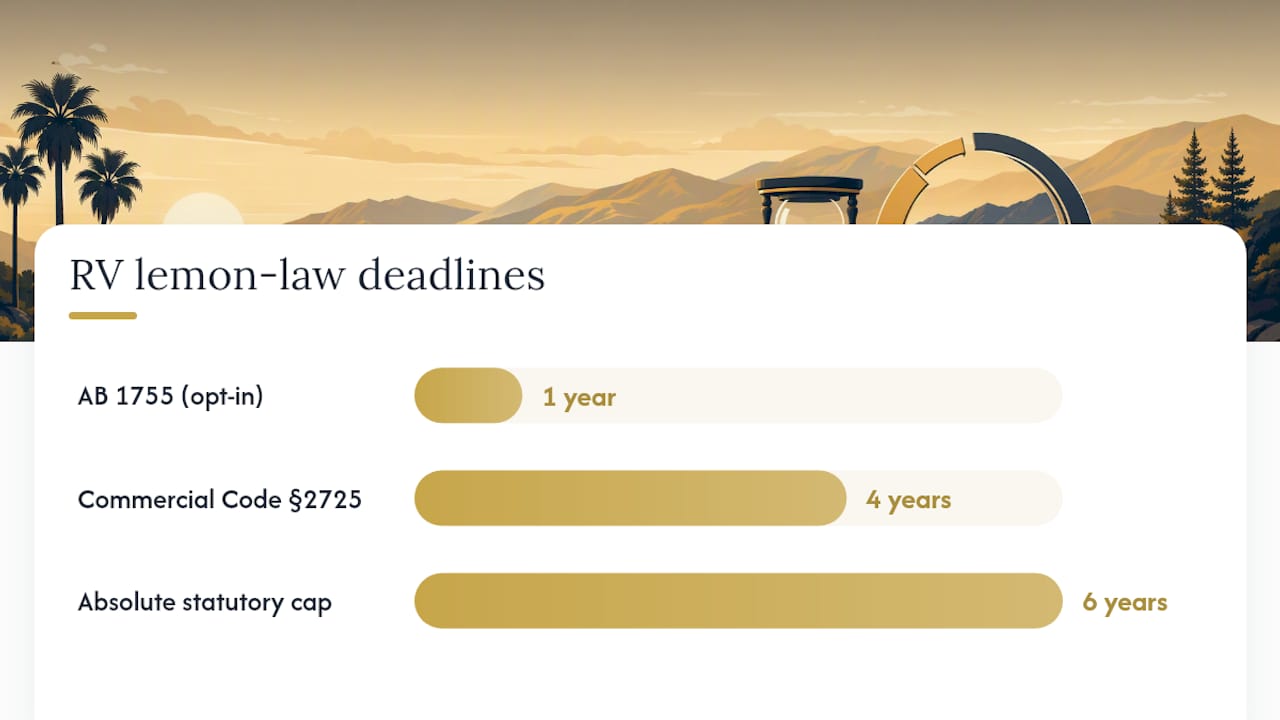
California’s lemon law statute of limitations depends on whether your vehicle’s manufacturer opted into the new AB 1755 procedures. If it did, you generally have one year after your applicable express warranty expires, capped at six years from delivery. If it did not, the older four-year rule under Commercial Code §2725 still governs. Confirm your manufacturer’s opt-in status now, and start collecting repair records today, especially if you’re already several years past delivery.
TL;DR:
- Manufacturers that have not opted into AB 1755 still follow the four-year statute starting from vehicle delivery, unless the warranty explicitly extends coverage based on discovery.
- Opted-in manufacturers require claims within one year of the warranty’s expiration or six years from delivery, with strict pre-suit notice and mediation processes.
- Tolling events such as repair delays and pre-suit notice periods can extend the deadline, but owners must carefully document all repair efforts and delays.
- Failing to send proper pre-suit notice forfeits eligibility for civil penalties, which are up to twice the damages, even if the underlying claim is successful.
- RV owners face complex deadline calculations due to multiple warranties and prolonged repair times, making early documentation and verification of manufacturer opt-in status crucial.
Table of Contents
- What is the lemon law statute of limitations in California?
- How do AB 1755 and SB 26 change your filing timeline?
- Which deadline applies to my vehicle?
- When does the clock start, and what pauses it?
- What must a pre-suit notice include, and what happens if you skip it?
- Does the 18-month/18,000-mile rule set my filing deadline?
- What can I recover, and what if I missed a deadline?
- What should I do right now to protect my claim?
- Why RV owners face harder deadline calculations
- What should I do based on how long it’s been since delivery?
- Get a Free Case Review Before Your Deadline Closes
- Where to verify these statutes and deadlines yourself
- Sources
What is the lemon law statute of limitations in California?
Two different deadlines can govern a California lemon law claim, and which one applies depends entirely on your manufacturer’s opt-in status under a 2024 legislative overhaul.
The older rule comes from Commercial Code §2725, which sets a four-year statute of limitations for breach-of-warranty claims. This has been the default in California for decades, and it still applies to any manufacturer that has not opted into the new procedural track created by AB 1755 and SB 26. Under §2725, the clock usually starts running the day you take delivery of the vehicle, not the day the defect shows up.
There’s an important wrinkle. If your warranty explicitly covers “future performance”, meaning it promises the vehicle or a component will perform correctly over a specific future period, the four-year clock can start at discovery of the defect instead of at delivery. That distinction matters more than most owners realize, because it can add years to your effective deadline depending on how the warranty is written.
The newer rule, created by AB 1755 and its companion bill SB 26, applies only to manufacturers that have chosen to opt into the revised procedures. For those manufacturers, you must file within one year after the applicable express warranty expires, with an absolute outer limit of six years from the vehicle’s original delivery date. That six-year cap is a hard stop. No tolling event or notice period pushes it further out.
Here’s the practical breakdown of who falls under which rule:
- Manufacturers that opted into AB 1755: one year after the applicable express warranty expires, six-year absolute cap from delivery, plus a mandatory 30-day pre-suit notice and mediation requirement.
- Manufacturers that have not opted in: the traditional four-year statute of limitations under Commercial Code §2725, generally running from delivery unless the future-performance exception applies.
- All owners, regardless of track: the Song-Beverly Consumer Warranty Act still defines your substantive rights to repurchase, replacement, or cash settlement. The statute of limitations only controls how long you have to file, not what you can recover.
SB 26 is the mechanism that lets a manufacturer choose the new track in the first place. Once a manufacturer opts in, its vehicles fall under the AB 1755 procedural rules for pre-suit notice, mediation, and the one-year deadline. The Department of Consumer Affairs publishes and updates the list of manufacturers that have opted in, and checking that list is the single most important first step in figuring out which deadline applies to your case. Manufacturers can opt in at different times, and the list has grown steadily since AB 1755 took effect, so a brand that wasn’t on the list last year may be on it now.
How do AB 1755 and SB 26 change your filing timeline?
AB 1755 replaces open-ended litigation with a structured, front-loaded process: written notice, a short manufacturer response window, and mandatory mediation, all before a lawsuit gets very far.
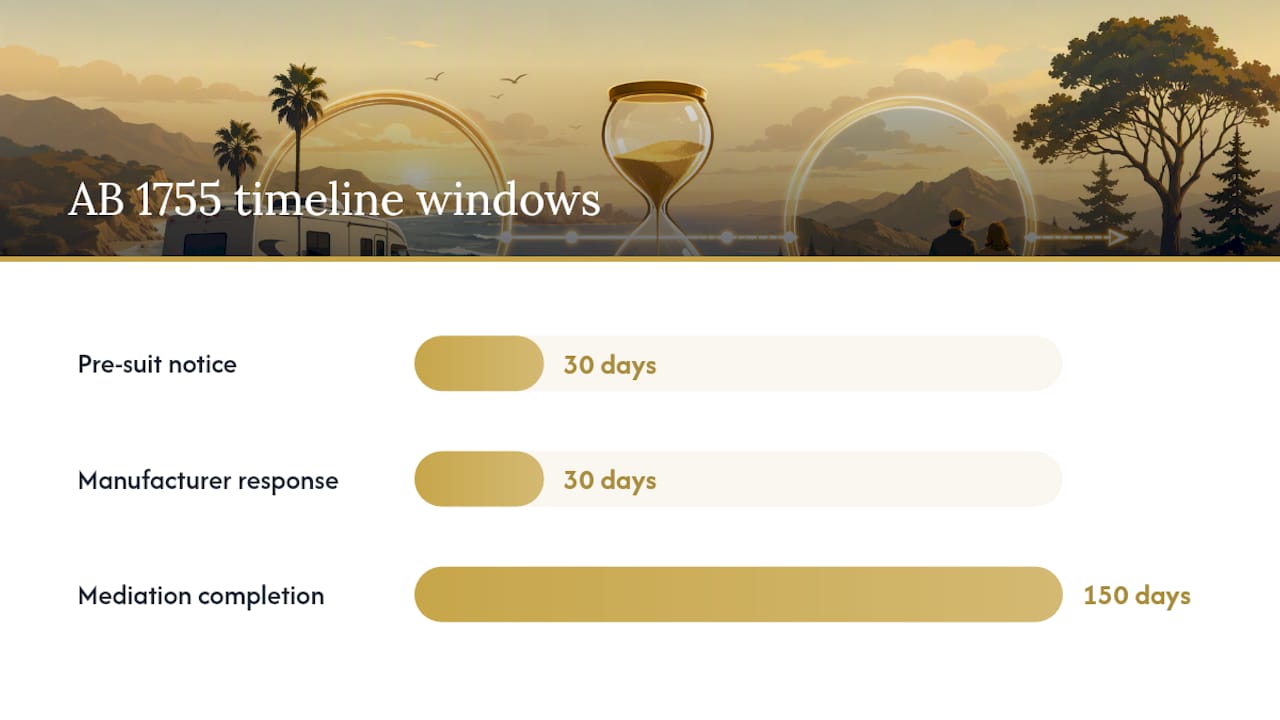
For opted-in manufacturers, you can’t just file a claim and wait for a court date. The statute requires you to send a written pre-suit notice at least 30 days before filing if you want to preserve your right to civil penalties. That notice has to include your vehicle identification number, a summary of your repair history, and a specific request for repurchase or replacement. Skip this step, or send an incomplete notice, and you risk losing the civil penalty portion of your claim entirely, even if you still recover a refund or replacement.
Once a case is filed against an opted-in manufacturer, the law requires mediation. Under CCP §871.26, mediation must be scheduled and completed within 150 days of the manufacturer’s responsive pleading, and discovery is stayed during that window to push both sides toward settlement rather than protracted litigation. The American Arbitration Association and similar mediation providers handle much of this caseload, and the compressed timeline means cases that used to drag on for a year or more can now resolve far faster, for better or worse depending on how prepared you are.
Statistic callout: Under AB 1755, mediation must occur within 150 days of the manufacturer’s responsive pleading, and the pre-suit notice window is fixed at 30 days before filing, according to the bill text of AB 1755.
Here’s what changes in practice once a manufacturer opts in:
- Faster resolution, less room for error. The compressed mediation schedule rewards owners who arrive with complete repair documentation and penalizes those who don’t.
- Civil penalties are conditional. You generally need a compliant pre-suit notice to preserve eligibility for the civil penalty of up to two times your actual damages.
- Discovery is stayed early on. That limits your ability to gather evidence through formal legal channels before mediation, so your own records carry more weight.
- The manufacturer has 30 days to respond. If it offers restitution or replacement within that window and you accept, the case can resolve before it ever reaches a courtroom.
This isn’t a minor tweak to old Song-Beverly procedure. It’s a genuinely different track that rewards early preparation and can quietly cost you the right to civil penalties if you file without sending proper notice first. Learn more about how AB 1755 shortens lemon claim timelines and what that means for your specific filing window.
Which deadline applies to my vehicle?
Start by checking whether your manufacturer has opted into the AB 1755 track, because that single fact determines whether you’re working with a one-year deadline or a four-year deadline.
The Department of Consumer Affairs maintains an updated opt-in list, and you should search it by your manufacturer’s exact legal name, not just the brand name you see on the vehicle. RV owners in particular need to be careful here, because a motorhome or fifth wheel can involve separate warranties from the chassis manufacturer, the coach builder, and individual component makers like the generator or slide-out mechanism. Each of those entities might have a different opt-in status.
Follow these steps to figure out your actual deadline:
- Check the DCA opt-in list using your manufacturer’s full legal name, then repeat the search for any secondary manufacturer if your vehicle has more than one (common with RVs).
- Identify the applicable express warranty, meaning the specific written warranty that actually covers the defect you’re dealing with, since a powertrain warranty and a bumper-to-bumper warranty can expire on different dates.
- Pull your delivery date from the purchase contract or original paperwork, since this anchors both the four-year default clock and the six-year absolute cap.
- Log every repair attempt, including the date the vehicle went into the shop, the date it came out, the mileage at each visit, and what the repair order says was diagnosed and fixed.
- Calculate days out of service, because this figure matters both for the Tanner presumption discussed later and for any tolling argument tied to your specific timeline.
Pro Tip: Save the actual written warranty booklet, not just the summary page from the dealer. Manufacturers sometimes amend warranty terms mid-model-year, and the exact expiration language for your specific component can differ from what a general sales brochure implies.
If you own an RV, this step is more complicated than it sounds. A single vehicle might carry a chassis warranty from one manufacturer, an appliance warranty from a third-party maker, and a structural warranty from the coach builder, each running on a different clock. This guide to identifying the right AB 1755 deadline for your vehicle walks through how to sort out which warranty actually governs your defect.
When does the clock start, and what pauses it?
Your filing clock generally starts on the date you took delivery of the vehicle, but discovery-based accrual and specific tolling events can shift that date substantially.
Under Commercial Code §2725, the default rule is delivery-based accrual. The four-year period starts the day you drive the vehicle off the lot. But if the warranty explicitly extends to future performance, meaning it promises the vehicle will function correctly over a defined future period rather than just at the moment of sale, accrual can shift to the date you discovered or reasonably should have discovered the defect. This future-performance exception is one of the most overlooked provisions in California lemon law, and it can make the difference between a claim that’s alive and one that’s already expired.
For AB 1755 cases, several tolling events can pause the running clock:
- Time the vehicle spends out of service for repair can toll the limitations period for that duration, since the law doesn’t want the manufacturer’s own repair delays to eat into your filing window.
- The pendency of qualified third-party dispute resolution, such as a manufacturer’s certified arbitration program, tolls the clock while that process is active.
- Pre-suit notice periods toll the deadline as well, though this tolling is capped at 60 days and doesn’t extend indefinitely.
Here’s a concrete example. Say your vehicle’s applicable warranty expired on June 1, 2026, putting your one-year AB 1755 deadline at June 1, 2027. If the vehicle then spent 45 days in the shop for a warranty repair during that window, and you also sent a 30-day pre-suit notice, both periods could toll the clock and push your effective deadline into August 2027, depending on how the tolling periods overlap. These calculations get complicated fast, which is exactly why owners who wait until the last few weeks to sort this out often run into trouble.
What must a pre-suit notice include, and what happens if you skip it?
A compliant pre-suit notice under AB 1755 must include your VIN, a documented repair history, and a specific written request for repurchase or replacement, sent at least 30 days before you file.
The notice isn’t a formality. It’s the trigger that starts the manufacturer’s response clock and, more importantly, it’s the gatekeeper for civil penalty eligibility. If you file suit against an opted-in manufacturer without having sent proper notice, or if your notice is missing required information, you generally forfeit the right to collect the civil penalty of up to two times your actual damages, even if you still win a refund or replacement on the underlying claim.
A compliant notice should include:
- Your full VIN, matching exactly what appears on the vehicle’s registration and title documents.
- A complete repair history, listing every visit, the reported defect, the repair performed, and the dates in and out of service.
- A specific demand, stating clearly whether you’re seeking repurchase, replacement, or another defined remedy.
- Delivery to the correct manufacturer entity, since sending notice to a dealer instead of the manufacturer, or to the wrong subsidiary in a multi-brand corporate structure, can invalidate the notice.
Once the manufacturer receives a compliant notice, it has 30 days to respond. If the manufacturer offers restitution or replacement within that window and you accept, the case typically resolves without further litigation. But there’s a strategic catch worth understanding: a timely, compliant offer within that 30-day window can eliminate your ability to later collect civil penalties, even if the manufacturer dragged its feet for years beforehand. That statutory mechanic cuts both ways, rewarding manufacturers who respond quickly and limiting what a consumer can ultimately recover if they accept.
Does the 18-month/18,000-mile rule set my filing deadline?
No. The 18-month, 18,000-mile window is an evidentiary presumption, not a statute of limitations, and confusing the two is one of the most common and costly mistakes lemon law claimants make.
This presumption, sometimes called the Tanner presumption, gives you a shortcut for proving your vehicle qualifies as a lemon if certain repair thresholds are met within the first 18 months or 18,000 miles, whichever comes first. It shifts the burden of proof in your favor during that window, but it has nothing to do with how long you have to file a claim. A vehicle can qualify for the presumption at month six and still be governed by a filing deadline that runs years later, or a defect can surface at month 30, well outside the presumption window, and still support a valid claim under ordinary lemon law standards.
Courts generally look for these repair patterns as strong evidence, whether or not the presumption technically applies:
- Two or more repair attempts for a defect that creates a serious safety hazard.
- Four or more repair attempts for the same defect that doesn’t rise to a safety hazard.
- Thirty or more cumulative days out of service for repair of one or more defects covered by the warranty.
Pro Tip: Don’t treat the presumption as a safety net just because your vehicle qualifies. The statute of limitations question is entirely separate and often the deciding factor, so track your filing deadline independently of whatever repair threshold your vehicle has or hasn’t hit.
Special cases complicate this further. Electric vehicle battery defects, for instance, often fall under separate, longer warranty terms than the rest of the powertrain, which affects both the presumption calculation and your applicable filing deadline. Intermittent defects, the kind that appear during one shop visit and mysteriously vanish by the next, require especially careful documentation, since inconsistent repair orders can undercut an otherwise strong case. This breakdown of California’s repair attempt standard covers how courts weigh these patterns in practice.
What can I recover, and what if I missed a deadline?
Missing a filing deadline doesn’t automatically mean you walk away with nothing, but it does typically eliminate your strongest remedies and shifts you toward more limited legal options.
Under the Song-Beverly Consumer Warranty Act and the Tanner presumption framework, a successful lemon law claim can recover a full vehicle repurchase or refund, a replacement vehicle, a negotiated cash settlement, a civil penalty of up to two times your actual damages when the manufacturer’s failure to comply was willful, and recovery of your attorney’s fees.
- Repurchase or refund: the manufacturer buys back the vehicle, minus a mileage offset for use before the defect first appeared.
- Replacement vehicle: a comparable new vehicle in place of the defective one.
- Cash settlement: a negotiated payment that lets you keep the vehicle.
- Civil penalties: up to two times actual damages for willful violations, conditioned on proper pre-suit notice under AB 1755.
- Attorney’s fees: recoverable from the manufacturer in a successful claim, which is why contingency representation is viable in the first place.
If you’ve missed the applicable statute of limitations, whether that’s the four-year default or the one-year AB 1755 window, your lemon law claim itself is likely barred. That doesn’t necessarily close every door. Depending on the facts, you might still have a general breach-of-contract claim, though these typically carry weaker remedies and don’t include the civil penalty or automatic fee-shifting that make lemon law claims so effective for consumers. Understanding what happens once the lemon law deadline passes can help you see what, if anything, remains available.
What should I do right now to protect my claim?
Start collecting documentation today, regardless of how confident you feel about your deadline, because the paper trail you build now is what determines whether a filed claim succeeds later.
Gather and preserve these specific items:
- Every repair order, from every visit, even for issues that seem minor or unrelated, since patterns across multiple small problems can matter as much as one big defect.
- All dealer invoices and service-lane receipts, which establish dates, mileage, and what was billed to whom.
- Your complete warranty documentation, including the specific booklet for each component if you own an RV with multiple manufacturers involved.
- The original purchase or lease contract, which anchors your delivery date for both the four-year default and the six-year absolute cap.
- Written communications with the dealer and manufacturer, including emails and text messages, especially anything where a representative acknowledged the defect.
- Your vehicle identification number, confirmed against your registration, title, and every repair order to make sure it’s recorded consistently.
Beyond documentation, take these immediate steps: send a written complaint to both the dealer and the manufacturer describing the defect in specific terms, photograph any visible defect with a timestamp, and keep a simple calendar log of every date the vehicle went in and out of service. Ask the shop for written acknowledgment of each reported problem, even if it seems like an obvious formality.
Pro Tip: If you’re within a few months of what you believe is your filing deadline, don’t wait to “see if the problem gets worse.” Send your pre-suit notice or consult an attorney immediately, since AB 1755’s 30-day notice window has to run before you can file, and waiting too long can push you past your own deadline before the notice period even completes.
Why RV owners face harder deadline calculations
Twenty-five years in this practice, including eleven spent on the other side of the table defending manufacturers, taught me that RV cases break the simple deadline calculations that work fine for a car or truck.
A standard passenger vehicle usually has one manufacturer and one dominant warranty. An RV, whether it’s a Class A motorhome, a fifth wheel, or a travel trailer, often has separate warranties from the chassis manufacturer, the coach builder, and individual component suppliers for things like the generator, slide-out mechanism, or awning system. Each of those warranties can carry a different expiration date, and if the manufacturer that built the defective component hasn’t opted into AB 1755 while the chassis manufacturer has, you could be working with two different statutes of limitations on the same vehicle.
RVs also tend to sit in the shop longer than cars. A specialty part backordered from a component manufacturer can keep a motorhome out of service for months, not weeks, which makes tolling arguments both more valuable and more contested. Manufacturers dispute these calculations aggressively, and having spent over a decade building that defense strategy for the other side, I know exactly which documentation gaps they’ll try to exploit.
During the pre-suit phase, our firm confirms the opt-in status for every manufacturer involved in your vehicle, not just the primary one, assembles a complete repair history across every component, drafts a pre-suit notice that meets AB 1755’s specific requirements, and identifies every available tolling argument before a deadline can quietly pass. That groundwork determines whether a claim succeeds long before it ever reaches mediation.
What should I do based on how long it’s been since delivery?
Your priorities shift dramatically depending on where you sit on the timeline, and treating a six-month-old defect the same way as a five-year-old one is a mistake that costs owners real money.
| Time since delivery or discovery | Priority actions |
|---|---|
| 0 to 6 months | Keep the vehicle under active repair documentation, request written repair orders every visit, and confirm your manufacturer’s opt-in status early so you know which deadline track applies. |
| 6 to 12 months | Verify your applicable express warranty’s exact expiration date, calculate days out of service, and consult an attorney well before either the one-year or four-year deadline approaches. |
| 48 to 72 months | Move urgently. You’re likely approaching or past the four-year default and possibly nearing the six-year absolute cap, so get a professional review of accrual and tolling arguments immediately. |
If you’re inside the first six months, your job is mostly about documentation discipline. Between three and six years out, the calculation gets genuinely complicated, and small facts, like whether a warranty covers future performance or whether a repair delay qualifies for tolling, can decide whether your claim is still viable. Past six years from original delivery, the AB 1755 absolute cap likely applies regardless of tolling, though a four-year claim under the older rule might still be alive depending on your manufacturer’s opt-in history and your discovery date.
— Jeff Le Pere
Get a Free Case Review Before Your Deadline Closes
If your RV, truck, or SUV has been in and out of the shop and you’re not sure which filing deadline applies, The Law Offices of Jeffrey Le Pere reviews your repair history and opt-in status at no cost, and you pay nothing unless the case recovers money. Every case runs on contingency, which means the manufacturer or dealer covers the legal fees when you win or settle, not you.

What sets this firm apart is the vantage point. Jeff Le Pere spent eleven of his twenty-five years in practice defending manufacturers and dealerships, which means he built the exact playbook that manufacturers now use against consumers, and he uses that same knowledge in reverse. RV cases get particular attention here, a category many lemon law firms avoid entirely because multiple overlapping warranties and component manufacturers make the deadline math harder than a typical car case. You also speak directly with your attorney rather than a case manager, a deliberate departure from the high-volume firm model where advertising budgets often come before your actual claim.
Recovery can include a full repurchase, a replacement vehicle, a cash settlement, or a civil penalty of up to two times your damages when a manufacturer willfully ignored its warranty obligations. If your issue involves a dealer misrepresenting a vehicle’s condition or certification status, the firm’s dealer fraud practice covers that ground as well.
Request a free case review today and upload your VIN, repair orders, and warranty documents so the firm can confirm your manufacturer’s opt-in status and calculate your actual filing deadline before it closes.
Where to verify these statutes and deadlines yourself
The full text of AB 1755 lays out the one-year filing deadline, the six-year cap, and the pre-suit notice and mediation requirements in exact statutory language. The Department of Consumer Affairs’ lemon law page publishes the current list of opted-in manufacturers and consumer guidance on the new procedures. California’s court self-help resource on statutes of limitations explains general accrual and tolling concepts that apply across civil claims, including lemon law cases. For broader consumer protection context, Javitch Law Office’s analysis of California pricing statutes covers related civil remedy frameworks worth understanding alongside lemon law procedure.
This article is general information, not a substitute for advice from a qualified lawyer. Consult a qualified legal professional about your own circumstances before acting on anything here.
Sources
- Bill Text - AB-1755 Civil actions: restitution for or replacement of a new motor vehicle.
- California Department of Consumer Affairs - New lemon law
- California Courts Self-Help - Statute of Limitations