California Lemon Law Arbitration: 25 Year Attorney Playbook for ACP Claims

California operates state-certified Lemon Law arbitration through the Department of Consumer Affairs’ Arbitration Certification Program, letting consumers pursue repurchase, replacement, or repair at no filing cost. The program reviews manufacturer-sponsored arbitration under the Arbitration Certification Program (ACP) and typically issues decisions within a few weeks. If your vehicle qualifies, the next move is checking whether your manufacturer runs a certified program or contacting an attorney for a free case evaluation.
TL;DR:
- Only certified arbitration programs meet the state’s standards and can efficiently and impartially handle lemon law claims at no cost.
- Filing an arbitration claim involves submitting supporting records within about 40 days, with decisions typically binding and enforceable through the certified program.
- Arbitration awards mostly include vehicle repurchase or replacement, with specific details on mileage offsets and performance deadlines for manufacturer compliance.
- Legal action offers broader remedies but involves longer timelines and higher costs, making arbitration preferable for straightforward mechanical defect cases.
- Organized documentation and early written notices are essential for building a strong case, especially for RV owners with multiple warranties and complex issues.
Table of Contents
- What Is the Arbitration Certification Program and Why Does Certification Matter?
- How Does the California Arbitration Process Work Step by Step?
- What Can Arbitration Award, and How Do You Enforce It?
- Should You Choose Arbitration or File a Lawsuit?
- How Do You Prepare Evidence for a Strong Arbitration Claim?
- Where Do You File a California Lemon Law Arbitration Claim?
- What Does 25 Years on Both Sides of the Table Teach You About Arbitration?
- How Can The Law Offices of Jeffrey Le Pere Help With Your Claim?
- Where Can You Verify These Rules and File Your Claim?
- Sources
What Is the Arbitration Certification Program and Why Does Certification Matter?
The Arbitration Certification Program is the state office that certifies and monitors every manufacturer-sponsored arbitration program operating under California’s Song-Beverly Consumer Warranty Act. It exists because manufacturers run their own arbitration panels, and without oversight, that setup would invite obvious conflicts of interest.
ACP certification is mandated under California Business and Professions Code sections 472 through 472.5, and it means a program has met specific standards before it can hear your claim.
Certification requires:
- Arbitrator training on Song-Beverly Act standards and impartiality rules
- A documented process for handling consumer complaints about the program itself
- Biennial performance reporting submitted to the state
- Ongoing monitoring, including surveys and complaint investigations, under the ACP’s oversight functions
Not every manufacturer runs a certified program. If yours doesn’t, the ACP’s Lemon Law Q&A guidance confirms you aren’t required to arbitrate at all before filing a civil claim. Checking your manufacturer’s certification status before filing saves time and tells you whether arbitration is even the right first step.
How Does the California Arbitration Process Work Step by Step?
Filing starts with the certified program itself, not a courthouse. Most manufacturers list their arbitration program contact information in the warranty booklet or on the ACP’s program directory.
The process generally runs in this order:
- Submit your claim to the manufacturer’s certified arbitration program, including your vehicle information and a summary of the defect history.
- Choose a presentation format. The ACP’s FAQ guidance confirms you can present your case in person, by phone or video, or through a documents-only submission.
- Submit supporting records, including repair orders, your purchase or lease contract, warranty documents, and any written notices sent to the manufacturer.
- Wait for the arbitrator’s determination. Programs typically aim to decide cases within about 40 days of filing.
- Accept or reject the decision within the window specified in your notification. Accepting makes the award binding on you and the manufacturer.
Filing is free. Arbitration under a certified program costs consumers nothing, which is one reason it’s worth pursuing before jumping straight to litigation.
Bring organized paperwork. A shoebox of receipts works far worse than a simple timeline showing each visit, each symptom, and each day your vehicle sat in the shop.
What Can Arbitration Award, and How Do You Enforce It?
Arbitrators can order repurchase, replacement, or continued repair, and the consumer generally gets to choose between repurchase and replacement when both options are offered. That choice matters because a replacement vehicle carries its own new warranty, while a repurchase hands you cash back.
Awards commonly include these features:
- A mileage offset deducted from your refund, based on miles driven before the first repair visit for the defect
- Exclusion of certain dealer add-ons, like extended service contracts, from the refund calculation in some cases
- A manufacturer performance deadline, typically requiring payment or vehicle exchange within a set number of days after you accept
If the manufacturer doesn’t perform on time, 16 CCR 3398.12 requires the certified program to investigate nonperformance, and the ACP has authority to report noncompliant manufacturers as part of its enforcement backstop. The New Motor Vehicle Board also handles related manufacturer accountability issues. If you’re wondering how mileage offsets get calculated in a repurchase, our RV owner guide on mileage offsets walks through real examples.
Should You Choose Arbitration or File a Lawsuit?
Arbitration is faster and free, but a lawsuit gives you more leverage in complex cases. That’s the tradeoff every California lemon law claim eventually comes down to.
- Arbitration typically resolves in weeks, not months, and costs nothing to file. But once you accept a decision, you’re generally bound by it.
- Court action takes longer and usually involves attorney representation, but it opens the door to broader remedies, including civil penalties for willful violations and claims involving dealer fraud that arbitration panels can’t touch.
- Attorneys working on contingency can pursue either path. A lawyer can file directly in court, or in some cases assist you through arbitration and pivot to litigation if the manufacturer doesn’t perform.
If your dispute involves straightforward mechanical defects, arbitration is worth trying first. If it involves misrepresentation, a rolled-back odometer, or a “certified” vehicle that wasn’t properly inspected, a lawsuit usually serves you better.
How Do You Prepare Evidence for a Strong Arbitration Claim?
Your case is only as strong as your paper trail, and most consumers throw away the documents that would have won it. Every repair visit counts, even the ones where the shop wrote “no problem found,” because that notation still documents a legitimate repair attempt tied to a recurring complaint.
- Keep every repair order, service invoice, and diagnostic printout, no matter how minor the visit seemed.
- Track cumulative days out of service across all repair attempts, not just the most recent one. California’s presumption under Civil Code § 1793.22 kicks in after multiple repair attempts, including at least two safety-related attempts, or a significant cumulative number of days out of service within the warranty period.
- Send a short written notice to the manufacturer once you’re approaching those thresholds, and keep proof of delivery, such as a certified mail receipt or email read confirmation.
- Save loaner and rental car records. They corroborate how long your vehicle was actually unavailable to you.
Pro Tip: Don’t wait until you’re near the presumption thresholds to start organizing paperwork. Build a simple folder, physical or digital, the moment your first repair attempt fails to fix the problem.
For RV owners specifically, this gets more complicated. A motorhome has separate chassis and house system warranties, often from different manufacturers, so you need repair records tied to each subsystem, not just a single dealer file. Our guide on repair attempt evidence that wins a case breaks down exactly what documentation carries the most weight, and our piece on the repair attempt standard explains why you may still have a claim even outside the standard mileage window.
Where Do You File a California Lemon Law Arbitration Claim?
Start with the ACP’s program directory, which lists every certified manufacturer arbitration program along with contact details and filing instructions. Most manufacturer portals are also linked directly from their warranty documentation or customer service pages.
- File directly through your manufacturer’s certified arbitration program if one exists for your brand.
- If no certified program covers your manufacturer, arbitration isn’t required, and mediation through the New Motor Vehicle Board or small claims court become viable alternatives.
- Contact a contingency-fee attorney early if your case involves a safety defect, an RV with multiple warranty holders, or any hint of dealer fraud, since those cases often benefit from legal representation before you ever file paperwork.
- Keep in mind that AB 1755 shortened the filing window, so consumers now generally must file within one year of the warranty’s expiration date. Don’t sit on a claim.
What Does 25 Years on Both Sides of the Table Teach You About Arbitration?
Spending 11 years defending manufacturers taught me exactly which arguments get raised against consumers, and it’s almost always the same two: owner misuse and inadequate notice. Manufacturers will claim you caused the damage, or that you never gave them a fair chance to fix it.
Documentation kills both defenses. A clean timeline of repair attempts, consistent symptom descriptions, and proof of written notice makes it very hard for a manufacturer to argue you didn’t give them the chance to repair the vehicle. If you’re weighing arbitration right now, pull every repair order today, count your days out of service, and send written notice if you’re approaching the presumption thresholds. That paperwork is your entire case.
— Jeff Le Pere
How Can The Law Offices of Jeffrey Le Pere Help With Your Claim?
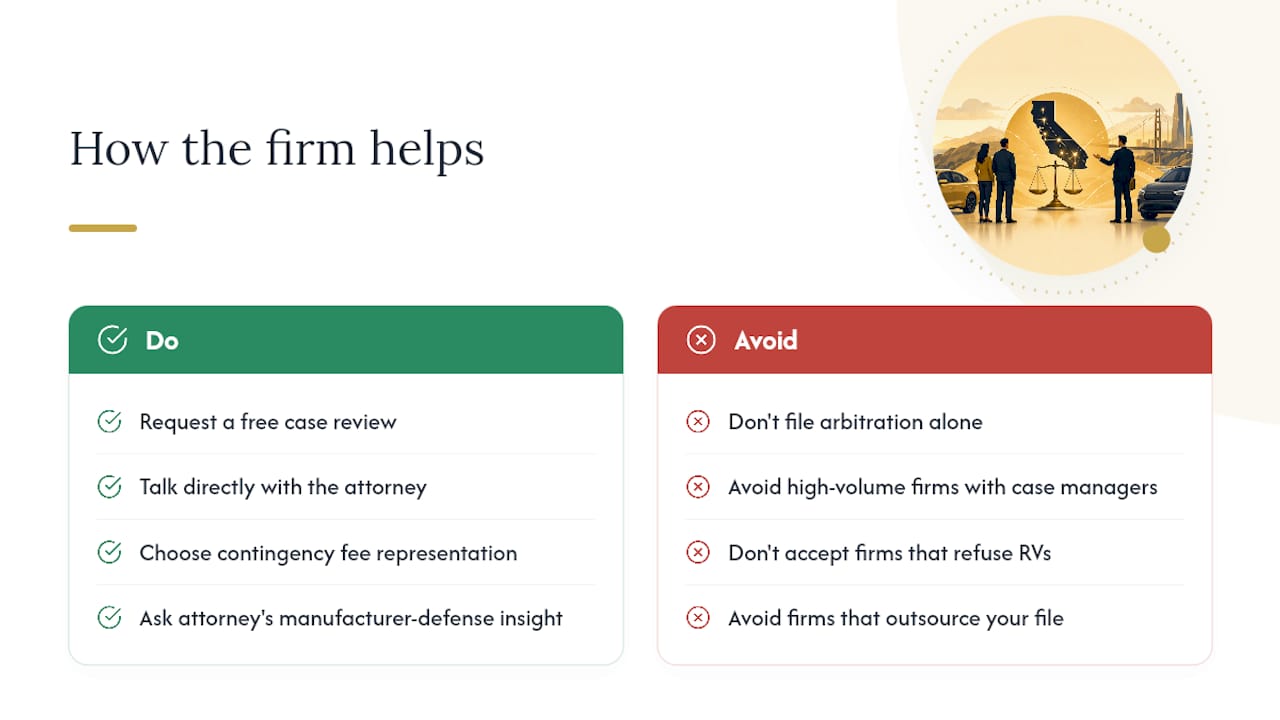
Some law firms offer an alternative to going through arbitration alone or hiring a high-volume firm that hands your case to a rotating cast of case managers. An attorney who previously defended manufacturers may review your repair orders with insight into a manufacturer’s defense strategy.

Some firms represent California owners of defective RVs, motorhomes, fifth wheels, and travel trailers, as well as cars, trucks, and SUVs, including buyers affected by dealer fraud, such as vehicles sold as “certified” without proper inspection. RV cases get particular attention here because most lemon law firms turn them down, put off by multiple component warranties and separate chassis and house systems.
Some firms offer contingency-based legal services, potentially allowing you to find out where you stand without upfront costs. Potential recovery options may include a full repurchase, a replacement vehicle, a negotiated settlement, or a civil penalty in cases where manufacturers have willfully ignored warranty obligations. If your RV or auto claim needs more than a do-it-yourself arbitration filing, request a free case review and talk directly with the attorney handling your case, not a case manager.
Where Can You Verify These Rules and File Your Claim?
Start with the state’s own resources before relying on secondhand summaries.
- Arbitration Certification Program (ACP) for program directories and filing guidance
- ACP Frequently Asked Questions for timelines, presentation options, and acceptance rules
- California Civil Code § 1793.22 for presumption thresholds
- 16 CCR 3398.12 for arbitration notification and performance rules
The New Motor Vehicle Board and the California State Bar’s attorney referral service offer additional avenues if you need help outside ACP’s certified programs.
This article is general information, not a substitute for advice from a qualified lawyer. Consult a qualified legal professional about your own circumstances before acting on anything here.
Sources
- Arbitration Certification Program (ACP) | CA.gov
- Frequently Asked Questions - Arbitration Certification Program
- 16 CCR 3398.12 - Arbitration notification and performance rules
- California Civil Code § 1793.22