How to Escalate an RV Warranty Claim for Known Defects

If your RV has a known defect the dealer or manufacturer refuses to fix, you may be entitled to a full repurchase, a replacement vehicle, or civil penalties under California’s Song-Beverly Consumer Warranty Act or the federal Magnuson-Moss Warranty Act. Three actions preserve those rights right now:
- Document every repair visit with a repair order that names the specific defect, the date, and the odometer reading.
- Send a written pre-suit demand to the manufacturer by certified mail, including your VIN, a summary of the defect, and copies of all repair orders.
- Retain possession of the vehicle for at least 30 days after sending that notice, as California’s AB 1755 requires in many scenarios.
The escalation order to follow: service writer, service manager, dealer general manager, manufacturer customer service, regional or district representative, manufacturer executive office, then external remedies including NHTSA for safety defects, your state Attorney General, and a lemon law attorney.
Key Takeaways
Sending a written pre-suit demand to the manufacturer within one year of warranty expiration, with all repair orders attached, is the single most important step to preserve your right to a repurchase, replacement, or civil penalties under California’s Song-Beverly Consumer Warranty Act.
| Point | Details |
|---|---|
| Document every repair visit | Insist on descriptive repair orders naming the specific defect, date, and odometer at each visit. |
| Send a written pre-suit demand | Mail and email the demand to the manufacturer with your VIN and repair history; AB 1755 requires this before seeking civil penalties. |
| Watch the filing deadlines | California law sets a one-year window after warranty expiration and a six-year outer limit from original delivery. |
| Retain vehicle possession | Keep the vehicle for at least 30 days after sending notice, as AB 1755 requires in many California scenarios. |
| The Law Offices of Jeffrey Le Pere | Offers contingency-based RV lemon law representation; no upfront cost; free case review available at rvautolegalteam.com. |
Table of Contents
- How to escalate an RV warranty claim for a known defect
- What paperwork do you need to prove a known RV defect?
- What are the legal deadlines for RV warranty claims in California?
- What external options can you use when the manufacturer won’t respond?
- When should you contact an RV lemon law attorney?
- Sample templates and a practical escalation timeline
- What manufacturers don’t want you to know about RV warranty disputes
- The Law Offices of Jeffrey Le Pere: RV lemon law representation on contingency
- Sources
How to escalate an RV warranty claim for a known defect
Known RV defect warranty escalation works as a ladder. Each rung gives the manufacturer one more structured opportunity to cure the problem before you move to a remedy with more legal force. Moving too slowly costs you repair attempts. Moving too fast without documentation costs you credibility. Here is the order, what each rung can actually deliver, and what to attach at each stage.
-
Service writer or technician. This is your first contact. The service writer opens the repair order. Insist that the order describes the symptom in plain language (“slide-out motor fails to retract at temperatures below 50°F”) rather than vague shorthand (“checked slide, no issue found”). A repair order that says nothing specific is nearly worthless in court. Give the technician one clear written description of the defect before they touch the vehicle.
-
Service manager. When the technician cannot replicate the defect or the repair does not hold, escalate to the service manager the same day. Ask whether a Technical Service Bulletin (TSB) or manufacturer field advisory covers your defect. If one exists, note the TSB number on the repair order. Manufacturers issue TSBs precisely because a defect is known across multiple units.
-
Dealer general manager. If two repair attempts have not resolved the defect, go to the GM in writing. A short email stating “This is my third visit for the same defect per the attached repair orders” creates a paper trail the GM cannot later claim ignorance of. Attach all prior repair orders.
-
Manufacturer customer service. Call and open a case number, then follow up in writing to the manufacturer’s customer relations address. Reference your VIN, the case number, and the repair history. Ask for a regional representative to inspect the vehicle.
-
Regional or district representative. A regional rep has authority the dealer does not: they can authorize extended repairs, approve goodwill replacements of components, or escalate internally to a buyback team. Request their name and direct contact in writing.
-
Manufacturer executive office or corporate legal intake. When the regional rep stalls or denies the claim, send a formal written demand to the manufacturer’s executive office. This letter should state that you are invoking your rights under Song-Beverly and, where applicable, the Tanner Consumer Protection Act, and that you expect a written response within 30 days per California law.
-
External remedies. If the manufacturer does not respond or refuses, you move outside the dealer-manufacturer chain entirely. That means NHTSA for safety defects, your state Attorney General, third-party arbitration, or a lemon law attorney.
Pro Tip: When you speak with any manufacturer representative, frame the defect as “an existing known defect per repair orders dated [dates].” That phrasing signals to their internal system that a documented repair history exists and triggers a different review path than a general complaint. Ask them to note that exact language in their case file.
What paperwork do you need to prove a known RV defect?
Courts and manufacturers both look for the same core evidence: a clear repair history that shows the defect existed, persisted, and was reported. Build this file from the first visit.
| Document | What to capture | Why it matters |
|---|---|---|
| Purchase or lease agreement | Purchase price, delivery date, VIN, mileage at delivery | Establishes the warranty start date and original delivery |
| Manufacturer warranty booklet | Coverage terms, exclusions, component-specific warranties | Identifies which warranty governs each defect |
| All repair orders | Date, odometer, symptom description, diagnosis, parts replaced | Core proof of repair attempts and defect persistence |
| Communication log | Names, titles, dates, and content of every call or email | Prevents “he said, she said” disputes |
| Photos and videos | Defect visible, date-stamped | Corroborates repair orders; powerful in arbitration |
| Tow and storage receipts | Dates, amounts, vendor | Recoverable as incidental damages |
| Out-of-pocket repair invoices | Parts, labor, rental transportation | Adds to restitution calculation |
| Pre-suit demand letter | Certified mail receipt and email read receipt | Proves notice was given and when |
The repair order is the single most important document in any California RV lemon law claim. Before you sign it, read the “customer complaint” and “technician diagnosis” fields. If either field says only “inspected, no defect found” or “customer states noise,” ask the service writer to add the specific symptom you described. A sample repair-order complaint line that holds up: “Owner reports intermittent generator failure during highway operation; unit shuts off without warning after approximately 20 minutes of use.”
Pro Tip: Manufacturers and dealers sometimes use multiple warranties across chassis, coach, and individual components as a delay tactic. Document which component failed and which warranty booklet covers it. Sending your demand directly to the manufacturer with compiled repair orders reduces that tactic’s effectiveness.
What are the legal deadlines for RV warranty claims in California?
California’s pre-suit notice rules and filing deadlines are the most consequential part of any known RV defect warranty escalation. Miss a deadline and you may lose the right to civil penalties or the claim entirely.
California’s 30/60 day mechanics under AB 1755
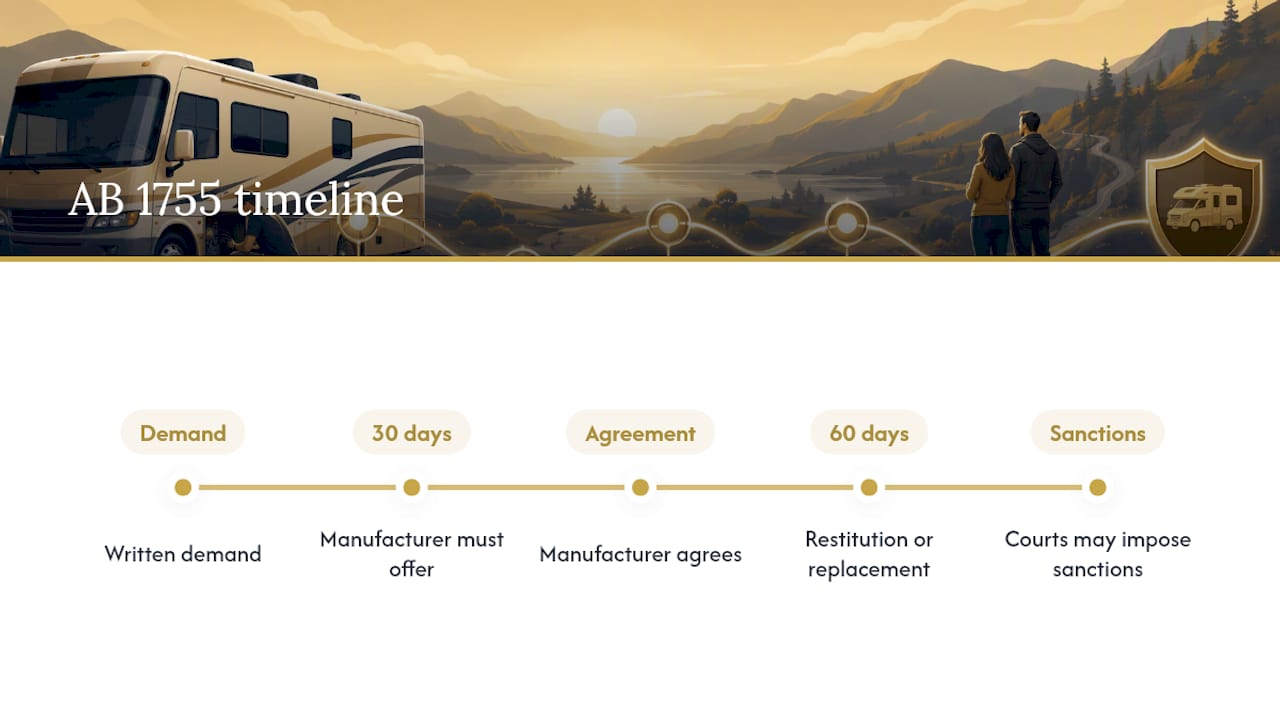
AB 1755 restructured pre-litigation procedures for Song-Beverly restitution and replacement claims. When you send a written demand for repurchase or replacement, the manufacturer has 30 days to respond with an offer. If the manufacturer agrees, it must complete restitution or replacement within 60 days of that agreement. California’s Department of Consumer Affairs confirms both timelines. The Assembly Bill analysis also notes that courts may impose sanctions on manufacturers who repeatedly fail to comply with these mandatory timelines.
Tanner presumption versus Song-Beverly general warranty rules
The Tanner Consumer Protection Act creates a rebuttable presumption that a vehicle is a lemon if it meets certain repair-attempt or days-in-shop thresholds within 18 months or 18,000 miles of original delivery. For RVs, the Tanner presumption applies to chassis and drivetrain components within that window. Habitation components, such as slide-outs, water heaters, and HVAC systems, are governed by Song-Beverly’s general warranty rules and typically do not carry the automatic Tanner presumption.
Pro Tip: Because RVs carry separate chassis and coach warranties, your pre-suit demand may need to go to two different manufacturers: the chassis maker (Ford, Freightliner, Ram) and the coach builder (Winnebago, Thor, Coachmen). Identify which component failed and which entity issued the warranty for it before you send notice. Sending to the wrong party restarts your clock.
For a deeper look at what makes RV lemon cases different from car cases, the split between chassis and habitation coverage is the central complication.
What external options can you use when the manufacturer won’t respond?
External remedies serve two purposes: they create additional pressure on the manufacturer, and some of them generate official records that strengthen a later lawsuit or arbitration.

NHTSA safety complaints. When your defect involves a safety risk, such as brake failure, steering loss, or fire hazard, file a complaint at the NHTSA recall portal. NHTSA complaints can trigger investigations and manufacturer recalls. They also create a federal record that the defect was reported.
State Attorney General consumer division. Most state AGs maintain a consumer protection complaint portal. Filing there creates a government record and, in some states, triggers a mandatory manufacturer response. In California, the AG’s office handles patterns of consumer warranty violations.
BBB complaint. A BBB complaint rarely produces a binding remedy, but it creates a documented escalation record and sometimes prompts a manufacturer’s customer relations team to reopen a closed case.
Certified arbitration programs. Some manufacturers participate in arbitration programs certified by the California Department of Consumer Affairs. Whether the outcome is binding depends on the manufacturer’s program terms and enrollment. DCA-certified arbitration is generally faster and less formal than civil litigation, but it caps some remedies and may not award civil penalties.
Small claims court. California small claims handles disputes up to $12,500 for individuals. This route works for incidental damages like towing and rental costs but cannot deliver a full repurchase or civil penalties.
Civil suit with a lemon law attorney. A civil suit under Song-Beverly or the Magnuson-Moss Warranty Act can produce a full repurchase, a replacement vehicle, a cash settlement, and civil penalties of up to two times actual damages when a manufacturer willfully ignored its warranty obligations. Attorney fees are paid by the manufacturer if you prevail, not by you.
- NHTSA: best for safety defects; creates federal record; free to file.
- State AG: best for patterns of manufacturer misconduct; free to file; remedy speed varies.
- BBB: low cost; rarely binding; useful as a paper-trail step.
- DCA-certified arbitration: faster than court; binding terms vary by program; may limit civil penalties.
- Small claims: capped at $12,500; no attorney needed; limited to incidental damages.
- Civil suit: full remedies available; contingency representation means no upfront cost to you.
When should you contact an RV lemon law attorney?
Contact an attorney when any of the following is true: the manufacturer has not responded to your written pre-suit demand within 30 days, the same defect has returned after two or more repair attempts without a cure, your RV has spent 30 or more days in the shop during the warranty period, or you believe the manufacturer willfully ignored its warranty obligations and you want to pursue civil penalties.
An RV lemon law attorney handles the steps that are hardest to do correctly on your own:
- Drafting and sending a legally compliant pre-suit demand under AB 1755.
- Calculating the correct buyback offset (mileage deduction) and restitution formula under Song-Beverly.
- Identifying whether the Tanner presumption applies to your chassis defect or whether you must build the case through general Song-Beverly proof.
- Negotiating directly with the manufacturer’s legal team or in-house counsel.
- Filing suit or initiating arbitration and managing discovery.
- Pursuing civil penalties when the manufacturer’s conduct was willful.
When you contact an attorney, bring a chronological repair-order bundle, your communication log, photos and videos of the defect, your purchase documents, odometer evidence at each visit, and receipts for incidental costs. That file lets an attorney evaluate your claim quickly.
Contingency representation means the attorney’s fees are paid by the manufacturer or dealer if the case resolves in your favor. You pay nothing out of pocket. This is general educational information, not legal advice; consult a qualified attorney to evaluate your specific facts and applicable deadlines.
For owners of motorhomes with recurring defects, the same escalation process applies, with the added complexity of chassis-versus-coach warranty splits.
Sample templates and a practical escalation timeline
Pre-suit demand letter structure
Adapt this structure for your own demand. Send by certified mail with return receipt requested and by email to the manufacturer’s documented customer relations address.
Subject: Written Demand for Repurchase or Replacement Under California Civil Code § 1793.2 and AB 1755
[Your name and address] [Date]
[Manufacturer name and address]
VIN: [Vehicle Identification Number] Year/Make/Model: [e.g., 2023 Winnebago Adventurer] Odometer at time of this demand: [miles]
I am writing to formally demand repurchase or replacement of the above vehicle under the Song-Beverly Consumer Warranty Act (Cal. Civil Code § 1790 et seq.) and AB 1755.
Repair history summary:
- [Date 1], [Dealer name], Odometer [miles]: [Defect description]
- [Date 2], [Dealer name], Odometer [miles]: [Defect description]
- [Date 3], [Dealer name], Odometer [miles]: [Defect description]
The defect substantially impairs the use, value, or safety of the vehicle and has not been cured after a reasonable number of repair attempts.
Under California law, you have 30 days to respond to this demand and, if you agree to restitution or replacement, 60 days to complete it. I am retaining possession of the vehicle as required.
Please respond in writing to the address above.
[Your signature]
Escalation email to dealer and manufacturer customer service
Subject: Escalation Request — VIN [number] — [Defect description] — [Number] Repair Attempts
I am writing to escalate an unresolved warranty defect on my [Year/Make/Model], VIN [number]. I have attached repair orders from [dates] documenting [number] repair attempts for [defect description]. The defect has not been cured. I am requesting that a regional representative inspect the vehicle and that this matter be escalated to your buyback or restitution team. Please confirm receipt and provide a case number within five business days.
Sample escalation timeline
- Day 1: First repair visit. Insist on a descriptive repair order. Photograph the defect.
- Day 30 (or second visit for same defect): Escalate to service manager. Request TSB search.
- Day 60 (or third visit): Email dealer GM and open manufacturer customer service case. Attach all repair orders.
- Day 75: Contact regional representative. Request written response.
- Day 90: If no resolution, send formal pre-suit demand by certified mail and email to manufacturer.
- Day 120: Manufacturer’s 30-day response window closes. If no offer, consult a lemon law attorney.
- Day 150: Manufacturer’s 60-day completion window closes if they agreed. If incomplete, attorney files suit or arbitration.
Pro Tip: Send every demand by certified mail AND email. Keep the USPS return receipt card and the email read receipt in your file. California courts treat certified mail as proof of notice. An email read receipt adds a second timestamp that is harder for a manufacturer to dispute.
What manufacturers don’t want you to know about RV warranty disputes
Most RV owners who contact me have already spent months cycling through the dealer without results. By the time they call, they have lost repair attempts, lost days in the shop that count toward statutory thresholds, and sometimes lost the right to civil penalties because no written demand was ever sent.
The manufacturers I used to represent knew exactly how to use that delay. Eleven years defending manufacturers and dealerships taught me that the single most effective tactic on their side is complexity: pointing to multiple warranties across chassis, coach, and individual components to slow the consumer down. A direct written demand that compiles every repair order and names the specific statute changes the dynamic immediately. It signals that you understand the rules, and manufacturers respond differently to consumers who do.
The RV lemon law claim benefits available under Song-Beverly are real: a full repurchase, a replacement vehicle, or a cash settlement, plus civil penalties when the manufacturer’s noncompliance was willful. Those outcomes are not theoretical. They are what the statute was written to deliver.
If you are ready to have your file reviewed, The Law Offices of Jeffrey Le Pere offers a free case evaluation. Bring your repair orders, your communication log, and your purchase documents.
The Law Offices of Jeffrey Le Pere: RV lemon law representation on contingency
Recovering a refund, replacement, or civil penalties from a manufacturer is not a process most RV owners should navigate alone, especially when the manufacturer’s legal team is already involved.
The Law Offices of Jeffrey Le Pere represents California RV owners in lemon law claims for motorhomes, fifth wheels, and travel trailers on a full contingency basis. You pay nothing. If the case resolves in your favor, the manufacturer covers attorney fees. Jeff Le Pere spent 11 years on the manufacturer’s side before switching to consumer representation, which means he knows the internal review process, the buyback calculation formulas, and the arguments manufacturers use to deny claims. That background directly informs how cases are built and negotiated. Every client speaks with Jeff directly, not a case manager. To start a free case review, visit Rvautolegalteam and submit your repair history.
Sources
The most important official sources for California and federal RV warranty claims are listed below. Use these to verify current rules and file complaints directly.
- New Lemon Law Procedures - Arbitration Certification Program
- Assembly Bill Policy Committee Analysis
- Nhtsa
Song-Beverly and Tanner apply to California consumers. The Magnuson-Moss Warranty Act is a federal statute that applies in all states and provides a parallel basis for warranty claims, though its remedies and procedures differ from California’s. Owners outside California should consult their state’s lemon law statutes and an attorney licensed in their state.
This article is general educational information, not legal advice. Consult a qualified attorney to evaluate your specific facts, applicable deadlines, and available remedies.
This article is general information, not a substitute for advice from a qualified lawyer. Consult a qualified legal professional about your own circumstances before acting on anything here.