How AB 1755 Shortens Lemon Claim Time in California
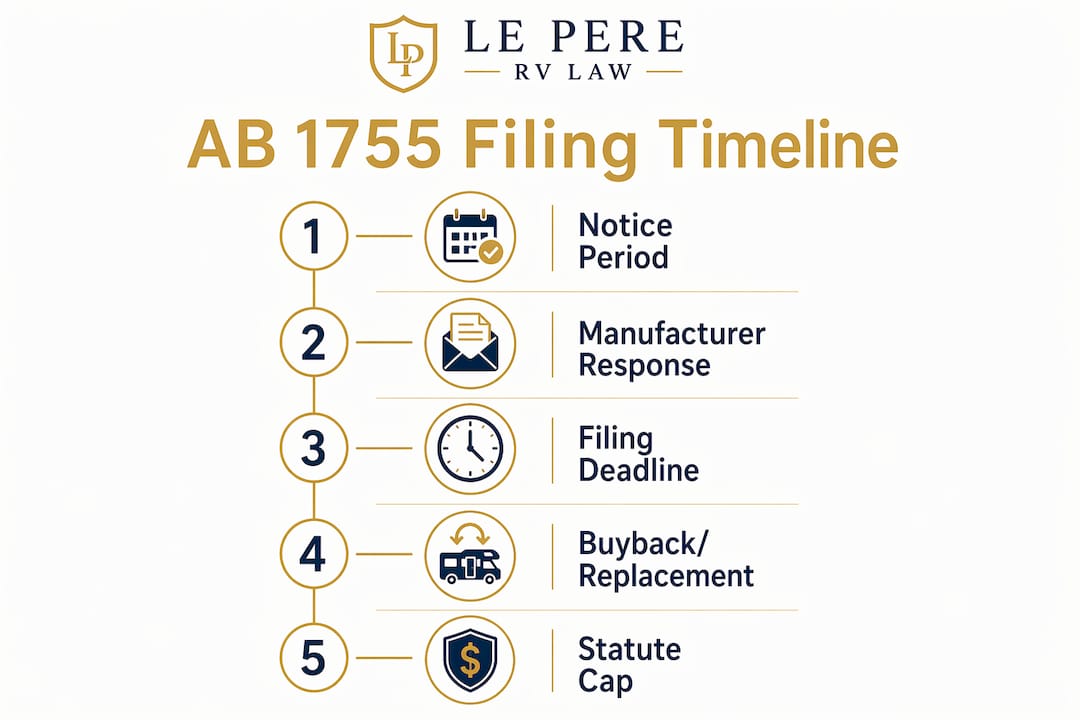
AB 1755 shortens the time to file certain California lemon law claims by imposing a post-warranty filing window and an absolute cap from original delivery, whichever comes first, for manufacturers that opt into the new procedures. That is a hard cap that did not exist under the Song-Beverly Consumer Warranty Act before this law took effect. The statute also front-loads the process with a mandatory written pre-suit notice period, a manufacturer response window, and a completion deadline once a buyback or replacement is agreed upon.
The governing code sections are California Code of Civil Procedure sections 871.20 through 871.30, enacted by AB 1755 and now in effect. These sections sit alongside the Song-Beverly Consumer Warranty Act, which continues to govern claims against manufacturers that have not opted in. The California Department of Consumer Affairs Arbitration Certification Program (DCA ACP) publishes the list of manufacturers that have elected into the new procedures. That list is your first stop before you assume which rules apply to your vehicle.
Key facts to know immediately:
- The new statute of limitations requires filing within a fixed period after warranty expiration or from original delivery, whichever occurs first, for opted-in manufacturers.
- A consumer must send a written pre-suit notice before filing suit.
- The manufacturer has a set period to offer restitution or replacement after receiving that notice.
- If the consumer accepts and signs a release, the manufacturer must complete the buyback or replacement within a defined completion deadline.
- Tolling events pause the clock: days the vehicle is out of service for repairs, time spent in qualified third-party dispute resolution, and the pre-suit notice period (capped at 60 days).
- A manufacturer’s election into these procedures is irrevocable for five years and must be published by the DCA ACP.
The bottom line: If your manufacturer is on the DCA ACP opt-in list, you are working under a compressed timeline. One year after your warranty expires, your right to sue under the AB 1755 chapter may be gone. Verify opt-in status before anything else.
Table of Contents
- What did AB 1755 and SB 26 actually change about California lemon law?
- Which claims and manufacturers does AB 1755 cover?
- What are the exact filing deadlines and tolling rules under AB 1755?
- What does the AB 1755 procedural timeline look like step by step?
- How does AB 1755 shorten timelines compared with prior Song-Beverly practice?
- How do you verify opt-in status and preserve evidence before your deadline?
- What should you do right now if you think you have a lemon?
- How does our firm apply AB 1755 timelines in practice?
- Key Takeaways
- The real trade-off AB 1755 creates for California consumers
- AB 1755 deadlines are tight — here is how we help
- Primary sources and official guidance to read next
What did AB 1755 and SB 26 actually change about California lemon law?
AB 1755, signed by Governor Gavin Newsom in September 2024 and effective January 1, 2025, created a new chapter in the California Code of Civil Procedure (sections 871.20 through 871.30) that sits alongside the Song-Beverly Consumer Warranty Act. Senate Bill 26, introduced in the 2025 legislative session as the agreed-upon follow-up amendment, made the new procedures elective rather than mandatory. That shift happened because Governor Newsom’s signing message noted that several automakers, including smaller electric-vehicle manufacturers, raised serious concerns that the original mandatory procedures were unworkable for them.

The result is an opt-in framework. Manufacturers that choose to participate get a structured, faster resolution process. Manufacturers that do not opt in remain subject to the existing Song-Beverly rules, which carry a longer and more flexible statute of limitations.
The most significant statutory changes under the new chapter include:
- The law sets specific post-warranty and absolute filing deadlines for opted-in manufacturers.
- Consumers must provide a written pre-suit notice prior to filing suit.
- Manufacturers have a set period to respond with offers of restitution or replacement.
- Once accepted and released, manufacturers must complete the buyback or replacement within a specified timeframe.
- Tolling pauses apply for certain repair and dispute resolution periods.
- Once a manufacturer opts in, the election remains binding for a set number of years and is publicly published.
- Discovery timelines are compressed to speed litigation resolution.
“AB 1755 aims to speed resolution of Lemon Law claims and reduce litigation,” Governor Newsom wrote in his signing message, while acknowledging that the Legislature would need to adopt amendments to make the procedures subject to manufacturer election.
The DCA ACP now serves as the official clearinghouse. Manufacturers that elect into the new procedures must notify the DCA ACP, and the DCA ACP publishes that list publicly so consumers and attorneys can verify which rules apply.
Which claims and manufacturers does AB 1755 cover?
AB 1755 applies only to manufacturers that have affirmatively elected to participate. That election is not automatic, and it is not permanent in the traditional sense: once a manufacturer opts in, the election is irrevocable for five years and must be published by the DCA ACP. After five years, the manufacturer may choose not to renew.
For consumers, the practical difference is significant. If your manufacturer has opted in, you are subject to the one-year post-warranty filing cap and the front-loaded notice requirements. If your manufacturer has not opted in, the existing Song-Beverly Consumer Warranty Act rules govern your claim, which generally allow more time to file and do not impose the same pre-suit notice structure.
Two owners of the same vehicle model from the same year can face completely different procedural rules depending on when their manufacturer made its election and which model years the election covers. The DCA ACP list specifies the effective years, so the same make and model year could fall under AB 1755 for one owner and under Song-Beverly for another if the election timing differs.
Practical steps to determine which rules apply to your vehicle:
- Visit the DCA ACP opt-in list and search for your vehicle’s manufacturer.
- Note the effective date and the model years covered by the election.
- Confirm whether your vehicle’s year of original delivery falls within the elected period.
- If your manufacturer is not on the list, assume Song-Beverly rules apply and consult an attorney about your specific filing window.
Pro Tip: Check the DCA ACP list again if your manufacturer recently announced a recall or warranty extension. Election status and effective years can affect which claims fall under AB 1755, and the list is updated as manufacturers submit their elections.
What are the exact filing deadlines and tolling rules under AB 1755?
The statute of limitations under AB 1755 has two parts, and both must be satisfied. A consumer must file within one year after the applicable express warranty expires, or no later than six years after the date of original vehicle delivery, whichever comes first. If your warranty expired three years after delivery, you have one year from that expiration date, well within the six-year cap. If your warranty runs longer, the six-year cap from delivery may cut off your claim first.
Tolling events that pause the clock
Three events toll (pause) the AB 1755 statute of limitations:
- The statute of limitations is paused for days the vehicle is out of service for repair, participation in qualified third-party dispute resolution, and the pre-suit notice period, with a maximum tolling period for notice.
Filing deadline calculation examples
| Scenario | Warranty Expires | Original Delivery | One-Year Deadline | Six-Year Cap | Controlling Deadline |
|---|---|---|---|---|---|
| Standard 3-year warranty | 3 years after delivery | January 1, 2025 | — | — | — |
| Extended 7-year warranty | 7 years after delivery | — | — | — | — |
In the first scenario, the one-year post-warranty deadline falls before the six-year cap, so it controls. In the second scenario, the six-year cap from delivery cuts off the claim before the one-year post-warranty window even opens, because the warranty runs longer than six years. This is the scenario that catches consumers off guard: a long warranty does not mean more time to file under AB 1755.
Out-of-service days add directly to your available window. If your vehicle spent 45 days in the shop across multiple repair visits, those 45 days are added to your filing deadline. Documenting each repair visit and the exact dates the vehicle was unavailable is not optional; it is the factual record that determines whether your claim is timely.
What does the AB 1755 procedural timeline look like step by step?
For a manufacturer that has opted into AB 1755, the process follows a defined sequence from the consumer’s first written notice through resolution or the right to file in court.
- Consumer sends written pre-suit notice. The notice must be in writing, identify the vehicle (VIN, make, model, year), describe the nonconformity and repair history, and demand restitution or replacement. The 30-day clock for the manufacturer starts on the date of receipt.
- Manufacturer responds within 30 days. The manufacturer must offer restitution or replacement, or deny the claim, within 30 days of receiving the notice. Silence or a non-response after 30 days gives the consumer the right to file suit.
- Consumer accepts or rejects the offer. If the consumer accepts and signs a release, the 60-day completion window begins from the date of the original notice.
- Manufacturer completes the buyback or replacement within 60 days. The manufacturer must process and complete the agreed restitution or replacement within that window.
- Penalty for delayed completion. If the manufacturer fails to complete performance within 30 days of receiving a signed release, a mandatory penalty of $50 per day accrues until the settlement is completed, unless the parties agree otherwise.
- Consumer maintains possession during key periods. Consumers must generally keep possession of the vehicle for at least 30 days after sending notice and for 60 days after the manufacturer receives the notice if an offer of restitution or replacement is made, so the vehicle can be properly removed from the road and title-branded.
- Consumer files suit if no offer or no completion. If the manufacturer does not respond within 30 days, rejects the claim, or fails to complete performance, the consumer may file in court under the AB 1755 chapter.
Note on civil penalties: If the manufacturer timely complies with the pre-suit notice process and completes the buyback or replacement within the required windows, civil penalties under Song-Beverly may be barred for that claim. The pre-suit notice requirement is not just procedural; it directly affects the remedies available.
The pre-suit notice requirement fundamentally changes the lemon law claim process by front-loading manufacturer interaction. Consumers who want to preserve the right to civil penalties must send the written demand at least 30 days before filing and must give the manufacturer a genuine opportunity to respond.

How does AB 1755 shorten timelines compared with prior Song-Beverly practice?
Under the Song-Beverly Consumer Warranty Act before AB 1755, the statute of limitations for lemon law claims was generally four years under California’s commercial code, and there was no mandatory pre-suit notice requirement. Consumers could file suit without first sending a written demand and waiting for a manufacturer response. Discovery timelines in litigation were governed by standard civil procedure rules, with no compressed initial disclosure window.
AB 1755 compresses the timeline at every stage for opted-in manufacturers:
| Dimension | Prior Song-Beverly Practice | AB 1755 (Opted-In Manufacturers) |
|---|---|---|
| Filing deadline | Generally allowed a longer time from breach | Shortened filing deadlines after warranty expiration or delivery apply for opted-in manufacturers |
| Pre-suit notice | Not required | 30-day written notice mandatory |
| Manufacturer response | No statutory window | 30 days to offer restitution or replacement |
| Completion window | Negotiated or litigated | 60 days from notice date after signed release |
| Initial disclosures (if suit filed) | Standard civil procedure timelines | 60 days after responsive pleading |
| Tolling events | Limited statutory tolling | Out-of-service days, dispute resolution, pre-suit period (max 60 days) |
| Scope | All Song-Beverly-covered vehicles | Only vehicles from opted-in manufacturers |
| Remedies | Repurchase, replacement, civil penalties up to 2x damages | Same, but civil penalties may be barred if manufacturer timely complies |
The time savings are real when a manufacturer complies within the prescribed windows. A consumer who sends a proper pre-suit notice and receives a buyback offer in a timely manner can complete the repurchase process within the defined completion deadline, often without filing a lawsuit. Under prior practice, the same claim might have taken 12 to 24 months of litigation to reach the same outcome.
The risk is the flip side of that speed. The one-year post-warranty filing cap is shorter than the prior four-year window, and consumers who delay sending notice or who miss the warranty expiration date by even a few months may find their claim time-barred. The lemon law claim timeframe under AB 1755 rewards consumers who act quickly and penalizes those who wait.
How do you verify opt-in status and preserve evidence before your deadline?
Verifying opt-in status takes one step: check the DCA ACP published list and confirm your manufacturer’s name, the effective date of the election, and the model years covered. Write down the date you checked and take a screenshot. If your manufacturer is listed, note the exact effective years so you can confirm your vehicle’s delivery date falls within the elected period.
Once you confirm which rules apply, your documentation becomes the foundation of your claim. The granular record of repair visits, out-of-service days, and written communications is often what determines whether a close-deadline case survives or fails.
Document checklist:
- Repair orders: Every repair order from every dealership visit, including the date in, date out, mileage, and description of the complaint and work performed.
- VIN and delivery date: Your vehicle identification number and the original delivery date from the purchase or lease agreement.
- Warranty expiration date: The express warranty start and end dates from your warranty booklet or manufacturer documentation.
- Out-of-service log: A running log of every day the vehicle was unavailable because of repairs, cross-referenced with repair orders.
- Written communications: Every email, letter, or text with the dealership or manufacturer about the defect, including any denial letters or repair estimates.
- Pre-suit notice copies: Copies of your written pre-suit notice and proof of delivery.
For proof of delivery of your pre-suit notice, use certified mail with return receipt, a tracked courier service, or email with a read receipt. Keep the delivery confirmation with your notice copy. A notice that cannot be proven to have been received does not start the manufacturer’s 30-day response clock.
Pro Tip: Create a single folder, physical or digital, that holds every document in this checklist. If you need to compute tolling days or prove your notice was timely, having everything in one place cuts hours off the process and removes any ambiguity about dates.
Recording out-of-service days is straightforward but requires consistency. Each time you drop the vehicle off for a covered repair, note the date and time. Each time you pick it up, note the date and time. The difference is your out-of-service period for that visit. Total those days across all visits, and that number extends your filing deadline by the same amount.
What should you do right now if you think you have a lemon?
Act on the following steps in order. The AB 1755 lemon claim process rewards consumers who move quickly and punishes those who assume they have more time than they do.
- Verify your manufacturer’s opt-in status on the DCA ACP list. Confirm the effective years and your vehicle’s delivery date.
- Calculate your filing deadline. Find your warranty expiration date and your original delivery date. Apply the one-year post-warranty rule and the six-year cap. Add any documented out-of-service days.
- Gather and organize all repair orders. Pull every repair order from every visit. Confirm the dates and the defect descriptions match your records.
- Draft and send your 30-day pre-suit written notice. The notice should include your name, address, VIN, make, model, year, a brief description of the nonconformity and repair history, and a clear demand for repurchase or replacement. Send it by certified mail and keep the tracking confirmation.
- Maintain possession of the vehicle. Do not sell, trade, or surrender the vehicle during the 30-day notice period or the 60-day completion window if the manufacturer makes an offer.
- Contact an attorney before the 30-day response window closes. If the manufacturer denies the claim or does not respond within 30 days, you need to be ready to file. Waiting until after the manufacturer responds to find counsel costs you preparation time you do not have.
Pro Tip: The shortened filing window under AB 1755 makes the timing of your first attorney call more important than it used to be. An attorney with defense-side experience, who has seen how manufacturers evaluate pre-suit notices and build their response strategy, can help you frame the notice in a way that limits the manufacturer’s room to maneuver.
Missing the pre-suit notice requirement or failing to maintain possession during the required periods does not just delay your claim. It can eliminate remedies, including civil penalties, that would otherwise be available. The consequences of a procedural misstep under AB 1755 are more severe than they were under prior Song-Beverly practice, because the new chapter’s structure is more rigid.
How does our firm apply AB 1755 timelines in practice?
Jeff Le Pere has been practicing California lemon law for approximately 25 years, including 11 years as a defense attorney representing manufacturers and dealerships. That background is not incidental. When a manufacturer receives a pre-suit notice, the response it drafts is shaped by the same playbook Jeff spent over a decade writing. Knowing how manufacturers evaluate notices, identify procedural weaknesses, and structure buyback offers gives the firm a concrete advantage in the pre-suit phase.
In the first 30 days after a consumer contacts the firm, the team:
- Verifies the manufacturer’s opt-in status on the DCA ACP list and confirms the effective model years.
- Calculates the filing deadlines using relevant warranty and delivery dates along with repair documentation.
- Reviews repair orders and assesses viable nonconformity claims.
- Drafts and sends a pre-suit written notice according to procedural requirements.
- Monitors the manufacturer’s 30-day response window and prepares to file if no compliant offer is received.
In days 30 through 60, if the manufacturer makes an offer, the firm evaluates whether the proposed repurchase or replacement is complete and accurate, negotiates any shortfalls, and manages the signed release and completion timeline to ensure the $50-per-day penalty provision is preserved if the manufacturer delays.
Every case is handled on contingency. You pay nothing out of pocket. If the claim succeeds, the manufacturer covers attorney fees under Song-Beverly. If it does not, you owe nothing. The firm also handles California auto lemon law claims for cars, trucks, and SUVs, as well as RV lemon law for motorhomes, fifth wheels, and travel trailers.
Key Takeaways
AB 1755 imposes a one-year post-warranty filing cap and a front-loaded 30/60-day notice and response structure that compresses the entire lemon law claim process for consumers whose manufacturer has opted in.
| Point | Details |
|---|---|
| One-year post-warranty cap | File within one year after express warranty expiration or six years from delivery, whichever comes first. |
| 30-day pre-suit notice required | Send written notice before filing; the manufacturer has 30 days to respond and 60 days to complete a buyback. |
| Tolling extends your window | Out-of-service repair days, dispute resolution participation, and the notice period (max 60 days) all pause the clock. |
| Verify opt-in status first | Check the DCA ACP published list to confirm whether AB 1755 or Song-Beverly rules apply to your vehicle. |
| The Law Offices of Jeffrey Le Pere | The firm verifies opt-in status, computes deadlines, and drafts pre-suit notices within the first 30 days, on contingency. |
The real trade-off AB 1755 creates for California consumers
AB 1755 is genuinely good for consumers whose manufacturers comply. A buyback or replacement completed within 60 days of a pre-suit notice is a faster resolution than most Song-Beverly litigation ever produced. That speed is real, and it matters when you are making loan payments on a vehicle that does not work.
The risk that most consumers underestimate is the verification trap. Two owners of the same make and model, both with identical defects, may face entirely different procedural rules depending on whether their manufacturer opted in and which model years the election covers. Assuming AB 1755 applies when it does not, or assuming Song-Beverly applies when the manufacturer has opted in, leads to procedural errors that can be fatal to a claim. The DCA ACP list is not a formality. It is the document that determines which set of rules governs your case.
The other underestimated risk is the out-of-service log. Most consumers do not track repair downtime with the precision AB 1755 rewards. Every day your vehicle sat at a dealership waiting for a part or a technician is a day that extends your filing deadline, but only if you can prove it. A repair order that shows a drop-off date and a pickup date is proof. A vague recollection is not. Having spent years on the manufacturer’s side of these disputes, I can tell you that manufacturers look for exactly this gap in consumer documentation when they want to argue a claim is time-barred.
AB 1755 deadlines are tight — here is how we help
If your vehicle qualifies under AB 1755 and your manufacturer has opted in, the clock is already running. The Law Offices of Jeffrey Le Pere offers contingency-fee representation for California lemon law claims involving cars, trucks, SUVs, motorhomes, fifth wheels, and travel trailers. You pay nothing upfront and nothing if the claim does not succeed.
In the first 30 days after you contact the firm, the team verifies your manufacturer’s DCA ACP election status, computes your filing deadline using your warranty expiration and delivery dates, reviews your repair orders, and drafts your pre-suit written notice. If the manufacturer makes a buyback or replacement offer, the firm evaluates it, negotiates any shortfall, and monitors the 60-day completion window to protect your right to the $50-per-day penalty if the manufacturer delays.
Jeff Le Pere’s 11 years defending manufacturers means the firm knows how automakers read pre-suit notices and where they look for procedural weaknesses. That knowledge is now working for you. To get your filing deadline calculated and your notice drafted, schedule a free case review with The Law Offices of Jeffrey Le Pere today.
This article is general legal information, not legal advice. Deadlines and procedures vary by manufacturer election status and individual circumstances. Confirm the current rules with the DCA ACP and consult a qualified California lemon law attorney for your specific situation.
Primary sources and official guidance to read next
The following sources contain the authoritative text of AB 1755, the governing code sections, and DCA guidance on opt-in procedures. Each one serves a specific purpose in computing deadlines and verifying manufacturer election status.
- AB 1755 Bill Status and Full Text: The complete enrolled bill text, including the Governor’s signing message. Read this to understand the original statutory language and the legislative intent behind the opt-in framework.
- CCP Sections 871.20 through 871.30: The operative code sections that set the statute of limitations, tolling rules, pre-suit notice requirements, and manufacturer response windows. This is the primary legal authority for computing your filing deadline.
- DCA ACP New Lemon Law Procedures Page: The DCA’s official summary of the AB 1755 procedures, including the tolling rules, the 30/60-day windows, and guidance on the five-year irrevocable election. Updated as manufacturers submit elections.
- DCA ACP Opt-In Manufacturer List: The live list of manufacturers that have elected into the AB 1755 procedures, with effective dates and model years. Check this list first, before assuming which procedural rules apply to your vehicle.
- AB 1755 Assembly Judiciary Committee Analysis: The policy committee’s analysis of the bill, including the rationale for the compressed discovery timelines and the consumer possession requirements. Useful for understanding how the Legislature intended the new procedures to work in practice.
- Governor’s AB 1755 Signing Message: Governor Newsom’s September 2024 signing statement, which explains the political context for the opt-in amendment and flags the Legislature’s commitment to adopting SB 26. Relevant for understanding why the procedures are elective rather than mandatory.
The DCA ACP opt-in list and CCP sections 871.20 through 871.30 are the two documents that directly determine whether AB 1755 applies to your claim and what your filing deadline is. Read those two sources first, then consult an attorney to apply the rules to your specific vehicle and repair history.