Common Toyota Tacoma Lemon Law Issues: Owner’s Guide

If your Toyota Tacoma keeps returning to the dealer for the same problem, California law may entitle you to a full repurchase, a replacement truck, or a cash settlement, plus civil penalties up to two times your actual damages if the manufacturer willfully ignored its warranty obligations. The controlling statute is the Song-Beverly Consumer Warranty Act, and Assembly Bill 1755 now requires most claims to be filed within one year of your warranty’s expiration date. Act quickly, because that window closes faster than most owners realize.
Your first moves matter most. Before you call an attorney, do these things now:
- Collect every repair order from every dealer visit, including dates in and out.
- Write down the total days your truck sat at the dealership, cumulatively.
- Send a written notice to Toyota’s customer service documenting the unresolved defect.
- Photograph or video the defect whenever it occurs, especially warning lights or drivability failures.
- Do not authorize any repair that modifies the vehicle outside factory specifications.
Recent model years carry particular risk. The 2024 and 2025 Tacoma have generated documented recalls and owner complaints covering transmission behavior, instrument panel failures, and rear brake hose leaks, all of which can form the basis of a qualifying lemon-law claim.
Pro Tip: Save every piece of paper the dealer hands you, even the ones that say “no problem found.” A “no problem found” repair order can actually strengthen your claim by showing the manufacturer had notice of the defect and failed to diagnose it.
Table of Contents
- What are the most common Toyota Tacoma defects that trigger lemon-law claims?
- How does California’s Song-Beverly Act protect Tacoma owners?
- When does a recurring Tacoma defect actually qualify for a claim?
- What steps should you take right now to protect your Tacoma claim?
- What can you actually recover, and how is a buyback calculated?
- What deadlines apply to your Tacoma lemon-law claim in California?
- What does an experienced lemon-law attorney do that you cannot do alone?
- Key Takeaways
- What most Tacoma owners get wrong about lemon-law claims
- Get a free case evaluation from The Law Offices of Jeffrey Le Pere
- Primary sources and statutes to keep in your claim file
What are the most common Toyota Tacoma defects that trigger lemon-law claims?
The 2024 through 2026 Tacoma introduced a redesigned platform and an 8-speed automatic transmission, and that combination has produced a concentrated cluster of owner complaints and formal recall campaigns. Understanding which defects recur most often helps you recognize whether your situation fits the lemon-law pattern.
1. Transmission jumping to neutral or hard shifting
The most widely reported problem on recent Tacoma models is the 8-speed automatic transmission unexpectedly jumping into neutral while driving, particularly at highway speeds. Owners also report harsh, unpredictable gear changes that feel nothing like normal shift behavior. This is a safety defect, not a nuisance, because losing drive power at speed creates a real collision risk.

2. Instrument panel and display failures
Toyota issued a recall covering certain recent Tacoma models for instrument panel display failures that can prevent critical information, including speed and warning indicators, from appearing on the screen. A display that goes dark while driving disables safety-critical functions and meets the substantial impairment standard under Song-Beverly.
3. Rear brake hose leaks
A separate recall addressed rear brake hoses on certain recent Tacoma models damaged by mud and debris intrusion. Brake fluid loss directly impairs stopping ability, which is the clearest possible safety defect. If your truck received a recall repair for this issue and the problem persisted or returned, that repair attempt counts toward your lemon-law threshold.
4. Driveshaft and axle separation concerns
Driveshaft failures and axle separation reports have appeared in NHTSA complaint data for recent Tacoma model years. A driveshaft that separates at speed can strike the road surface and cause the driver to lose control entirely. These reports have prompted service campaigns and owner alerts.
5. Infotainment and electrical system faults
Recurring infotainment freezes, Bluetooth failures, and screen reboots are among the most common Tacoma issues across multiple model years. These complaints often do not produce immediate safety recalls, but they can still meet the substantial impairment standard when they disable navigation, backup camera feeds, or safety-critical displays.
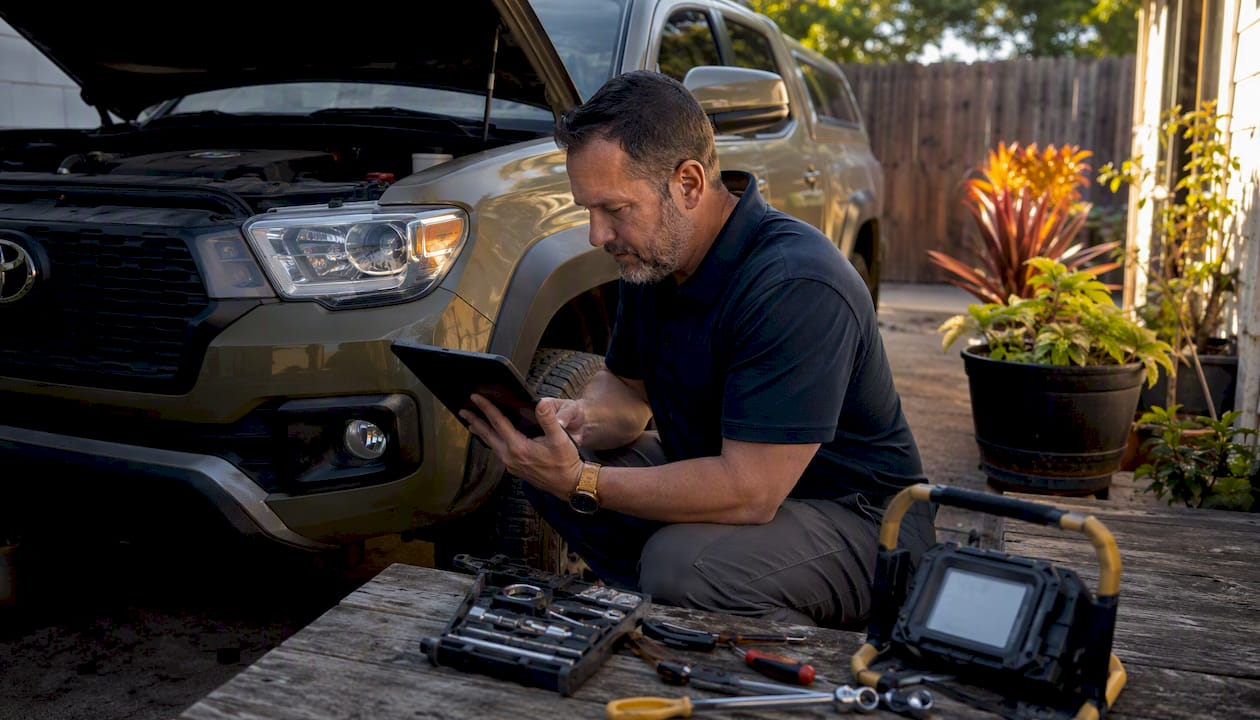
6. Excessive oil consumption and coolant leaks
Oil consumption complaints appear across multiple Tacoma generations, not just the current redesign. When an engine burns oil faster than the manufacturer’s stated acceptable rate, or when coolant leaks internally and contaminates engine oil, the result is accelerated engine wear and potential catastrophic failure. These defects are harder to document but qualify when properly recorded across multiple repair visits.
7. Starter and electrical faults
No-start conditions caused by starter failures or parasitic battery drain have been reported on Tacoma models across several years. A truck that will not start reliably substantially impairs its use, which is one of the three statutory impairment tests under Song-Beverly.
8. Steering and suspension concerns
Steering pull, vibration at highway speeds, and axle-related noise complaints round out the common defect picture. Some owners have reported steering components that feel loose or unresponsive, which raises obvious safety concerns on a truck marketed for both highway and off-road use.
| Defect Category | Model Years Most Affected | Recall or TSB Status |
|---|---|---|
| 8-speed transmission (neutral jump, hard shift) | Recent years | Owner complaints, service campaigns |
| Instrument panel display failure | Recent years | Formal recall issued |
| Rear brake hose leak | Recent years | Formal recall issued |
| Driveshaft/axle separation | Recent years | NHTSA complaints, service campaigns |
| Infotainment/electrical faults | Recent years | TSBs issued, no universal recall |
| Excessive oil consumption | Several recent years | TSBs issued |
| Starter/no-start conditions | Several recent years | TSBs issued |
You can verify current recall status for your specific VIN directly through the NHTSA recall database.
How does California’s Song-Beverly Act protect Tacoma owners?
Song-Beverly requires a manufacturer to repurchase or replace your vehicle when a defect substantially impairs its use, value, or safety and cannot be fixed after a reasonable number of repair attempts while the vehicle is under warranty. That is the direct answer. The statute does not require the defect to be catastrophic, and it does not require the manufacturer to agree that a problem exists.
The remedies available under Song-Beverly are:
- Repurchase (buyback): Toyota refunds the full purchase price, including taxes, registration, and finance charges, minus a mileage-based use allowance calculated from the miles you drove before the first repair attempt.
- Replacement: Toyota provides a comparable new vehicle at no charge.
- Cash settlement: A negotiated amount that compensates you for the diminished value of the truck.
- Civil penalties: Up to two times your actual damages if Toyota’s failure to comply was willful.
The statute creates a rebuttable presumption in your favor. Under California Civil Code section 1793.22, the presumption that a reasonable number of repair attempts has been made arises when, within 18 months of delivery or 18,000 miles (whichever comes first), four or more repair attempts were made for the same defect, or the vehicle was out of service for more than 30 cumulative calendar days. Once that presumption applies, the burden shifts to Toyota to prove the repairs were adequate.
Recalls and Technical Service Bulletins factor into the legal analysis in a specific way. A TSB acknowledges that Toyota knew about a defect pattern. A recall repair counts as a repair attempt. If the recall repair does not fix the problem, that failed attempt strengthens your claim rather than ending it.
When does a recurring Tacoma defect actually qualify for a claim?
Your Tacoma likely qualifies for a lemon-law claim when all of the following are true:
- The defect appeared while the vehicle was covered by Toyota’s original manufacturer warranty.
- The defect substantially impairs the truck’s use, value, or safety.
- You gave Toyota or its authorized dealers a reasonable number of opportunities to repair it.
- The manufacturer has not successfully fixed the defect.
The California lemon law presumption thresholds give you a concrete benchmark: four or more repair attempts for the same defect, or more than 30 cumulative days out of service, within 18 months or 18,000 miles of delivery. Meeting those numbers creates the presumption, but you do not have to wait for them. Fewer attempts can still support a claim if the defect is serious enough.
Certified pre-owned Tacomas present a different picture. California’s lemon law covers CPO vehicles when the manufacturer’s written warranty is still active at the time the defect manifests. The remaining factory warranty or a separately issued CPO warranty can both qualify, but the analysis is more nuanced than with a new vehicle, and the documentation requirements are stricter.
Common pitfalls that can disqualify or weaken a claim:
- Modifications that void the warranty, including aftermarket lift kits, non-OEM tires, or performance tuning.
- Damage caused by off-road use that exceeds the vehicle’s designed capability.
- Failure to bring the truck to an authorized Toyota dealer for repairs (taking it to an independent shop instead).
- Missing or incomplete repair orders that cannot establish a timeline of attempts.
- Waiting too long to act, particularly after the warranty expires.
Pro Tip: If you use your Tacoma for off-roading, document every trip with photos showing the truck’s condition before and after. This protects you from a manufacturer argument that trail damage caused the defect rather than a factory flaw.
What steps should you take right now to protect your Tacoma claim?
Start documenting immediately. Every day you wait without a written record is a day the manufacturer’s defense team can use against you.
- Gather all repair orders. Request copies from the dealer if you do not have them. Repair orders must show the date in, date out, mileage, your complaint description, and what the technician did.
- Calculate your days out of service. Add up every calendar day the truck was at the dealership, including weekends. Keep a running log in a spreadsheet or notes app.
- Record the defect when it happens. A short video of the transmission jumping to neutral, the instrument panel going dark, or a warning light illuminating is powerful evidence.
- Send a written notice to Toyota. Mail or email Toyota Motor Sales USA customer service with a clear description of the unresolved defect, the dates of repair attempts, and a request for repurchase or replacement. Keep a copy with proof of delivery.
- Request TSBs and recall notices for your VIN. Ask the service manager to print any Technical Service Bulletins that apply to your truck. These documents show Toyota knew about the defect pattern.
- Preserve loaner and rental receipts. Every dollar you spent on transportation while your truck was in the shop is potentially recoverable.
- Do not authorize non-warranty repairs. If a dealer tries to charge you for a repair that should be covered under warranty, refuse and document the attempt in writing.
When you contact the dealer or Toyota’s customer service, keep your language factual and unemotional. A sample written notice might read: “I am writing to notify Toyota Motor Sales USA that my [year] Toyota Tacoma, VIN [number], has been presented for repair of [describe defect] on [dates]. The defect has not been resolved despite [number] repair attempts totaling [number] days out of service. I request that Toyota repurchase or replace this vehicle pursuant to the Song-Beverly Consumer Warranty Act.”
- Keep every email and letter you send, and every response you receive.
- Note the name, date, and substance of every phone call with a dealer or Toyota representative.
- Do not return the vehicle to the manufacturer or agree to any settlement without consulting an attorney first.
For Tacoma owners who have experienced brake-related defects specifically, the documentation steps for truck brake defect lemon law claims follow a slightly different sequence because brake safety defects often trigger a shorter path to the presumption threshold.
What can you actually recover, and how is a buyback calculated?
The most common remedy in a successful Tacoma lemon-law claim is a repurchase, and the calculation follows a specific formula under Song-Beverly.
Repurchase amount = purchase price paid + taxes + registration fees + finance charges paid to date, minus a mileage offset.
The mileage offset is calculated as: (miles driven before the first repair attempt for the qualifying defect) divided by 120,000, multiplied by the purchase price. If you drove 6,000 miles before the first repair attempt on a truck you paid $45,000 for, the offset is approximately $2,250, meaning you would recover roughly $42,750 plus taxes and fees.
| Remedy | When It Applies | What You Recover |
|---|---|---|
| Repurchase (buyback) | Manufacturer cannot fix the defect | Purchase price minus mileage offset, plus taxes, fees, finance charges |
| Replacement | Consumer prefers a new vehicle | Comparable new Tacoma, same or similar configuration |
| Cash settlement | Negotiated resolution | Agreed amount reflecting diminished value and damages |
| Civil penalties | Manufacturer’s failure was willful | Up to two times actual damages, in addition to repurchase or replacement |
| Attorney fees | Any successful claim | Paid by the manufacturer, not the consumer |
Civil penalties under Civil Code section 1794© are available when Toyota knew about the defect and chose not to comply with its warranty obligations. These penalties can double your recovery. Manufacturers do not volunteer them, and establishing willfulness typically requires an attorney who understands how manufacturers document their internal decisions.
The 30-day completion rule under AB 1755 also matters here. If Toyota offers restitution within 30 days of receiving your written pre-suit notice, it must complete the transaction within 60 days or face daily penalties. That timeline creates real financial pressure on the manufacturer to resolve claims promptly.
What deadlines apply to your Tacoma lemon-law claim in California?
Assembly Bill 1755, signed into law on September 29, 2024, and effective for claims filed after April 1, 2025, changed the filing landscape significantly. Under AB 1755, actions seeking restitution or replacement must generally be filed within one year after the expiration of the applicable express warranty and no later than six years from the vehicle’s delivery date.
The key deadlines to track:
- Warranty expiration date: Your clock starts here. Once the factory warranty expires, you have one year to file.
- Six-year outer limit: No claim may be filed more than six years after the date you took delivery of the truck, regardless of when the warranty expired.
- 30-day pre-suit notice: Before seeking civil penalties, you must send Toyota a written notice and give it 30 days to offer restitution or replacement. If Toyota completes the restitution within 60 days of that notice, civil penalties may not apply.
- 18 months/18,000 miles presumption window: The statutory presumption under Civil Code section 1793.22 applies to defects that meet the repair-attempt or days-out thresholds within this window from delivery.
The pre-suit notice requirement is where many owners make costly mistakes. A notice that is incomplete, sent to the wrong address, or missing required information can forfeit your right to civil penalties even if your underlying claim is strong. Attorneys now routinely handle this notice because the procedural requirements are specific and the consequences of error are severe.
The AB 1755 deadline guide published by The Law Offices of Jeffrey Le Pere walks through each step in detail, including what the notice must contain and how to confirm Toyota received it. If you are within 12 months of your warranty expiration, treat this as urgent.
What does an experienced lemon-law attorney do that you cannot do alone?
An attorney preserves your claim evidence, sends the statutory pre-suit notice correctly, negotiates directly with Toyota’s legal team, and files suit when Toyota refuses to comply. That is the practical answer. The strategic answer is more nuanced.
Typical attorney actions in a Tacoma lemon-law case include:
- Pulling your complete repair history from Toyota’s internal systems, which often contains more detail than the dealer-printed repair orders you received.
- Sending the AB 1755 pre-suit notice with the exact language and delivery method required to preserve civil penalty eligibility.
- Identifying whether Toyota has issued any internal communications, TSBs, or field technical reports acknowledging the defect.
- Negotiating with Toyota’s manufacturer counsel, who handles these cases daily and knows every argument in the playbook.
- Filing a civil complaint if Toyota refuses a reasonable resolution, and pursuing daily penalties if Toyota misses the 60-day completion deadline.
The contingency model means you pay nothing upfront. The Law Offices of Jeffrey Le Pere collects attorney fees from Toyota if the claim succeeds, not from you. That structure aligns the firm’s interest directly with yours: a larger recovery for you means a larger fee recovery from the manufacturer.
Pro Tip: Ask any lemon-law attorney you consult whether you will speak directly with the attorney or with a case manager. High-volume firms often route clients through non-attorney staff. At The Law Offices of Jeffrey Le Pere, you speak with Jeff Le Pere directly, which matters when strategy decisions need to be made quickly.
For a detailed look at how repair attempt counts are evaluated under California law, including how courts weigh partial repairs and “no problem found” visits, that guide covers the analysis in depth.
Key Takeaways
A Toyota Tacoma with recurring defects that substantially impair its use, value, or safety may qualify for a full repurchase, replacement, or cash settlement under California’s Song-Beverly Consumer Warranty Act, but AB 1755 now requires most claims to be filed within one year of warranty expiration.
| Point | Details |
|---|---|
| Most common qualifying defects | Transmission neutral jumps, instrument panel failures, rear brake hose leaks, and driveshaft issues concentrate in 2024–2025 Tacomas. |
| Presumption thresholds | Four or more repair attempts or 30 cumulative days out of service within 18 months/18,000 miles triggers the Song-Beverly presumption. |
| AB 1755 filing window | Claims must be filed within one year of warranty expiration and no later than six years from delivery; pre-suit notice is required for civil penalties. |
| Documentation priority | Repair orders, days-out logs, written manufacturer notice, and defect videos are the most persuasive evidence in early settlement discussions. |
| The Law Offices of Jeffrey Le Pere | Offers contingency-based Toyota lemon-law representation with 25 years of experience, including 11 years defending manufacturers, and no upfront cost to you. |
What most Tacoma owners get wrong about lemon-law claims
The conventional wisdom says to wait until you have four repair attempts before calling an attorney. That advice costs owners money and sometimes costs them their claim entirely.
Here is what actually happens in practice. By the time a Tacoma owner has four repair orders in hand, they have often already made two or three mistakes that weaken the case. They authorized a repair that modified a component outside factory spec. They accepted a dealer’s verbal assurance that the problem was fixed and did not get it in writing. They missed the window to send a pre-suit notice that would have preserved civil penalty eligibility. Or they waited until 13 months after the warranty expired, which under AB 1755 means the filing window has closed.
The four-attempt threshold is a presumption trigger, not a minimum requirement. A single repair attempt for a catastrophic safety defect, like a driveshaft separation at highway speed, can support a claim without waiting for three more visits. The statute asks whether the manufacturer had a reasonable opportunity to fix the defect, and “reasonable” depends on the severity of the problem.
The other thing most owners underestimate is how much the manufacturer’s internal documentation matters. Toyota’s legal team will pull every TSB, every field report, and every internal communication about your VIN before they respond to a demand. An attorney who spent 11 years on that side of the table knows what those documents say and how to use them. That is not a generic credential. It is a specific tactical advantage that changes how a demand letter is written and how a negotiation unfolds.
Get a free case evaluation from The Law Offices of Jeffrey Le Pere
If your Tacoma meets the checklist above, a free case evaluation is the logical next step. The Law Offices of Jeffrey Le Pere reviews Toyota Tacoma defect claims at no charge, and the firm works entirely on contingency, meaning Toyota pays the attorney fees if the case succeeds.

To make the most of your evaluation, have these documents ready before you call:
- All repair orders from every dealer visit, in chronological order.
- Your original purchase contract, warranty booklet, and vehicle delivery date.
- Any recall notices or TSB printouts you received from the dealer.
- Photos or videos of the defect occurring.
- A written log of days the truck was out of service.
The intake process is straightforward. A quick screening call determines whether the facts meet the Song-Beverly thresholds. If they do, Jeff Le Pere reviews the documentation directly, not a case manager. If the case appears meritorious, the firm sends the AB 1755 pre-suit notice on your behalf and begins the demand process with Toyota.
AB 1755 deadlines are real and unforgiving. If your warranty has expired or is close to expiring, contact the firm now. You can start your free Toyota lemon-law case review today, or visit the firm’s Toyota lemon-law practice page for more on how California law applies to Tacoma, Tundra, and 4Runner claims.
This article is general legal information, not legal advice. California lemon-law rules change, and your specific facts determine your rights. Consult a qualified California lemon-law attorney to evaluate your individual claim.
Primary sources and statutes to keep in your claim file
Every Tacoma owner building a lemon-law claim should print and retain the following sources. These are the documents attorneys and courts rely on, and having them in your file from the start signals to the manufacturer that you are serious.
| Source | What It Covers | Why It Matters |
|---|---|---|
| Song-Beverly Consumer Warranty Act | Full statutory text of California lemon law | The controlling law for repurchase, replacement, and civil penalty claims |
| AB 1755 bill text | Filing deadlines, pre-suit notice procedures, daily penalties | Required reading before sending any demand letter after April 1, 2025 |
| California DCA Arbitration Certification Program — AB 1755 procedures | New lemon-law procedures effective 2025, recent amendments | Explains manufacturer opt-in options and arbitration paths |
| Civil Code section 1793.22 | Presumption thresholds (four attempts, 30 days out) | Exact statutory language for the presumption that shifts burden of proof |
| NHTSA Tacoma recall page | Active recalls by VIN and model year | Confirms whether your truck is subject to a recall and tracks repair status |
| PickupTruckTalk Tacoma known problems summary | 2024–2026 defect and recall overview | Useful background on defect patterns and model-year clusters |
Print the statutory pages directly from the California Legislature’s official site. Save the NHTSA recall page as a PDF with your VIN entered. These documents, combined with your repair orders and written manufacturer notice, form the core of a well-documented claim file.