California Lemon Law Settlement Options: Your Full Guide

California lemon law settlement options give you the right to demand a refund, a replacement vehicle, or a cash payment when a manufacturer cannot fix your defective car, truck, or RV under warranty. The governing statute is the Song-Beverly Consumer Warranty Act, and it is one of the strongest consumer protection laws in the country. Under Song-Beverly, you choose the remedy. The manufacturer does not get to pick the cheapest exit. Knowing which option fits your situation, and how each one is calculated, is the difference between a fair recovery and leaving money on the table.
What are the primary California lemon law settlement options?
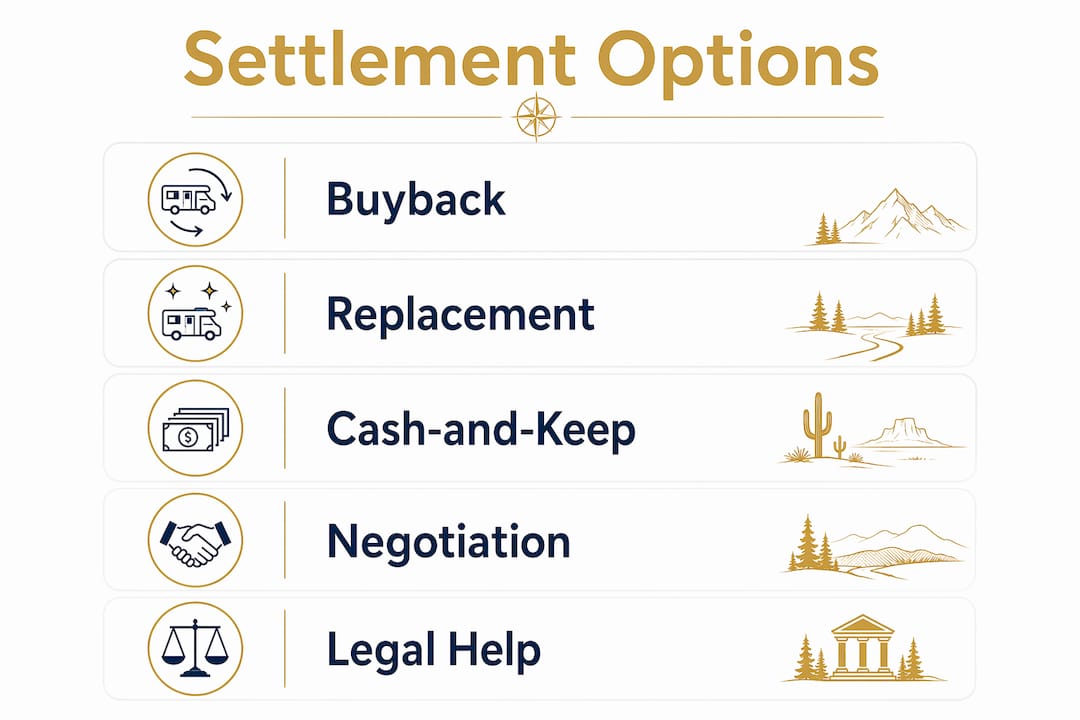
California’s Song-Beverly Act requires manufacturers to offer a refund, a replacement vehicle, or a cash settlement when they cannot repair a defect under warranty. These are the three core paths, and each works differently.
Buyback (refund). The manufacturer repurchases your vehicle and reimburses your full purchase price, minus a mileage offset, plus collateral charges such as sales tax, registration fees, and finance charges. This is the most complete form of recovery. You walk away clean, with your money back.

Replacement vehicle. The manufacturer provides a substantially identical new vehicle in place of the defective one. The replacement is also subject to a mileage offset. This option suits consumers who want to stay in the same vehicle model and do not want the hassle of shopping for a new one.
Cash-and-keep settlement. You keep the vehicle and receive a negotiated cash payment. This is not a statutory remedy with a fixed formula. The amount is negotiated, and it typically falls well below what a full buyback would deliver. It works best when the defect is minor, the vehicle is otherwise satisfactory, or when speed of resolution matters more than maximum recovery.
| Settlement type | Title branding | Financial outcome | Consumer keeps vehicle |
|---|---|---|---|
| Buyback | Yes, “Lemon Law Buyback” brand | Full purchase price minus mileage offset | No |
| Replacement | No branding | New vehicle of equal value | No (trades defective unit) |
| Cash-and-keep | No branding | Negotiated partial payment | Yes |
Pro Tip: If you are unsure which option fits your case, calculate the buyback value first. That number becomes your baseline for evaluating any cash offer the manufacturer puts on the table.
How is the lemon law buyback amount calculated?
The buyback formula under Song-Beverly is specific and statutory. Understanding each component protects you from accepting a lowball offer.
The refund starts with your full purchase price, including your down payment, the outstanding loan balance, sales tax, registration fees, and any dealer-installed options. From that total, the manufacturer subtracts a mileage offset. The mileage offset formula is: (Purchase Price × Miles Driven to First Repair Attempt) ÷ 120,000. That divisor of 120,000 is set by California statute. A vehicle driven 12,000 miles before the first defect report on a $60,000 purchase would carry a $6,000 offset, leaving $54,000 before adding other recoverable costs.
Beyond the base refund, you can recover incidental and consequential damages. These include costs beyond the purchase price such as towing fees, rental car expenses, and repair costs you paid out of pocket. Many consumers overlook these items and leave real money unclaimed.
The most powerful financial lever is the civil penalty. California law allows a civil penalty of up to twice the actual damages when the manufacturer willfully violated its warranty obligations. That penalty is separate from your refund. On a $54,000 buyback, a willfulness finding could add up to $108,000 in penalties. That is not a guarantee, but it is a legitimate statutory tool that changes the negotiation entirely.
Attorney fees under Civil Code § 1794(d) are paid by the manufacturer if you prevail. You do not pay your attorney out of your settlement. That fee-shifting provision is why contingency representation costs you nothing out of pocket.
| Buyback component | What it covers |
|---|---|
| Purchase price reimbursement | Down payment, loan payoff, dealer options |
| Collateral charges | Sales tax, registration, finance charges |
| Mileage offset (subtracted) | (Price × Miles to First Defect) ÷ 120,000 |
| Incidental and consequential damages | Towing, rentals, out-of-pocket repair costs |
| Civil penalty (if willful) | Up to 2× actual damages |
| Attorney fees | Paid by manufacturer under § 1794(d) |
Pro Tip: Document every out-of-pocket expense from day one. Towing receipts, rental car invoices, and repair bills all count toward your recoverable damages and increase your total settlement.
When is a cash-and-keep settlement the right choice?
A cash-and-keep settlement is a negotiated agreement, not a statutory right. That distinction matters because there is no formula protecting you. The manufacturer’s opening offer is almost always low.
Cash settlements typically yield 30%–60% of what a full buyback would provide, depending on mileage and the severity of the defect. On a $54,000 buyback, that range translates to roughly $16,200–$32,400. The gap is significant.
That said, cash-and-keep has real advantages in specific situations:
- The defect is intermittent or minor and unlikely to cause safety issues.
- You have high mileage and the buyback mileage offset would substantially reduce your refund.
- You need fast resolution and cannot wait for a full buyback process.
- You have a strong emotional or practical attachment to the vehicle.
- The vehicle has aftermarket modifications that complicate a clean buyback.
The primary risk is that you keep a vehicle with a known defect history. If the problem recurs after settlement, your legal options narrow considerably. Buyback titles receive a permanent “Lemon Law Buyback” brand warning, which protects future buyers. Cash settlements carry no such branding, which preserves your resale value but also means the next buyer has no warning.
For RV owners in particular, cash-and-keep deserves extra scrutiny. RV defects often involve structural issues, roof leaks, slide-out failures, or electrical problems that compound over time. Accepting cash and keeping a motorhome with a chronic defect can mean years of costly repairs.
Pro Tip: Before accepting any cash offer, run the full buyback calculation. If the cash offer is below 50% of your calculated buyback value, push back or consult an attorney before signing anything.
How to evaluate, negotiate, and choose the best settlement option
Choosing the right remedy starts with knowing your numbers. Calculate your buyback value using the statutory formula before any negotiation begins. That figure is your floor.
- Calculate your baseline. Add your purchase price, sales tax, registration, and collateral charges. Subtract the mileage offset. Add documented incidental damages. This is your minimum acceptable buyback figure.
- Check your legal presumption status. The Tanner Consumer Protection Act establishes a rebuttable presumption once your vehicle has had four repair attempts for the same defect, or has been out of service for 30 days within 18 months or 18,000 miles. That presumption forces the manufacturer to prove the vehicle is not a lemon. It is a powerful negotiation tool.
- Review every line of the manufacturer’s offer. Confirm that sales tax, registration, and incidental damages are included. Manufacturers routinely omit these items in initial offers.
- Assess willfulness. If the manufacturer knew about a defect through Technical Service Bulletins or prior complaints and still failed to repair it, a civil penalty argument is viable. That changes the settlement math dramatically.
- Retain an attorney on contingency. Because the manufacturer pays attorney fees when you prevail, legal representation costs you nothing. An attorney with experience on both sides of lemon law cases knows exactly where manufacturers undervalue claims.
The most common mistake consumers make is accepting the first offer. Manufacturers count on consumers not knowing the full statutory formula. A single phone call to an attorney before signing can reveal thousands of dollars in unclaimed damages.
Pro Tip: Under California AB 1755, you must file your lemon law claim within one year of your warranty’s expiration date. Check your filing deadline before you do anything else.
What unique considerations apply to RV lemon law settlements?
California lemon law protections cover RVs including motorhomes, fifth wheels, and travel trailers under the same Song-Beverly framework that applies to cars and trucks. The remedy options are identical: buyback, replacement, or cash settlement.
The complexity is different, though. RVs carry multiple warranties covering the chassis, the coach, appliances, and structural components separately. A defect in the slide-out mechanism may fall under a different warranty than a defect in the engine. Tracking which manufacturer is responsible for which defect requires experience that most general lemon law attorneys do not have.
Common RV defects that trigger lemon law settlements include:
- Roof delamination and water intrusion
- Slide-out failures and misalignment
- Electrical system failures affecting safety systems
- Chassis defects in Class A and Class C motorhomes
- Propane and HVAC system malfunctions
Repair timelines for RVs are also longer than for cars. Dealerships often lack parts for specialized coach components, and out-of-service days accumulate quickly. That works in your favor when building toward the 30-day threshold for the rebuttable presumption.
Specialized RV lemon law attorneys understand how to separate warranty responsibilities across multiple manufacturers and how to document defects that span different vehicle systems. That knowledge directly affects the settlement amount you can recover.
Key Takeaways
California lemon law gives you three statutory remedies under the Song-Beverly Act: a full buyback, a replacement vehicle, or a negotiated cash settlement, and knowing the buyback formula is the foundation of every successful claim.
| Point | Details |
|---|---|
| Three core remedies | Buyback, replacement, and cash-and-keep are your options under Song-Beverly. |
| Buyback formula | Subtract the mileage offset (Price × Miles to First Defect ÷ 120,000) from your full purchase price. |
| Civil penalty leverage | Willful warranty violations allow up to 2× actual damages on top of your refund. |
| Cash settlements pay less | Cash-and-keep typically yields 30%–60% of a full buyback; calculate your baseline before accepting. |
| AB 1755 deadline | File within one year of your warranty’s expiration or lose your right to claim. |
Why the manufacturer’s first offer is almost never the right one
I spent 11 years as a defense attorney building lemon law cases for manufacturers and dealerships. I know exactly how those initial settlement offers are constructed. They are designed to close the claim at the lowest defensible number, not the number you are actually owed.
The most consistent pattern I see is the omission of incidental damages. Sales tax and registration are often included because they are obvious. Towing fees, rental cars, and out-of-pocket repair costs are quietly left out. Consumers who do not know to ask for them never get them.
The second pattern is the underuse of the civil penalty. Manufacturers rarely volunteer that their conduct was willful. But if there is a Technical Service Bulletin acknowledging the defect, and the dealer still could not fix it after multiple attempts, willfulness is a real argument. That argument can double your recovery.
My advice for both car and RV owners is the same: do not negotiate alone. The attorney fee-shifting provision in Civil Code § 1794(d) exists precisely so that consumers can access legal help without paying for it themselves. Use it. The contingency structure means your attorney only gets paid when you win, and the manufacturer covers those fees. There is no financial reason to face a manufacturer’s legal team without representation.
For RV owners specifically, the stakes are higher. You may have paid $150,000 or more for a motorhome that has been in the shop more than on the road. The buyback on that vehicle, with civil penalties and incidental damages, can be a life-changing recovery. Do not settle for a fraction of it because the process felt complicated.
— Jeff Le Pere
Your California lemon law claim deserves a real attorney
The Law Offices of Jeffrey Le Pere handles California lemon law claims for car, truck, SUV, and RV owners statewide. Every case runs on contingency. The manufacturer pays attorney fees when you prevail, so representation costs you nothing.
Jeff Le Pere spent 11 years defending manufacturers before switching sides. That background means he knows exactly how manufacturers evaluate and undervalue claims. Whether you are pursuing a full vehicle buyback for a defective car or navigating the multi-warranty complexity of an RV lemon law claim, The Law Offices of Jeffrey Le Pere reviews your case for free. Contact the firm today to find out what your settlement should actually be worth.
FAQ
What does a California lemon law settlement include?
A California lemon law settlement can include a full purchase price refund minus a mileage offset, collateral charges, incidental damages, and a civil penalty of up to twice actual damages for willful violations. Attorney fees are paid separately by the manufacturer under Civil Code § 1794(d).
How many repair attempts trigger California lemon law?
Four repair attempts for the same defect, or 30 days out of service within 18 months or 18,000 miles, establishes a rebuttable presumption under the Tanner Consumer Protection Act. You do not need to meet these thresholds to have a valid claim, but meeting them strengthens your negotiating position significantly.
Can I keep my car and still get a lemon law settlement?
Yes. A cash-and-keep settlement lets you keep the vehicle and receive a negotiated payment. These settlements typically yield 30%–60% of a full buyback value, so they are best suited for minor defects or situations where a full buyback is impractical.
Does California lemon law cover RVs?
California lemon law covers motorhomes, fifth wheels, and travel trailers under the same Song-Beverly Act protections that apply to cars and trucks. RV claims are more complex due to multiple warranties covering different vehicle systems, which is why specialized legal representation matters.
What is the deadline to file a California lemon law claim?
Under California AB 1755, you must file your lemon law claim within one year of your warranty’s expiration date. Missing this deadline can eliminate your right to any recovery, so checking your timeline early is critical.