California Lemon Law Repair Attempt Standard: 2026 Guide

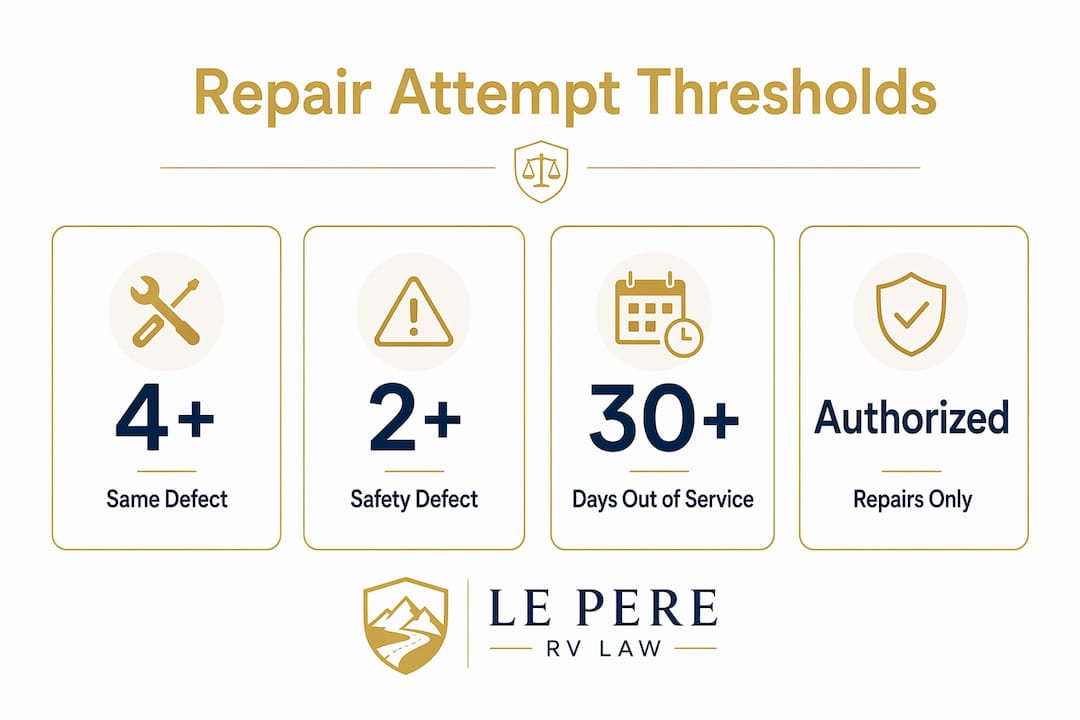
The California lemon law repair attempt standard is defined by Civil Code § 1793.22, which creates a rebuttable presumption that a manufacturer failed to repair a vehicle after a reasonable number of attempts when specific thresholds are met within 18 months or 18,000 miles. Those thresholds are four or more repair attempts for the same defect, two or more attempts for a defect likely to cause death or serious bodily injury, or 30 or more cumulative calendar days out of service for warranty repairs. Meeting any one of these triggers shifts the legal burden to the manufacturer to prove the vehicle is not a lemon. California residents pursuing claims for cars, trucks, SUVs, or RVs need to understand exactly how this standard works before their next dealer visit.
What are the repair attempt thresholds under California lemon law?
California Civil Code § 1793.22 sets three distinct numerical triggers for the lemon law presumption, all measured within an 18-month or 18,000-mile window from original delivery, whichever comes first. Each trigger operates independently. Hitting any one of them is enough to activate the presumption.

| Trigger | Threshold | Notes |
|---|---|---|
| Same defect, standard | 4 or more repair attempts | Applies to any recurring nonconformity |
| Same defect, safety risk | 2 or more repair attempts | Defect must be likely to cause death or serious injury |
| Out-of-service days | 30 or more cumulative calendar days | Counts all warranty repair visits combined |
| Time and mileage window | 18 months or 18,000 miles | Whichever occurs first from delivery |
One detail that surprises many vehicle owners: visits marked “no problem found” still count as repair attempts. The law counts every visit where you reported the defect, regardless of whether the dealer confirmed it. That means a dealer’s failure to duplicate your complaint does not erase the visit from your repair attempt tally.
Only visits to authorized repair facilities count toward the total. Taking your vehicle to an independent shop, even for the same defect, does not add to your lemon law repair attempt count. Every day a vehicle sits at an authorized facility for warranty work counts toward the 30-day out-of-service threshold, and cumulative out-of-service time is calculated across all visits combined, not per visit.
The presumption created by meeting these thresholds is powerful but not absolute. The Song-Beverly Consumer Warranty Act gives manufacturers the right to rebut it by showing the defect was caused by owner abuse, was already repaired, or does not substantially impair the vehicle’s use, value, or safety. Understanding that the presumption is a starting point, not a guaranteed win, shapes how you build your case from day one.
Why is written notice to the manufacturer so critical?
Written notice to the manufacturer before filing suit is mandatory under AB 1755. The 30-day pre-suit notice requirement gives the manufacturer one final opportunity to repurchase or replace the vehicle before litigation begins. Skipping this step can allow the manufacturer to undermine your claim even if your repair attempts clearly meet the thresholds.
The notice must be direct and traceable. Your written notice must identify the vehicle by VIN, describe the defect and its repair history, and demand a specific remedy such as a buyback or replacement. Sending it by certified mail with return receipt creates a paper trail that is difficult for a manufacturer to dispute.
A few important distinctions apply here:
- The 30-day written notice is required to trigger the repair attempt presumption under § 1793.22, but it is not a prerequisite for the 30-day out-of-service threshold.
- AB 1755 also changed the statute of limitations. You must now file your lemon law claim within one year of warranty expiration, a tighter deadline than many owners realize.
- AB 1755 introduced mandatory mediation as a procedural step but left the substantive repair attempt thresholds unchanged.
- The notice period gives the manufacturer 30 days to respond with a repurchase or replacement offer before you can proceed to litigation.
Pro Tip: Send your written notice to the manufacturer’s legal department or registered agent, not just the dealership. Dealers and manufacturers are separate legal entities, and notice to the dealer does not satisfy the requirement.
Timing matters as much as content. Sending notice too late, after the one-year filing window has closed, eliminates your right to claim the presumption. Owners who contact The Law Offices of Jeffrey Le Pere early in the process consistently have more options than those who wait until the deadline is weeks away.
How does the reasonable repair standard work beyond the numeric thresholds?
The numeric thresholds in § 1793.22 function as a floor, not a ceiling. Even without meeting the presumption thresholds, a vehicle may qualify for lemon law relief if the defect substantially impairs its use, value, or safety and the manufacturer failed to fix it after a reasonable opportunity. “Reasonable” in this context is a fact-specific standard that courts evaluate case by case.
The following scenarios illustrate when fewer repair attempts can still support a valid claim:
- Brake failure on a new vehicle. Two failed repair attempts for a defect that causes the brakes to lose pressure at highway speed can satisfy the safety defect threshold and may also meet the general reasonableness standard independently.
- Engine stall in traffic. A recurring stall that creates an accident risk may be considered substantially impairing safety after just two or three attempts, even if the standard four-attempt threshold is not reached.
- Structural defect on an RV. A slide-out that fails to retract correctly on a motorhome may render the vehicle unusable for its core purpose after two repair attempts, supporting a claim on impairment of use grounds.
- Manufacturer acknowledgment. If a Technical Service Bulletin exists for the defect and the dealer cannot fix it after two attempts, courts view that as strong evidence the manufacturer had a reasonable opportunity and failed.
- Extended out-of-service periods. A vehicle kept at the dealer for 45 days across three visits, even if no single visit exceeded 30 days, can satisfy the cumulative out-of-service threshold and support a reasonableness argument.
The rebuttable presumption is best understood as a legal shortcut. It removes the burden of proving reasonableness when the numbers are clear. Outside those numbers, you still have a claim, but you carry more of the evidentiary weight. That is why thorough documentation from the very first visit matters regardless of where you are in the repair attempt count.
Pro Tip: Ask the service advisor to note the specific complaint you reported on every repair order, word for word. Vague entries like “customer concern” are harder to connect to a recurring defect than specific language like “engine stalls at speeds above 55 mph.”
Courts also look at whether the manufacturer had a genuine opportunity to diagnose and fix the problem. If you brought the vehicle in while the defect was actively occurring and the dealer still could not replicate it, that visit still counts. The manufacturer cannot escape liability simply by failing to find a defect that you clearly reported.
How should you document repair attempts to support a lemon law claim?
Strong documentation is the foundation of every successful lemon law claim. Every dealer visit creates evidence, including visits where the dealer reports it could not duplicate the problem. Collecting and organizing that evidence from the start puts you in a far stronger position than trying to reconstruct it later.
Follow these documentation practices from your first repair visit:
- Collect every repair order. Request a copy of the complete repair order at the end of each visit, including the customer complaint section, the technician’s findings, and the work performed or not performed.
- Track out-of-service days precisely. Note the date you dropped off the vehicle and the date you picked it up for every visit. Keep a running total of cumulative days.
- Preserve all written communications. Save every email, text message, and letter exchanged with the dealer or manufacturer regarding the defect.
- Document the defect yourself. Take dated photos or video of warning lights, unusual sounds, or physical damage each time the problem occurs.
- Record your verbal complaints. After each dealer visit, write a brief note to yourself summarizing what you told the service advisor and what they said in response.
- Note “no problem found” outcomes. These visits are valuable. They show you reported the defect and gave the manufacturer an opportunity to fix it.
The repair attempt evidence you collect directly determines how strong your claim is when it reaches a manufacturer’s legal team or an arbitrator. Manufacturers look for gaps in the record. A complete, chronological file of repair orders with consistent defect descriptions gives them very little room to argue you did not provide a reasonable opportunity to repair.
Authorized facility visits are the only ones that count, so avoid taking the vehicle to independent shops for the same defect while a lemon law claim is active. If you are unsure whether a visit qualifies, an attorney at The Law Offices of Jeffrey Le Pere can review your repair orders and give you a clear answer before you take any further steps.
Key Takeaways
California lemon law requires meeting at least one of three specific repair attempt thresholds under Civil Code § 1793.22 to trigger the rebuttable presumption, but claims can succeed even without hitting those numbers if the defect substantially impairs the vehicle.
| Point | Details |
|---|---|
| Three triggers for the presumption | Four repair attempts, two for safety defects, or 30 cumulative out-of-service days within 18 months or 18,000 miles. |
| “No problem found” visits count | Every authorized dealer visit where you reported the defect adds to your repair attempt total. |
| Written notice is mandatory | AB 1755 requires a 30-day pre-suit notice to the manufacturer identifying the vehicle, defect, and demanded remedy. |
| Claims can succeed below thresholds | Substantial impairment of use, value, or safety can support a claim even with fewer than four repair attempts. |
| Documentation wins cases | Complete repair orders, out-of-service logs, and written communications are the evidence that manufacturers cannot easily rebut. |
What I’ve learned after 25 years on both sides of lemon law cases
The biggest mistake I see California vehicle owners make is waiting too long to get legal advice. By the time they call, they have already had five or six repair attempts, lost track of their out-of-service days, and sent informal emails to the dealer instead of a proper written notice to the manufacturer. The claim is still viable, but it is harder to build than it needed to be.
I spent 11 years defending manufacturers and dealerships before switching to the consumer side. That experience taught me exactly how manufacturers attack lemon law claims. The first thing their attorneys look for is a gap in the repair record. If you have four repair attempts but the repair orders describe the complaint differently each time, the manufacturer will argue those are four separate defects, not four attempts to fix one. Consistent, specific language on every repair order is the single most underrated factor in these cases.
The “2-4-30” rule is widely known, but what most owners do not realize is that it is a rebuttable presumption, not a guaranteed outcome. Manufacturers can and do fight back. I have seen cases where owners met all three thresholds and still faced aggressive pushback because the manufacturer argued the defect was caused by owner misuse. That argument rarely succeeds when the documentation is solid, but it can create delays and costs that a well-prepared claim avoids.
My advice to anyone in the middle of a recurring repair situation: start building your file now, send written notice to the manufacturer before you hit the filing deadline, and talk to an attorney before you accept any settlement offer. Manufacturers do not offer their best number first. They offer what they think you will accept without a fight.
— Jeff Le Pere
How The Law Offices of Jeffrey Le Pere can help with your claim
California lemon law claims involve strict deadlines, specific procedural steps, and manufacturers who know how to fight back. The Law Offices of Jeffrey Le Pere represents owners of defective cars, trucks, SUVs, motorhomes, fifth wheels, and travel trailers across California, with no upfront cost to you. Every case runs on contingency, meaning the manufacturer pays attorney fees if you win.

Jeff Le Pere’s 11 years defending manufacturers gives the firm a direct advantage in anticipating and countering the arguments manufacturers use to rebut the lemon law presumption. Recovery options include a full repurchase, a replacement vehicle, or a cash settlement, plus a civil penalty of up to two times actual damages when a manufacturer willfully ignored its warranty obligations. If your vehicle has been back to the dealer multiple times for the same defect, a free case review at The Law Offices of Jeffrey Le Pere is the fastest way to know where you stand.
FAQ
What is the California lemon law repair attempt standard?
The California lemon law repair attempt standard is the legal test under Civil Code § 1793.22 that determines whether a manufacturer had a reasonable number of opportunities to fix a defect. It creates a rebuttable presumption when four repair attempts, two safety-related attempts, or 30 cumulative out-of-service days occur within 18 months or 18,000 miles.
Do “no problem found” repair visits count under California lemon law?
Yes. Every visit to an authorized repair facility where you reported the defect counts as a repair attempt, even if the technician could not duplicate the problem or marked the order as “no problem found.”
How many repair attempts are allowed before a vehicle qualifies as a lemon in California?
The presumption triggers at four repair attempts for the same defect, or two attempts if the defect is likely to cause death or serious injury. A vehicle can also qualify after 30 cumulative out-of-service days, regardless of the number of individual visits.
What does AB 1755 change about California lemon law?
AB 1755 requires consumers to send a 30-day written notice to the manufacturer before filing suit and limits the filing window to one year after the warranty expires. The substantive repair attempt thresholds under § 1793.22 remain unchanged.
Can I file a lemon law claim with fewer than four repair attempts?
Yes. Even without meeting the presumption thresholds, a claim can succeed if the defect substantially impairs the vehicle’s use, value, or safety and the manufacturer failed to fix it after a reasonable opportunity, as defined by the Song-Beverly Consumer Warranty Act.