California Fifth Wheel Lemon Law Process: Your Rights

California’s Song-Beverly Consumer Warranty Act defines the fifth wheel lemon law process as the legal mechanism that entitles owners to a refund, replacement, or cash settlement when recurring defects substantially impair their vehicle’s use, safety, or value. Fifth wheels qualify as consumer goods under §1791(a) when purchased primarily for personal, family, or household use. Remedies include a full repurchase of the purchase price, sales tax, and registration fees, plus incidental damages and a civil penalty of up to two times actual damages when a manufacturer willfully ignored its warranty obligations. The Law Offices of Jeffrey Le Pere represents California fifth wheel owners through every stage of this process, on a contingency basis that costs you nothing out of pocket.
What legal criteria must a fifth wheel meet for lemon law protection in California?
California’s Song-Beverly Act covers fifth wheels that meet three core requirements: the defect must substantially impair use, safety, or value; the manufacturer must have had a reasonable number of attempts to repair it; and the vehicle must carry an active warranty at the time of the defect.
The phrase “substantially impairs” carries real legal weight. A sidewall crack that lets water into the living area, a slide-out that fails to retract, or a brake controller that malfunctions all qualify because they affect safety or make the fifth wheel unusable. A cosmetic scratch on a cabinet door generally does not meet the threshold.
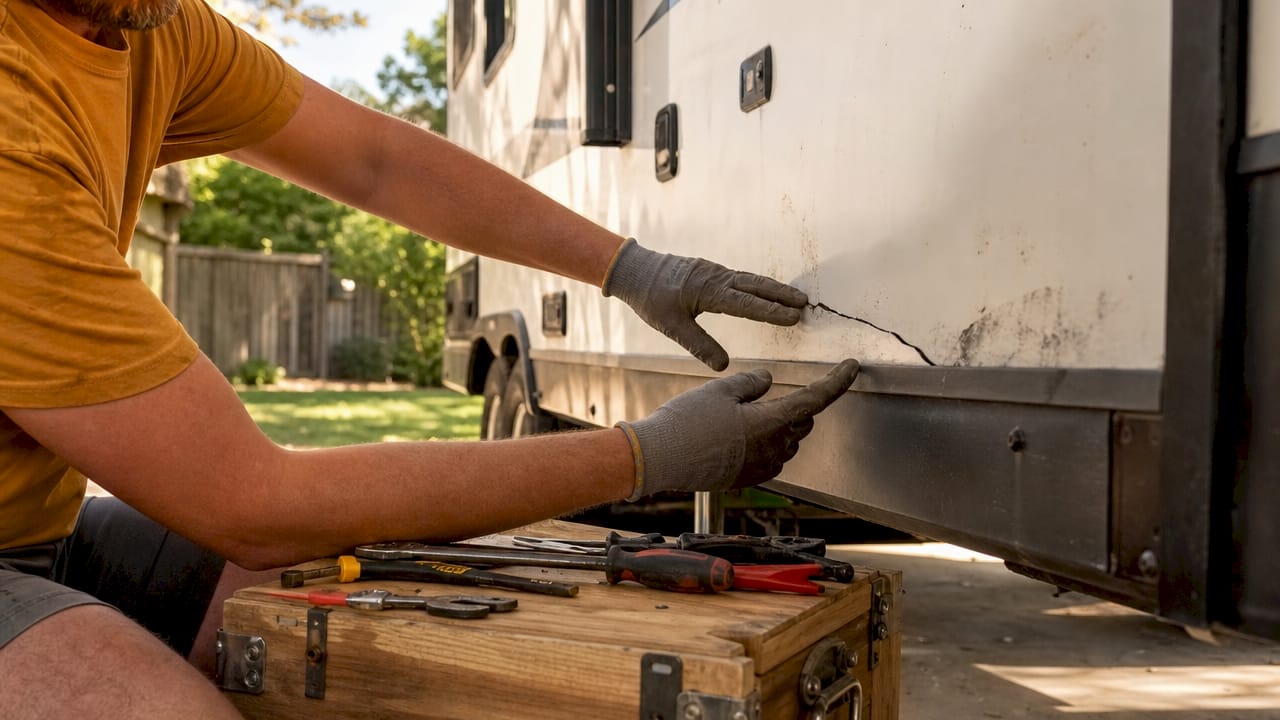
California law under §1793.22 presumes a defect is unrepairable if the same problem persists after two or more repair attempts for a safety issue, four or more attempts for any other defect, or if the vehicle has been out of service for more than 30 cumulative days due to repairs. Each of these thresholds is a separate path to qualification, not a single hurdle you must clear.
Fifth wheel warranty coverage is more layered than a standard car warranty. Owners typically deal with three separate warranties:
- Chassis warranty: Covers the frame, axles, and towing components. The chassis manufacturer (often Lippert Components or a similar supplier) is the responsible party.
- Coach warranty: Covers the living area structure, including walls, roof, slideouts, and flooring. The coach builder such as Thor Industries or Forest River holds this warranty.
- Component warranties: Cover individual appliances and systems like the refrigerator, furnace, water heater, and electrical inverter. Each appliance manufacturer carries its own separate warranty.
The vehicle must have been purchased for personal, family, or household use. A fifth wheel bought primarily for commercial rentals or business purposes falls outside the Song-Beverly Act’s protections. Keep your purchase agreement and any financing documents that confirm personal use.
How to document and gather evidence for a fifth wheel lemon law claim
Strong documentation is the foundation of every successful lemon law claim. Manufacturers fight back hard, and your repair orders are your primary evidence.
- Collect every repair order. Request copies from each authorized service center immediately after each visit. Repair orders must describe the defect you reported, the diagnosis, and the work performed. If a service writer writes “no problem found,” that notation still counts as a repair attempt under California law.
- Separate defects by warranty type. A fifth wheel sidewall crack lemon law claim targets the coach manufacturer, while a failed Lippert chassis component targets the chassis maker. Keep separate folders for chassis, coach, and component repair records. Mixing them together creates confusion that manufacturers exploit.
- Record every day out of service. California law counts cumulative days the vehicle is unavailable for use due to repairs. Create a simple log with the date you dropped the unit off, the date you picked it up, and the name of the facility.
- Document travel to service centers. Authorized service centers for fifth wheels are often scarce. If you drove 200 miles each way to reach the nearest authorized facility, log those trips. Travel time typically does not count as out-of-service days under the statute, but it is relevant context during settlement negotiations.
- Save all written communications. Every email, letter, or text message with a manufacturer representative or dealership service department belongs in your file. Written denials and delays are particularly valuable.
- Log alternate lodging and incidental costs. If a repair forced you to stay in a hotel or rent another space, save those receipts. Incidental damages are recoverable under the Song-Beverly Act.
Pro Tip: When you drop your fifth wheel off for a repair, write your defect description on the repair order yourself before signing. Service writers sometimes minimize or reframe the complaint, which weakens your claim. Your words on that document carry more weight than a technician’s summary.
Step-by-step process to file a fifth wheel lemon law claim in California
The California lemon law claim process for fifth wheels follows a defined sequence. Skipping steps or misordering them can delay your recovery or reduce your settlement.
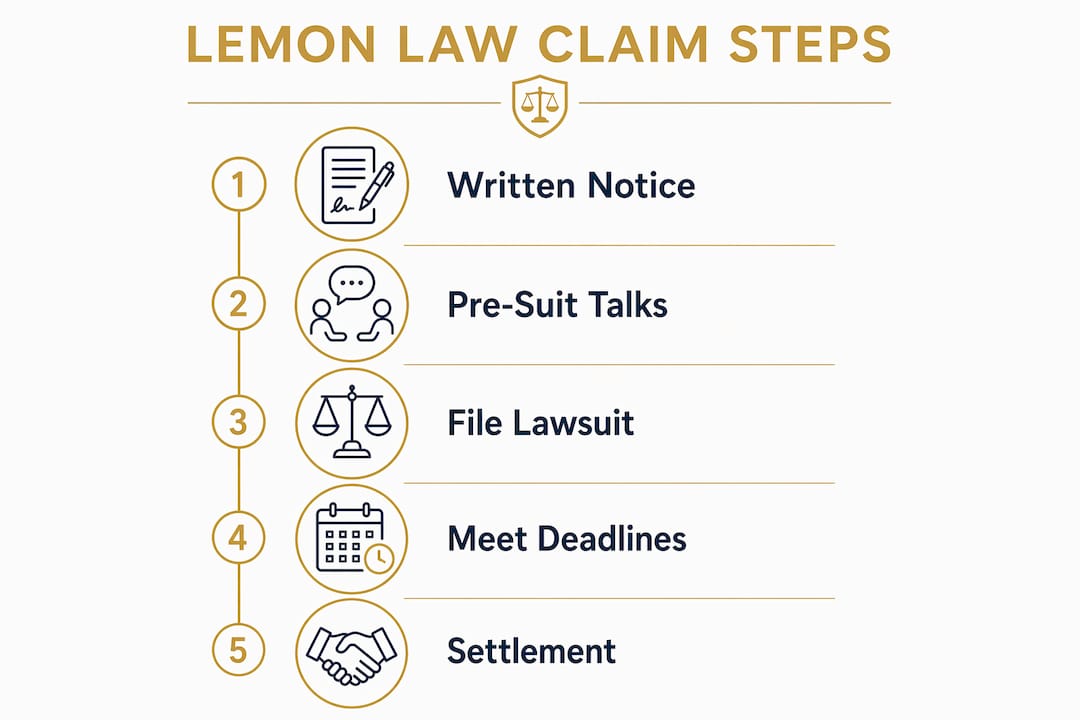
Step 1: Provide written notice to the manufacturer. Before filing a lawsuit, California law requires you to give the manufacturer a reasonable opportunity to repair the defect. Send a certified letter to the manufacturer’s warranty department describing the defect, the repair history, and your demand for a repurchase or replacement.
Step 2: Attempt pre-suit negotiation. Most manufacturers have internal dispute resolution programs. Engaging these programs is sometimes required before litigation. An attorney can handle this negotiation on your behalf and prevent you from accepting a settlement that undervalues your claim.
Step 3: File a lawsuit if negotiation fails. When the manufacturer refuses a fair settlement, your attorney files a civil complaint in California Superior Court. The Song-Beverly Act requires the manufacturer to pay your attorney fees if you prevail, which is why manufacturers often settle before trial.
Step 4: Discovery and settlement discussions. Both sides exchange documents and evidence. Most fifth wheel lemon law cases resolve during this phase. The lemon law case timeline generally runs three to six months for pre-suit settlements, with litigated cases taking longer. That range reflects how quickly manufacturers move when the documentation is airtight.
Step 5: Resolution. Your potential outcomes include:
- Full repurchase: The manufacturer buys back the fifth wheel at the original purchase price, minus a mileage offset calculated from the date of first repair.
- Replacement vehicle: The manufacturer provides a comparable new unit.
- Cash settlement: A negotiated payment that compensates you without a full buyback.
- Civil penalty: Up to two times actual damages when the manufacturer willfully failed to honor its warranty obligations.
Under AB 1755, you must file your lemon law claim within one year of your warranty’s expiration date. Missing that deadline eliminates your right to recover. If your warranty is approaching its end, contact an attorney before that window closes.
Common challenges in California fifth wheel lemon law cases
Fifth wheel lemon law cases are harder than car cases. Owners who go in without understanding the obstacles often end up with delayed claims or reduced settlements.
The biggest obstacle is manufacturer finger-pointing. When a defect falls in a gray area between the coach and a component, the coach builder blames the appliance manufacturer and vice versa. Neither accepts responsibility, and the owner waits. Segmenting defects by warranty from the start prevents this tactic from gaining traction.
Parts availability compounds the problem. Fifth wheel components are not stocked at every dealer. A replacement slide-out motor or a specific roof membrane may take weeks to arrive. Each day the unit sits waiting for parts counts toward your 30-day out-of-service threshold, which works in your favor.
Pro Tip: If a service center tells you a part is on backorder, get that statement in writing. A written backorder notice documents why the repair took so long and strengthens your out-of-service day count.
Other common pitfalls include:
- Failing to use authorized service centers. Repairs performed at independent shops generally do not count toward your repair attempt threshold. Always use a manufacturer-authorized facility.
- Accepting verbal repair confirmations. If a technician says the problem is fixed but does not document it on the repair order, that repair attempt may not hold up legally.
- Waiting too long to consult an attorney. Owners often spend a year or more attempting repairs before seeking legal help. By then, the warranty may be close to expiring, and AB 1755’s one-year filing deadline becomes a real threat.
How does the California lemon law process for fifth wheels differ from other vehicle claims?
Fifth wheel lemon law cases differ from standard car cases in three significant ways: the warranty structure, the mileage offset calculation, and the number of legal defendants.
A car lemon law claim typically involves one manufacturer and one warranty. A fifth wheel claim can involve the coach builder, the chassis supplier, and multiple appliance manufacturers simultaneously. Each defendant has its own legal team and its own strategy for minimizing liability.
The mileage offset for fifth wheels works differently than for motorhomes. Motorhomes accumulate mileage on the odometer, which directly reduces the repurchase amount. Fifth wheels are towable, so the offset calculation focuses on the towing vehicle’s mileage at the time of first repair rather than a traditional odometer reading on the unit itself. This distinction affects how much money you recover.
Settlement values in fifth wheel cases also tend to reflect the complexity of the claim. Cases with clear, documented defects across multiple repair attempts and a single identifiable manufacturer resolve faster. Cases where defect responsibility is disputed across three warranty holders take longer and require more legal work. A specialized RV lemon law attorney knows how to structure the claim to target the right defendant from the beginning, which shortens the timeline and increases the recovery.
Key Takeaways
California fifth wheel owners with documented recurring defects have a clear legal path to a full repurchase, replacement, or civil penalty under the Song-Beverly Act, provided they meet repair attempt thresholds and file within one year of warranty expiration.
| Point | Details |
|---|---|
| Eligibility threshold | Defects must substantially impair use, safety, or value, with at least two attempts for safety issues or four for other defects. |
| Warranty segmentation | Separate chassis, coach, and component defects into distinct files to prevent manufacturer finger-pointing. |
| Out-of-service tracking | Log every day the unit is unavailable for use; 30 cumulative days triggers a lemon law presumption. |
| AB 1755 deadline | File your claim within one year of your warranty’s expiration date or lose your right to recover. |
| Recovery options | Remedies include full repurchase, replacement, cash settlement, and civil penalties up to twice actual damages. |
What I’ve learned after 25 years on both sides of fifth wheel lemon law cases
The owners who recover the most are almost never the ones with the worst defects. They are the ones with the best paper trail.
I spent 11 years defending manufacturers before I switched sides. I know exactly what the manufacturer’s legal team looks for when they receive a claim. The first thing they pull is the repair order file. If the defect descriptions are vague, if the repair dates are inconsistent, or if the owner used an unauthorized shop even once, the defense team flags it immediately and uses it to reduce the settlement offer.
The second thing I see owners get wrong is waiting. They give the manufacturer chance after chance, hoping the problem gets fixed. By the time they call me, the warranty has expired or the AB 1755 deadline is weeks away. The law gives manufacturers a reasonable opportunity to repair, but “reasonable” does not mean unlimited. After four failed attempts or 30 days out of service, you have a claim. Use it.
Fifth wheel sidewall cracks are a perfect example of a defect that owners underestimate. A crack in the sidewall looks cosmetic at first. Then water intrudes, the insulation saturates, and the interior wall delaminates. By the time the owner documents the full extent of the damage, the coach manufacturer argues that improper maintenance caused the delamination. Catching and documenting that crack at the first sign of failure, and getting it on a repair order immediately, is the difference between a strong claim and a disputed one.
My advice: treat every repair visit like a legal proceeding. Write down what you told them. Get the repair order before you leave. Call an attorney before the warranty expires.
— Jeff Le Pere
How The Law Offices of Jeffrey Le Pere can help with your fifth wheel claim
California fifth wheel owners dealing with recurring defects have a direct path to legal representation through The Law Offices of Jeffrey Le Pere.
The firm handles California RV lemon law claims for fifth wheels, motorhomes, and travel trailers on a full contingency basis. You pay nothing. If the case resolves in your favor, the manufacturer covers attorney fees under the Song-Beverly Act. Jeff Le Pere’s 11 years defending manufacturers gives the firm a precise understanding of how warranty disputes are built and how to dismantle them. The firm offers a free case review so you can find out whether your fifth wheel qualifies before committing to anything. Contact The Law Offices of Jeffrey Le Pere to get your repair orders reviewed and your options explained.
FAQ
What qualifies a fifth wheel as a lemon in California?
A fifth wheel qualifies as a lemon under California’s Song-Beverly Act when a defect substantially impairs its use, safety, or value and the manufacturer fails to repair it after a reasonable number of attempts, typically four attempts or 30 cumulative days out of service.
Does California lemon law cover fifth wheel sidewall cracks?
A fifth wheel sidewall crack qualifies for lemon law protection when it substantially impairs the vehicle’s use or value and the coach manufacturer fails to repair it after a reasonable number of documented attempts.
How long does a fifth wheel lemon law case take in California?
Most California fifth wheel lemon law cases resolve in three to six months through pre-suit settlement. Cases that proceed to trial take longer, though the majority settle before reaching that stage.
What is the filing deadline for a California fifth wheel lemon law claim?
Under AB 1755, California owners must file a lemon law claim within one year of their warranty’s expiration date. Missing this deadline eliminates the right to recover a refund, replacement, or civil penalty.
Who pays attorney fees in a California fifth wheel lemon law case?
The Song-Beverly Act requires the manufacturer to pay the prevailing consumer’s attorney fees. The Law Offices of Jeffrey Le Pere handles these cases on contingency, meaning you owe nothing regardless of the outcome.