California AB 1755 Repair Threshold Explained for Owners

AB 1755 did not change the substantive repair thresholds that trigger California’s lemon presumption. What it did change, significantly, are the procedural rules governing when and how you can file a claim. Under the AB 1755 bill text, covered actions must be filed within one year after your express warranty expires and no later than six years after original vehicle delivery. Before you can seek civil penalties against an opted-in manufacturer, you must send a written pre-suit notice at least 30 days before filing. Mandatory mediation follows, with discovery stayed until it concludes.
The controlling statutes are AB 1755 (Kalra), the Song-Beverly Consumer Warranty Act (Cal. Civil Code §§ 1793.2, 1793.22, 1794), and the Tanner Consumer Protection Act. The numeric thresholds that matter most:
- 2 repair attempts for a defect likely to cause death or serious injury, after written notice to the manufacturer
- 4 repair attempts for the same nonconformity
- 30+ cumulative days out of service for warranty repairs
- 30 days to send pre-suit notice before filing for civil penalties
- 60 days maximum tolling during the pre-suit notice period
- 1 year after warranty expiration to file (for opted-in manufacturers)
- 6 years from original delivery as the absolute cap
Your immediate actions: document every repair visit, confirm whether your manufacturer has opted into the AB 1755 framework via the DCA Arbitration Certification Program, keep possession of the vehicle, and prepare your statutory pre-suit notice before the one-year window closes.
Key Takeaways
AB 1755 adds strict procedural deadlines and pre-suit steps for opted-in manufacturers, but the Tanner Act’s 2/4/30 repair thresholds and Song-Beverly remedies remain fully intact.
| Point | Details |
|---|---|
| Substantive thresholds unchanged | The 2-attempt, 4-attempt, and 30-day out-of-service thresholds under the Tanner Act still govern when the lemon presumption arises. |
| New filing limits for opted-in manufacturers | File within one year after warranty expiration and no later than six years from original delivery, with tolling for out-of-service days, Tanner ADR, and pre-suit notice (up to 60 days). |
| Pre-suit notice is mandatory for civil penalties | Send a written notice at least 30 days before filing; include your name, VIN, repair history, and a demand for repurchase or replacement. |
| Manufacturer’s 30/60 rule bars civil penalties | If the manufacturer offers restitution within 30 days and completes it within 60 days of receiving your notice, civil penalties are precluded. |
| The Law Offices of Jeffrey Le Pere | Represents California consumers on contingency for AB 1755 lemon-law claims; free case review available with no out-of-pocket cost. |
Table of Contents
- What are the new AB 1755 filing deadlines and how does tolling work?
- How do the Tanner Act repair thresholds still work under AB 1755?
- What exactly must your AB 1755 pre-suit notice include?
- How does mandatory mediation work and what discovery is stayed?
- What happens when the manufacturer responds to your notice?
- What remedies does AB 1755 preserve for California consumers?
- When does AB 1755 not apply to your claim?
- How do you preserve your lemon-law claim under AB 1755?
- Should you follow AB 1755 steps or file immediately?
- What AB 1755 really means for how your case plays out
- How The Law Offices of Jeffrey Le Pere can help with your AB 1755 claim
- Sources
What are the new AB 1755 filing deadlines and how does tolling work?
AB 1755 sets a one-year filing period measured from the date your express warranty expires, with an absolute six-year cap measured from original vehicle delivery. Both limits apply only when the manufacturer has elected the AB 1755 framework. If your manufacturer has not opted in, the older Song-Beverly procedures continue to govern your claim.
Three events toll those clocks. First, the pendency of qualified third-party dispute resolution under the Tanner Act pauses the filing period. Second, time the vehicle is out of service for warranty repairs does not count against your filing window. Third, the pre-suit notice period itself tolls the statute, but the tolling from notice cannot exceed 60 days. The Assembly Judiciary analysis confirms all three tolling categories and their interaction with the Tanner Act’s existing dispute-resolution provisions.
Here is how the timeline typically unfolds:
| Event | Clock Effect |
|---|---|
| Original vehicle delivery | Six-year absolute cap begins |
| Express warranty expiration | One-year filing window begins |
| Vehicle out of service for repairs | Filing clock paused for each day out of service |
| Tanner Act ADR pending | Filing clock paused during proceedings |
| Pre-suit notice sent | Filing clock paused, up to 60 days maximum |
| Filing deadline | Earlier of: one year after warranty expiration (plus tolled days) or six years from delivery |
AB 1755 was chaptered on September 29, 2024. For a practical breakdown of how these deadlines interact with your specific warranty period, the AB 1755 deadline guide walks through common scenarios for California owners.
How do the Tanner Act repair thresholds still work under AB 1755?
The substantive repair thresholds that create the Tanner presumption are unchanged. AB 1755 is a procedural statute. The thresholds themselves come from Cal. Civil Code § 1793.22 and remain the primary means consumers use to establish a lemon.
A “nonconformity” under the Tanner Act is a defect or condition that substantially impairs the use, value, or safety of the vehicle and is covered by the manufacturer’s express warranty. The presumption that a vehicle is a lemon arises within 18 months or 18,000 miles of delivery when any one of three conditions is met.
| Threshold | What It Requires | Common Example | Evidence Needed |
|---|---|---|---|
| 2 repair attempts, dangerous defect | Same defect likely to cause death or serious injury; written notice to manufacturer required before or during first attempt | Brake failure, steering loss | Written notice to manufacturer, two repair orders showing same defect |
| 4 repair attempts, same nonconformity | Same defect repaired four or more times without resolution | Persistent transmission slipping, recurring electrical shorts | Four repair orders showing same complaint code |
| 30+ cumulative days out of service | Vehicle out of service for warranty repairs totaling more than 30 days | Multiple separate repair visits for drivetrain issues | Repair orders with drop-off and pick-up dates, loaner records |
The two-attempt threshold for dangerous defects requires that you provide written notice to the manufacturer or its authorized agent before or during the first repair attempt, or the manufacturer must have had actual knowledge of the defect. Without that notice, the two-attempt threshold does not apply, and you fall back on the four-attempt standard. For a detailed breakdown of how these thresholds apply to specific defect types, the repair attempt standard guide covers the 2/4/30 rule with examples.
What exactly must your AB 1755 pre-suit notice include?
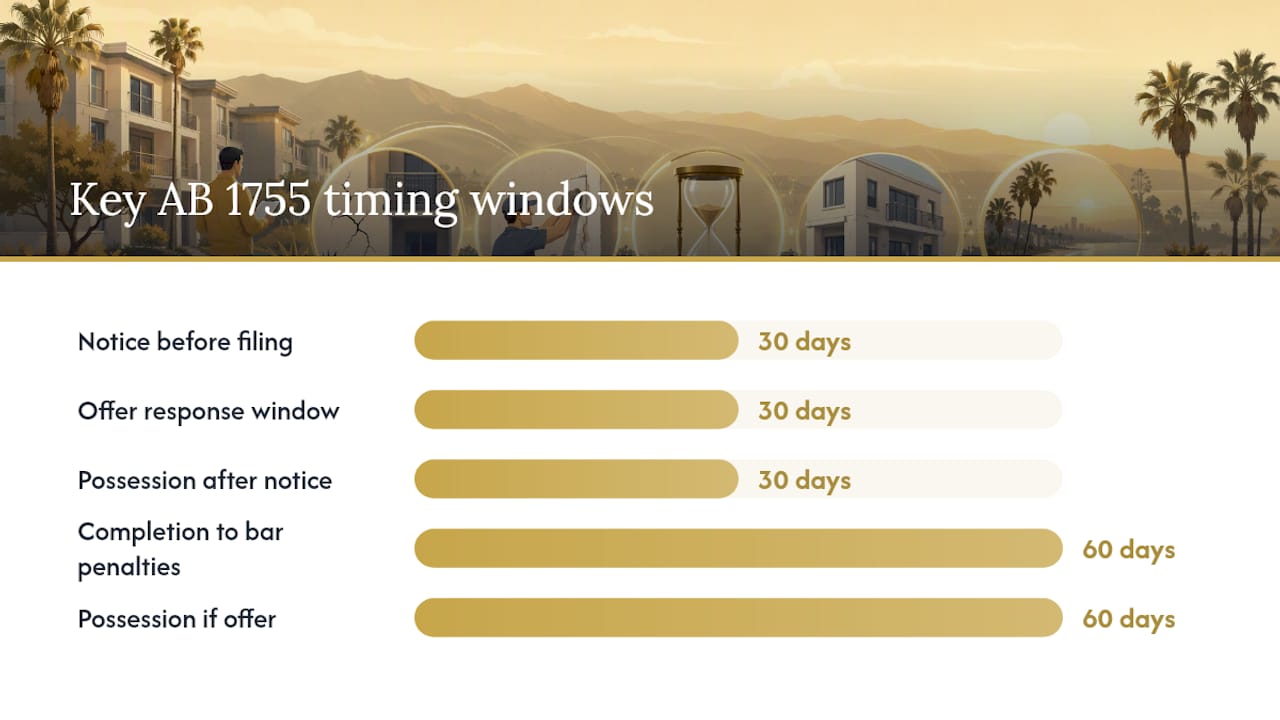
AB 1755 requires a written notice sent to the manufacturer at least 30 days before you file any action seeking civil penalties. The notice must include your name, the vehicle’s accurate VIN, a brief repair history, and a demand for repurchase or replacement. Per the ARB legislative summary, if the manufacturer offers restitution within 30 days of receiving that notice and completes it within 60 days, civil penalties are barred.
Required fields for the pre-suit notice:
- Consumer’s full legal name and contact information
- Vehicle Identification Number (VIN), confirmed accurate
- Brief chronological repair history (dates, dealership names, defect descriptions, repair outcomes)
- Clear demand for repurchase or replacement under Song-Beverly
- Reference to the applicable warranty and the statutory basis for the claim
Timing rules to follow:
- Send the notice at least 30 days before filing for civil penalties
- The notice period tolls your filing clock, but tolling from notice cannot exceed 60 days
- Keep the vehicle in your possession for at least 30 days after the manufacturer receives the notice
- If the manufacturer offers restitution or replacement, extend possession to 60 days from receipt of notice
Delivery dos and don’ts:
- Send to the manufacturer’s legally designated address or email as listed in the DCA/ACP guidance, not to a local dealership
- Use certified mail with return receipt requested, and retain the receipt
- If the manufacturer has designated an email address for statutory notices, send to that address as well and save the delivery confirmation
- Do not assume a dealer is an authorized recipient unless the manufacturer has explicitly designated that dealer in writing
Sending notice to the wrong address is one of the most common procedural failures in AB 1755 claims. Manufacturers’ counsel watch for exactly this.
How does mandatory mediation work and what discovery is stayed?
AB 1755 requires mediation in covered actions and stays most discovery until mediation concludes. The Senate Judiciary bill text provides the statutory language establishing the mediation requirement, the discovery stay, limited exceptions for disclosures and depositions, and the court’s authority to impose sanctions for noncompliance.
Mediation is typically triggered after the manufacturer files an answer. During the mediation period, broad discovery is paused. The statute does permit limited disclosures, including certain document exchanges necessary to facilitate meaningful mediation, and allows limited depositions under specified conditions. Courts retain authority to sanction any party that fails to comply with the procedural requirements, including parties who obstruct or delay the mediation process.
The practical effect on case timing is real. A consumer who files without completing the pre-suit notice step, or who fails to cooperate with mediation, risks sanctions and may lose the ability to recover civil penalties even if the underlying lemon claim is strong.
Pro Tip: Before mediation begins, organize all repair invoices, appointment records, and manufacturer communications in strict chronological order. The limited disclosures permitted during the discovery stay will draw directly from this file, and a well-organized production signals to the mediator that your claim is documented and credible.
What happens when the manufacturer responds to your notice?
If the manufacturer offers restitution or replacement within 30 days of receiving your statutory notice and completes that offer within 60 days, civil penalties under Song-Beverly are barred. That 30/60 rule is the central incentive structure AB 1755 creates for manufacturers to resolve claims quickly.
The statutory penalty for a manufacturer that agrees to restitution or replacement but then fails to complete it on time is $50 per day after the completion deadline, subject to stipulation between the parties.
Possession rules you must follow:
- Keep the vehicle in your possession for at least 30 days after the manufacturer receives your notice
- If the manufacturer makes a restitution or replacement offer, extend possession to 60 days from the date of manufacturer receipt of the notice
- You may sell or dispose of the vehicle before the 30-day window only if the manufacturer has failed to make any offer within that period
- Selling the vehicle during the possession window without manufacturer consent can jeopardize your claim
Documenting the manufacturer’s response:
- Record the exact date your notice was received (use certified mail tracking or email delivery confirmation)
- Save all written communications from the manufacturer, including any offer letters or emails
- Note the date any offer is made and the date any restitution or replacement is completed
- Retain all shipping records, return paperwork, and signed releases if you surrender the vehicle
A manufacturer that offers within 30 days but drags completion past 60 days does not automatically escape civil penalties. The $50 daily penalty applies to that delay, and the failure to complete timely can revive penalty exposure.
What remedies does AB 1755 preserve for California consumers?
AB 1755 does not eliminate any substantive remedy under Song-Beverly or the Tanner Act. Repurchase, replacement, civil penalties, and attorneys’ fees all remain available under qualifying circumstances. The practitioner summary at The Complete Lawyer confirms that AB 1755 tightened procedural baselines while leaving substantive presumption thresholds and remedies intact.
The available remedies and their governing provisions:
- Repurchase (restitution): The manufacturer must repurchase the vehicle at the original purchase price, less a mileage offset, plus incidental damages. Governed by Cal. Civil Code § 1793.2(d).
- Replacement: The manufacturer provides a comparable new vehicle. Also governed by § 1793.2(d).
- Civil penalties: Up to two times actual damages if the manufacturer’s failure to comply was willful. Governed by Cal. Civil Code § 1794©. Civil penalties are barred if the manufacturer timely offers and completes restitution or replacement under the 30/60 rule.
- Attorneys’ fees: A prevailing consumer is entitled to recover attorneys’ fees and costs under Cal. Civil Code § 1794(d). This provision is what makes contingency representation viable for consumers.
To prioritize your recovery, work through this sequence:
- Confirm you meet at least one Tanner threshold (2 attempts, 4 attempts, or 30 days out of service)
- Gather repair orders, invoices, and warranty documents to support the threshold you are relying on
- Calculate your actual damages (purchase price, finance charges, incidental costs)
- Assess whether the manufacturer’s conduct was willful to determine civil penalty exposure
- Preserve all communications showing the manufacturer was on notice of the defect
When does AB 1755 not apply to your claim?
AB 1755’s procedural regime applies only when the manufacturer has elected the AB 1755 framework or is certified through the DCA Arbitration Certification Program. If your manufacturer has not opted in, the older Song-Beverly procedures govern your claim, and the new one-year filing window, pre-suit notice requirement, and mandatory mediation do not apply.
Common situations where AB 1755 does not control:
- The manufacturer is not on the DCA ACP annual opt-in list
- The consumer elects to seek restitution under specific Civil Code subdivisions that AB 1755 excludes from its coverage
- The action does not involve a “covered action” as defined by the statute
The tradeoffs matter. If your manufacturer has not opted in and you send a statutory notice anyway, you may not receive the tolling benefit. Conversely, if your manufacturer has opted in and you skip the notice step, you may forfeit civil penalties even if you win on the underlying lemon claim.
The DCA Arbitration Certification Program publishes the official annual opt-in list. Opt-in elections run in five-year cycles, so a manufacturer that was not on last year’s list may be on this year’s, or vice versa. Verify the current list before drafting any notice. Manufacturer marketing materials are not a reliable substitute for the official ACP publication.
How do you preserve your lemon-law claim under AB 1755?
Start documenting now. Every repair visit, every communication with the dealer or manufacturer, and every day the vehicle sits in the shop is evidence. Here is the attorney-level checklist:
Core documents to gather:
- Vehicle title and purchase paperwork showing original delivery date
- All warranty documents, including any extended or supplemental warranties
- Every repair order, with odometer readings, drop-off dates, pick-up dates, and defect descriptions
- Appointment logs and service scheduling confirmations
- All emails, texts, and letters exchanged with the dealer or manufacturer
- Photos and videos of the defect, taken as close in time to each repair visit as possible
- Loaner vehicle records, which help establish out-of-service days
Notice preparation steps:
- Confirm your manufacturer’s opt-in status using the current DCA ACP list
- Identify the manufacturer’s designated notice recipient address or email from the ACP guidance
- Draft the notice with all required fields: name, VIN, repair history, and demand for repurchase or replacement
- Send via certified mail with return receipt and, if an email address is designated, by email with delivery confirmation
- Retain all proof of delivery
When to call a lemon-law attorney:
- Before you send the pre-suit notice, not after
- As soon as you believe you have met one of the Tanner thresholds
- If the manufacturer has denied a warranty claim or offered a repair that did not resolve the defect
- If you are approaching the one-year post-warranty expiration window
Contingency representation means no out-of-pocket cost to you. The manufacturer pays attorneys’ fees if you prevail. Early counsel matters because AB 1755’s procedural traps, particularly the notice address requirement and the possession rules, are exactly the kind of technical missteps manufacturers’ counsel are trained to exploit.
Pro Tip: Confirm your manufacturer’s opt-in status on the DCA ACP list before you draft a single word of the pre-suit notice. Sending the notice to the wrong address, or sending it to a manufacturer that has not opted in, can void the tolling benefit and expose your claim to a timeliness challenge.
Should you follow AB 1755 steps or file immediately?
In most cases, follow AB 1755’s notice and mediation steps if your manufacturer has opted in. Skipping the notice route is an option, but it carries real tradeoffs: you may forfeit civil penalties and lose the tolling benefit that the pre-suit notice period provides.
The decision flow is straightforward. Check the DCA ACP opt-in list first. If the manufacturer has opted in, send the statutory notice, preserve vehicle possession, and allow the 30-day response window to run. If the manufacturer has not opted in, or if an immediate safety risk makes continued use of the vehicle dangerous, consult a lemon-law attorney about filing under the existing Song-Beverly framework without the AB 1755 pre-suit steps.
Pro Tip: This article is educational information, not legal advice. AB 1755 is a complex statute with procedural requirements that vary based on manufacturer opt-in status, warranty terms, and the specific facts of your repair history. Confirm current statutory requirements and your specific rights with a qualified California lemon-law attorney before taking any action.
What AB 1755 really means for how your case plays out
AB 1755 shifts practical litigation dynamics in a way most consumer-facing summaries understate. The statute’s procedural requirements are not just administrative hurdles. They are leverage points that manufacturers’ counsel will use aggressively if you give them the opportunity.
Spending 11 years on the defense side means seeing exactly how manufacturers’ legal teams respond to lemon-law claims. The first thing they check is the notice. Was it sent to the right address? Does it include an accurate VIN? Is the repair history complete? A notice with a wrong address or a missing field is not a minor defect that gets corrected. It is a ground for dismissal or sanctions, and manufacturers know it.
The second thing defense counsel checks is possession. Did the consumer keep the vehicle for the full 30 days after notice? Did they hold it for 60 days after a restitution offer? Consumers who sell or trade in the vehicle during the possession window, often because they are frustrated and need transportation, hand the manufacturer a procedural defense that can eliminate civil penalties entirely.
What AB 1755 did not change is equally important. The Tanner thresholds still stand. The remedies still stand. A consumer who documents repairs carefully, sends a technically correct notice to the right address, and keeps possession through the statutory windows has preserved every substantive right the law provides. The statute rewards preparation. It punishes shortcuts.
How The Law Offices of Jeffrey Le Pere can help with your AB 1755 claim
AB 1755’s procedural requirements demand precision from the first notice forward. The Law Offices of Jeffrey Le Pere represents California consumers on a contingency basis for lemon-law and dealer-fraud claims, including RV motorhomes, fifth wheels, travel trailers, cars, trucks, and SUVs. You pay nothing out of pocket because the manufacturer covers attorneys’ fees when you prevail.
The firm handles every step the statute requires: verifying your manufacturer’s opt-in status through the DCA ACP, drafting the pre-suit notice with the correct fields and delivery address, preserving evidence through the possession windows, and representing you through mediation and litigation if the manufacturer does not resolve the claim promptly. Jeff Le Pere spent 11 years defending manufacturers before switching sides, which means he knows the procedural arguments they will raise and how to close those doors before they open.
To start a free case review for your auto or RV lemon-law claim, contact The Law Offices of Jeffrey Le Pere directly. Bring your repair orders, your warranty documents, and your original purchase paperwork. The consultation is free, and the clock on your claim is already running.
Sources
Check official government sources first. Manufacturer websites and marketing materials frequently misstate opt-in status and statutory requirements.
- Bill Text: CA AB1755 | 2023-2024 | Regular Session
- New Lemon Law Procedures - Arbitration Certification Program
- 2024 – Assembly Bill 1755 (Kalra, Ash), Civil Actions: Restitution for or Replacement of a New Motor Vehicle (Chaptered)
- Assembly Bill 1755 analysis (Kalra) — Assembly Judiciary
- AB-1755 bill text (Senate Judiciary file copy)
- California Lemon Law 2026: AB 1755 Changes Explained | The Complete Lawyer
This article provides general educational information about California AB 1755 and related lemon-law statutes. It is not legal advice and does not create an attorney-client relationship. Statutory requirements change, and the application of AB 1755 depends on your specific facts, warranty terms, and manufacturer opt-in status. Confirm current rules with a qualified California lemon-law attorney before taking any action.
This article is general information, not a substitute for advice from a qualified lawyer. Consult a qualified legal professional about your own circumstances before acting on anything here.