Sell a Car As Is in California Safely: Statutes, DMV Steps, Checklist

Yes, a private seller can complete an as is car sale in California when the bill of sale carries conspicuous as-is language under Cal. Comm. Code §2316, but that language does not erase every duty. Smog certification, branded-title disclosure, accurate odometer reporting, and honesty about known defects still apply regardless of what the paperwork says. Add bold as-is wording to the bill of sale, attach a signed list of known defects, and confirm your smog or transfer-fee paperwork before you file the DMV release of liability.
TL;DR:
- An “as is” sale in California does not exempt the seller from disclosing branded titles, known safety defects, or active recalls.
- Disclaimers must be conspicuous, clearly stating that the vehicle is sold “as is” without warranties, to be legally valid.
- Selling a vehicle with concealed known defects or knowingly hiding title brands can lead to fraud claims despite “as is” language.
- Proper paperwork, including smog compliance, accurate odometer disclosure, and timely DMV filings, remain mandatory regardless of the “as is” clause.
- For dealer sales, additional disclosures like the Buyer’s Guide and adherence to FTC rules override simple “as is” disclaimers.
Table of Contents
- What Does “As Is” Mean Under California Law?
- What Disclosures Can’t Be Skipped in an As-Is Sale?
- How Do Dealer As-Is Sales Differ From Private Sales?
- Writing an As-Is Bill of Sale That Holds Up
- How Do You Complete an As-Is Sale With the DMV?
- When Does “As Is” Stop Protecting the Seller?
- When Should You Call a Lawyer About an As-Is Sale?
- Where to Find the Statutes and Forms Referenced Here
- A California Attorney’s Take on As-Is Sales
- What to Do if an As-Is Sale Turns Into a Dispute
- Sources
What Does “As Is” Mean Under California Law?
An as is car sale in California means the buyer accepts the vehicle in its current condition, with no promise from the seller that it works, that it will keep working, or that it matches any particular standard. California Commercial Code §2316 lets a seller disclaim the implied warranties of merchantability and fitness, but only if the disclaimer is conspicuous. That word carries real legal weight. A clause buried in six-point type at the bottom of a photocopied bill of sale probably will not survive a challenge in small claims court.
“As is” limits implied warranty claims. It does not authorize lying. The California Commercial Code § 2316 disclaimer covers defects a reasonable buyer should discover through inspection, not defects the seller actively hid or lied about. That distinction runs through nearly every dispute that ends up in front of a judge.
It helps to know what as is does not touch:
- It does not waive smog certification requirements.
- It does not excuse failure to disclose a salvage or rebuilt title.
- It does not cover intentional concealment of a known mechanical defect.
- It does not apply the same way to dealers, who answer to a separate set of rules.
Statutory reality check: the Song-Beverly Consumer Warranty Act governs dealer warranties on retail sales, not the ordinary private-party as-is transaction between two individuals. A lot of sellers assume Song-Beverly protects them from buyer complaints. It does the opposite. It creates protections for buyers of dealer-sold vehicles, and it simply does not apply to most private as-is sales at all.
What Disclosures Can’t Be Skipped in an As-Is Sale?
Selling as is never suspends California’s mandatory disclosure rules. Smog certification, title branding, odometer accuracy, and open recalls sit outside the as-is disclaimer entirely, and skipping any of them can expose a seller to liability no bill of sale language will cure.
The smog certificate is usually the first paperwork question sellers get wrong. California generally requires a valid smog certificate for most used vehicle transfers, and a private-sale certificate is valid for 90 days from the date it is issued. Vehicles four model years old or newer typically skip the certificate and the buyer pays a smog transfer fee instead. That fee mechanic gets confusing fast, and the tax and transfer implications are worth a closer look through resources like Tolliver’s guide to clean vehicle credit and dealer transfers.
Beyond smog, four duties survive every as-is clause:
- Branded titles. Salvage, rebuilt, or flood-damage history must be disclosed. Silence on a branded title is not neutral. It is concealment, and concealment breaks the as-is protection.
- Odometer accuracy. Federal and state law require honest mileage disclosure, and any known discrepancy between the odometer reading and actual mileage must be flagged in writing.
- Open recalls. A buyer can check a vehicle identification number against the NHTSA recall database in under a minute, so a seller who stays silent on a known open recall is gambling on the buyer never bothering to look.
- Known safety defects. A brake system that fails intermittently or a frame with structural rust falls outside “buyer beware” once the seller knows about it.
How Do Dealer As-Is Sales Differ From Private Sales?
Dealers face a stricter disclosure standard than private sellers, and an as-is label on a dealer lot does far less legal work than the same label on a driveway sale between neighbors. Federal and state rules layer directly on top of any as-is language a dealer tries to use.
The FTC Used Car Rule requires every dealer to post a Buyer’s Guide on each used vehicle, stating plainly whether the car is sold as is or with a warranty, and listing the major systems that could need repair. That guide has to stay on the vehicle while it sits on the lot for sale. A dealer who fails to post it, or who sells a vehicle contrary to what the guide says, risks both a civil claim from the buyer and licensing discipline from the state.
Practical differences that matter to buyers and dealers alike:
- California does not grant a general 3-day “cooling off” right for used-car purchases; that protection applies only in narrower circumstances tied to specific contract cancellation options a dealer sells separately.
- Dealer as-is disclaimers cannot override the FTC’s disclosure obligations or California’s own consumer protection statutes.
- A dealer’s compliance paperwork, meaning a properly posted Buyer’s Guide and documented disclosures, is typically the dealer’s strongest defense if a buyer later files a claim.
Our auto lemon law page walks through how Song-Beverly protections interact with dealer sales specifically, since that framework simply does not exist for two private parties trading a car in a parking lot.
Writing an As-Is Bill of Sale That Holds Up
A California as-is bill of sale needs to state the vehicle’s identity, the transaction terms, and the as-is disclaimer in language a court would call conspicuous, not language a buyer could plausibly claim they never saw.
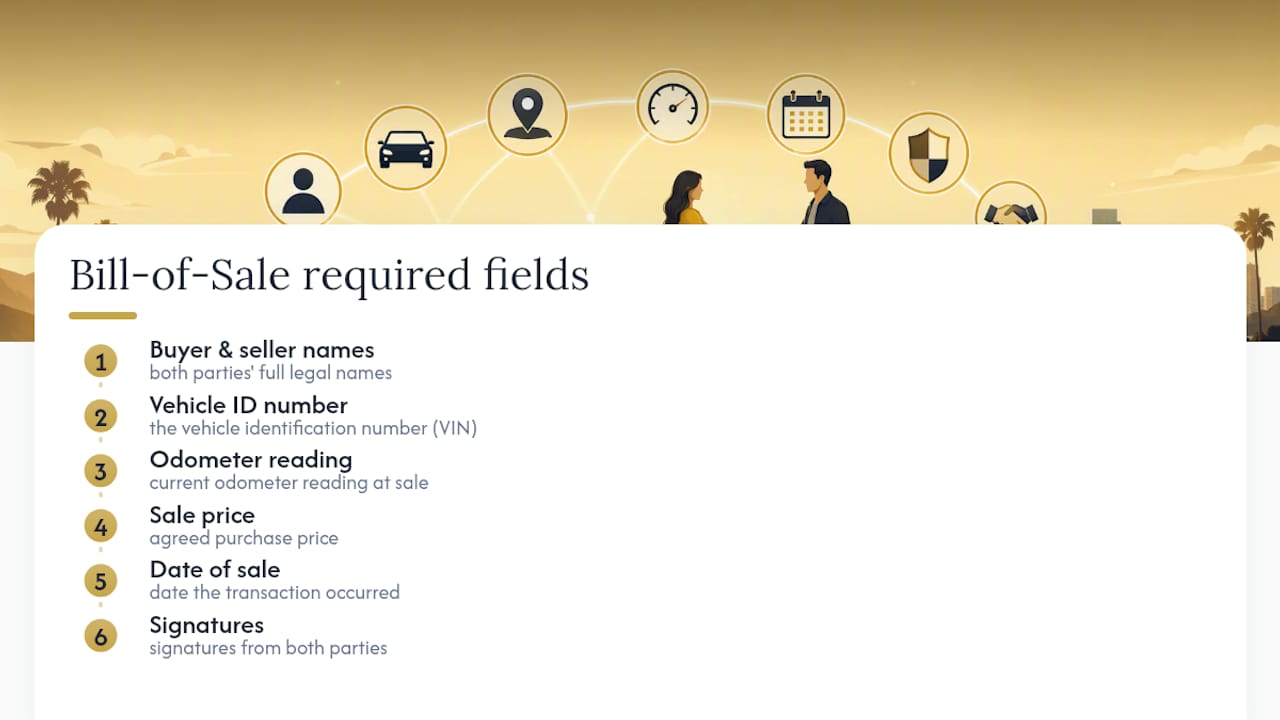
At minimum, include the buyer’s and seller’s full legal names, the vehicle identification number, the current odometer reading, the sale price, the date of sale, and signatures from both parties. Skipping any of these fields weakens the document if a dispute ever lands in small claims court.
For the as-is clause itself, conspicuous means visually distinct, not clever. Try language like this, set apart in its own paragraph:
“THIS VEHICLE IS SOLD ‘AS IS’ AND ‘WITH ALL FAULTS.’ THE SELLER MAKES NO WARRANTY, EXPRESS OR IMPLIED, AS TO THE CONDITION, MERCHANTABILITY, OR FITNESS FOR A PARTICULAR PURPOSE OF THIS VEHICLE. BUYER ACCEPTS FULL RESPONSIBILITY FOR ANY REPAIRS AFTER THIS SALE.”
Bold type, all capitals, and a standalone paragraph position all help satisfy the conspicuousness standard under California Commercial Code § 2316.
Pro Tip: Attach a separate, signed known-defects list to the bill of sale, even if it just says “check engine light on, transmission slips at highway speed.” A signed acknowledgment turns a future “you never told me” claim into a documented fact you can point to.
Add timestamped photos of the vehicle’s condition at sale, and keep copies of everything. You will want them for DMV filings, for tax records, and for your own protection if the buyer comes back with complaints six months later.
How Do You Complete an As-Is Sale With the DMV?
Completing an as is car sale in California requires three sequential steps: confirm smog compliance, transfer the title correctly, and file the DMV release of liability the same day the sale closes.
-
Verify smog status first. Obtain a smog certificate if the vehicle requires one, checking that it falls inside its 90-day validity window. If the vehicle is four model years old or newer, document the smog transfer fee exemption instead of hunting for a certificate you do not need.
-
Sign over the title accurately. Complete the odometer disclosure section on the title itself, and use REG 262 (Vehicle/Vessel Transfer and Reassignment Form) if the title is lost, illegible, or does not have room for a proper reassignment. Use REG 135 if you need a duplicate title before the sale can proceed.
-
File the release of liability immediately. The seller should submit the Notice of Transfer and Release of Liability with the DMV the same day the sale closes, ideally online. This step matters more than most sellers realize. The buyer then has a limited window to register the car and pay use tax; delaying either the release filing or the registration invites parking tickets, toll violations, or worse ending up attached to the seller’s name.
When Does “As Is” Stop Protecting the Seller?
An as-is clause stops protecting a seller the moment that seller actively conceals a known defect, because California treats deliberate suppression of a material fact as actual fraud under Cal. Civ. Code §1710.
The line between “buyer beware” and fraud usually comes down to knowledge and action. A seller who genuinely does not know the transmission is failing has a defensible as-is sale. A seller who taped over a check engine light, or who knew the transmission slipped and said nothing when the buyer asked directly, has committed suppression, and no bill of sale language will undo that.
Buyer remedies in a proven fraud case can include rescission of the sale, compensatory damages, and in some circumstances additional penalties tied to the seller’s conduct. None of that is guaranteed in any individual case, but the exposure is real enough that sellers should take basic precautions:
- Document every disclosure you make, in writing, before the sale closes.
- Encourage the buyer to get an independent inspection, and note in writing that you offered.
- Get the buyer’s signature acknowledging the known-defects list.
Pro Tip: If a buyer asks a direct question about a specific system, mechanical or otherwise, answer it honestly and put your answer in writing. Silence after a direct question is far riskier than a written “yes, the AC compressor is loud” ever will be.
When Should You Call a Lawyer About an As-Is Sale?
Call an attorney when you spot signs of dealer fraud, when repeated repairs on a car sold as certified suggest a hidden defect, when a title’s branded history was concealed, or when the dollar amount at stake justifies formal legal action. California’s AB 1755 also shortened the window for lemon law claims, requiring filing within one year of the warranty’s expiration, so waiting to investigate a potential claim can cost you the right to bring it at all.
The Law Offices of Jeffrey Le Pere handles these disputes on contingency, meaning representation costs nothing upfront and fees come from any recovery, which can include a refund, a replacement vehicle, or a civil penalty where a manufacturer or dealer acted in bad faith. Jeff Le Pere spent 11 years defending manufacturers and dealerships before switching sides, which means he has personally built the kind of defense case that opposing counsel will try to build against you. Our dealer fraud page covers the specific tactics that most often turn an as-is sale into an actionable fraud claim.
Where to Find the Statutes and Forms Referenced Here
Every statute and form cited above comes from a primary government source, not a summary site, so bookmark these directly:
- California Commercial Code § 2316 governs as-is warranty disclaimers.
- California Civil Code § 1710 defines fraud through suppression of material facts.
- California Civil Code § 1790 is the Song-Beverly Consumer Warranty Act for dealer sales.
- California DMV smog inspection requirements explain certificate validity and transfer-fee exemptions.
- DMV private-party registration guidance covers REG 262 and the release of liability process.
- The FTC Dealer’s Guide to the Used Car Rule explains the mandatory Buyer’s Guide.
A California Attorney’s Take on As-Is Sales
Most disputes I see do not come from a defect the seller hid. They come from a defect the seller genuinely did not know about, paired with a bill of sale that was too vague to protect anyone. Get the as-is language conspicuous, get the smog and title paperwork right, and put every known issue in writing before you sign. If you are evaluating a claim, bring the title, repair records, and any photos or texts about the vehicle’s condition to your first conversation.
— Jeff Le Pere
What to Do if an As-Is Sale Turns Into a Dispute
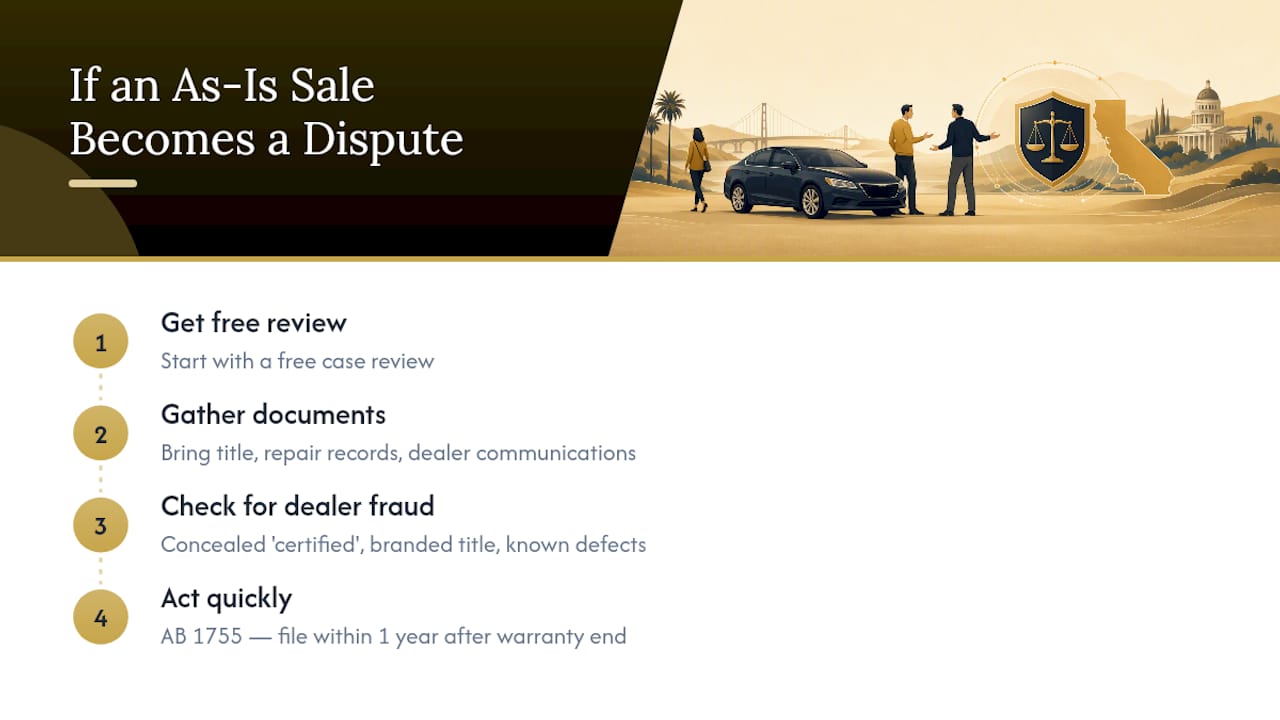
If you bought a vehicle that was concealed as certified, hid a branded title, or came with defects the seller clearly knew about and never mentioned, an as-is label on the paperwork will not stop you from pursuing a claim. The Law Offices of Jeffrey Le Pere built its practice specifically around the gap most buyers fall into: cases where “as is” gets used as a shield for outright dealer fraud rather than an honest private sale.

Jeff Le Pere spent 11 years on the other side of these cases, defending manufacturers and dealerships, before turning that experience toward representing California consumers directly. That background shapes strategy from day one, because he already knows which documents a dealer will produce and which ones they will not want you to see. The firm handles California RV lemon law for motorhomes, fifth wheels, and travel trailers, standard auto lemon law for cars, trucks, and SUVs, and dealer fraud claims involving vehicles illegally sold as certified, all on contingency, so representation costs nothing unless the case recovers money. Given AB 1755’s one-year filing deadline after warranty expiration, waiting to check your options can close the door on a valid claim.
Start with a free case review and bring your title, repair records, and any communication with the dealer about the vehicle’s condition. If dealer fraud looks like the issue, our dealer fraud practice page explains exactly what evidence strengthens a claim like yours.
This article is general information, not a substitute for advice from a qualified lawyer. Consult a qualified legal professional about your own circumstances before acting on anything here.
Sources
- California Commercial Code § 2316
- FTC: A Dealer’s Guide to the Used Car Rule
- California DMV — Smog inspections and requirements