30-Day Repair Shop Lemon Claim: California RV Guide

California’s Song-Beverly Consumer Warranty Act defines a lemon as any vehicle that has spent 30 or more cumulative business days out of service for repairs within the first 18 months or 18,000 miles of ownership. For RV owners, that threshold triggers a legal presumption that entitles you to a full refund or replacement vehicle. A 30 days repair shop lemon claim is not a loophole. It is a statutory right written into California Civil Code § 1793.22. The Law Offices of Jeffrey Le Pere handles these cases exclusively on contingency, meaning you pay nothing unless the manufacturer does.
What counts as “30 days” in a repair shop lemon claim?
The 30-day clock runs on cumulative business days your RV sits at an authorized repair facility. Those days do not need to be consecutive. Three separate repair visits totaling 30 business days count the same as one continuous stay.
California Civil Code § 1793.22 is specific about what qualifies. The clock starts the day the RV is dropped off at an authorized service center and stops the day it is returned to you. Travel time to and from the shop does not count toward the 30-day total. That distinction matters for RV owners who sometimes drive hours to reach an authorized facility.
What does count:
- Days the RV is physically at the authorized repair shop
- Days waiting for parts while the RV remains at the shop
- Days across multiple separate repair visits, added together
- Days at any authorized facility, not just the selling dealer
What does not count:
- Time spent driving to or from the repair center
- Days the RV sits at home waiting for a scheduled appointment
- Repairs performed at unauthorized shops or by the owner
Pro Tip: Keep a simple calendar log with drop-off and pickup dates for every repair visit. A running total of business days gives you an immediate picture of where you stand against the 30-day threshold.
The 30-day presumption is a legal floor, not a ceiling. Courts weigh defect severity and manufacturer effort, so a claim can succeed with fewer repair days when the defect is serious or safety-related. That said, reaching 30 cumulative business days puts the burden squarely on the manufacturer to prove the vehicle is not a lemon.

What RV defects count toward the 30-day threshold?
Any defect covered under the manufacturer’s written warranty qualifies, provided it was reported during the warranty period and repaired at an authorized facility. The specific defect does not need to be catastrophic. Persistent electrical failures, chronic slide-out malfunctions, repeated roof leak repairs, and ongoing engine problems all count.
RV lemon law cases are more complex than standard vehicle cases because most RVs carry two separate warranties: one for the chassis (the engine, drivetrain, and frame) and one for the coach (the living area, appliances, plumbing, and electrical systems). Repair records must be tracked separately for chassis and coach components, because different manufacturers are responsible for each. A Ford or Ram chassis warranty is handled by Ford or Ram dealers. The coach warranty is handled by the RV manufacturer’s authorized service centers.
Common RV defects that accumulate toward the 30-day threshold include:
- Chassis and engine defects such as transmission failures, brake system problems, and generator malfunctions
- Coach structural defects including roof delamination, slide-out failures, and water intrusion
- Plumbing and HVAC issues such as fresh water system leaks, sewage system failures, and air conditioning breakdowns
- Electrical system failures including inverter malfunctions, battery management failures, and wiring defects
- Appliance failures covering refrigerators, stoves, water heaters, and entertainment systems under the coach warranty
Parts delays are a significant factor in RV repairs. Specialized RV components often take weeks to arrive. Every day the RV sits at the shop waiting for a backordered part counts toward your cumulative total, as long as the RV remains in the shop’s possession.
Pro Tip: If your RV is your primary residence, document every night you spend in a hotel or rental while the RV is in the shop. Lodging and travel expenses are recoverable as incidental damages under the Song-Beverly Act.
How to document your repair attempts for a strong lemon claim
Strong documentation is the foundation of every successful lemon claim. Incomplete records are the single most common reason claims stall or fail.
Every repair visit should produce a written repair order from the authorized facility. That document is your legal record. Never leave a shop without one, even if the technician says the problem could not be reproduced.
Key documents to collect and organize:
- Repair orders from every authorized service visit, showing drop-off date, pickup date, defect description, and work performed
- Warranty claim records showing what the manufacturer authorized and paid for
- Parts delay notices from the shop confirming the RV was held waiting for components
- Correspondence with the manufacturer including emails, letters, and case numbers from customer service calls
| Document Type | Why It Matters |
|---|---|
| Repair orders | Proves dates, defects, and authorized repair attempts |
| Parts delay notices | Adds days to cumulative out-of-service total |
| Lodging receipts | Supports incidental damage recovery |
| Manufacturer correspondence | Establishes notice and manufacturer’s response |
| Defect photos and videos | Corroborates reported problems |
Proper documentation produces stronger settlements and faster resolutions. Gaps in records give manufacturers room to dispute the timeline or the severity of defects. Photograph defects before each repair visit and keep copies of every document in a dedicated folder, physical or digital.
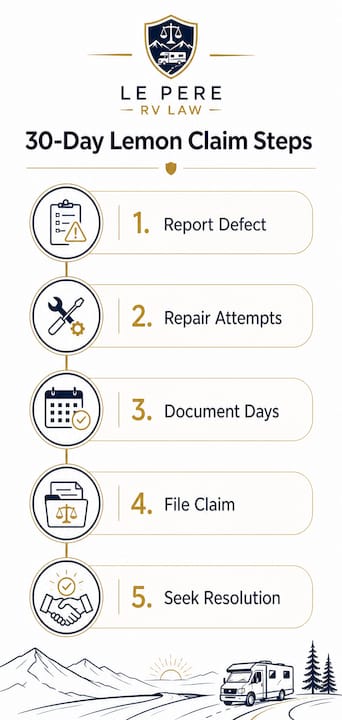
What are the steps to file a lemon claim after 30 repair days?
The lemon claim process follows a defined sequence under the Song-Beverly Act. Moving through each step correctly protects your rights and maximizes your recovery.
-
Confirm eligibility. Add up your cumulative business days at authorized repair shops. If you have reached 30 days within the first 18 months or 18,000 miles, the legal presumption applies. Review your repair orders against this threshold before taking any other action.
-
Send a written defect notice to the manufacturer. California law requires you to notify the manufacturer in writing before filing a claim. This notice must identify the defects and give the manufacturer a final opportunity to repair the vehicle. Written defect notices are a procedural requirement, not optional.
-
Allow the manufacturer’s final repair attempt. After receiving your notice, the manufacturer gets one more chance to fix the problem. If the repair fails or the manufacturer does not respond, you have met the “reasonable number of repair attempts” standard under the Song-Beverly Act.
-
Consult an experienced lemon law attorney. RV lemon law cases involve dual warranties, multiple manufacturers, and complex documentation requirements. An attorney who knows California RV lemon law can assess your records, identify the strongest claims, and handle all manufacturer negotiations.
-
Choose your remedy. Under the Song-Beverly Act, you can recover:
- A full repurchase, including down payment, monthly payments, registration, and sales tax
- A replacement vehicle of equal or greater value
- A cash settlement
- Civil penalties of up to two times your actual damages if the manufacturer willfully violated the warranty
- Attorney fees paid by the manufacturer
“The Song-Beverly Act gives California consumers real teeth. A manufacturer that ignores a legitimate lemon claim does not just owe you a refund. It can owe you twice that amount as a civil penalty, plus every dollar in attorney fees. That is the law working exactly as intended.”
Filing deadlines are critical. California AB 1755 requires consumers to file a lemon law claim within one year of the warranty’s expiration date. Missing that deadline can eliminate your right to recover entirely. Review the AB 1755 deadline rules before assuming you still have time.
Common mistakes that sink a 30-day lemon law claim
Most failed lemon claims trace back to a handful of avoidable errors. Knowing them in advance keeps your case on solid ground.
- Mixing chassis and coach repair records. Failing to separate records by warranty type delays identifying which manufacturer is responsible and can cause claims to be disputed or denied.
- Skipping the written defect notice. Verbal complaints to a dealer do not satisfy the notice requirement. The manufacturer must receive written notice before you can file a claim.
- Using unauthorized repair shops. Repairs performed outside the manufacturer’s authorized network do not count toward the 30-day threshold and can void warranty coverage on affected components.
- Ignoring lodging and travel costs. If your RV is your primary residence, every night in a hotel is a recoverable expense. Owners who do not track these costs leave money on the table.
- Waiting too long to consult an attorney. The AB 1755 deadline is firm. Owners who wait until the warranty expires to seek legal advice sometimes find the filing window has already closed.
Pro Tip: Review your repair attempt evidence with an attorney before sending any written notice to the manufacturer. The language in that notice can affect the outcome of your entire claim.
Key Takeaways
California RV owners who reach 30 cumulative business days at an authorized repair shop have a legal presumption of lemon status under the Song-Beverly Act, entitling them to a refund, replacement, or civil penalties.
| Point | Details |
|---|---|
| 30-day threshold | Cumulative business days at authorized shops trigger the Song-Beverly lemon presumption. |
| Dual warranty complexity | Track chassis and coach repairs separately to identify the correct manufacturer. |
| Written notice required | Send a written defect notice to the manufacturer before filing any lemon claim. |
| Document everything | Repair orders, parts delay notices, and lodging receipts all support your recovery. |
| AB 1755 deadline | File within one year of warranty expiration or lose your right to recover. |
RV lemon law is harder than it looks, and that is by design
I spent 11 years on the other side of these cases, defending manufacturers and dealerships. I know exactly how they build their defense, because I built it for them. The most common tactic is simple: attack the documentation. If your repair orders are incomplete, if you mixed chassis and coach records, or if you used an unauthorized shop even once, the manufacturer’s attorney will use that against you.
RV cases are genuinely more complex than car cases. You have two manufacturers, two warranty systems, and often two completely different authorized repair networks. A chassis problem might require a Ford dealer in one city while a coach problem requires an RV service center in another. Owners who do not understand that distinction often end up with repair records that do not clearly support either claim.
The 30-day rule gives you real leverage, but only if your records are clean. I have seen strong cases weakened by a single missing repair order. I have also seen cases succeed with fewer than 30 days because the defect was severe and the documentation was airtight. The law is flexible. Your preparation should not be.
— Jeff Le Pere
Your California RV lemon claim deserves a specialist

Most lemon law firms will not take RV cases. The dual warranty structure, the multiple manufacturers, and the specialized repair network make these cases harder to handle than standard vehicle claims. The Law Offices of Jeffrey Le Pere focuses specifically on California RV lemon law, covering motorhomes, fifth wheels, and travel trailers statewide.
Jeff Le Pere spent 11 years defending manufacturers before switching sides. That background means he knows exactly what manufacturers look for and how to counter it. Every case runs on contingency, so you pay nothing out of pocket. The manufacturer covers attorney fees when you win. If your RV has been in the shop for 30 or more cumulative business days, contact the California RV lemon law team for a free case review today.
FAQ
What is the 30-day rule in California lemon law?
California Civil Code § 1793.22 creates a legal presumption that a vehicle is a lemon if it has been out of service for 30 or more cumulative business days within the first 18 months or 18,000 miles. That presumption requires the manufacturer to refund or replace the vehicle.
Do RV travel trailers qualify for the 30-day lemon law threshold?
Travel trailers qualify under California lemon law if they were purchased or leased primarily for personal use and are covered by a manufacturer’s written warranty. The same 30-day cumulative repair standard applies.
Does travel time to an RV repair center count toward the 30 days?
Travel time to and from an authorized service center does not count as out-of-service time under California Civil Code § 1793.22. Only days the RV is physically at the authorized shop count toward the threshold.
What can I recover in a California RV lemon law claim?
Under the Song-Beverly Act, you can recover the full purchase price including down payment, registration, and sales tax, plus incidental damages such as lodging costs. If the manufacturer willfully violated the warranty, civil penalties of up to twice your actual damages apply.
How long do I have to file a California lemon law claim?
California AB 1755 requires consumers to file a lemon law claim within one year of the warranty’s expiration date. Missing this deadline can eliminate your right to recover, so consulting an attorney before the warranty expires is critical.